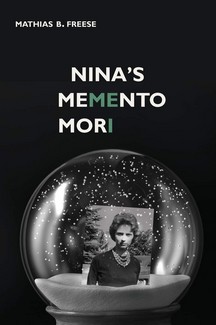
On the pages of Nina’s Memento Mori Writer Mathias Freese presents a earnest commanding lament to the wife he loved and lost to illness.
‘My intent here is to lay bare the themes and curlicues of my existence and in so doing, show how this impacted upon Nina, whether for good and bad with indifference at times.’
The 140 + pages of narrative subsequent to the statement read at times as might a script for a film, and at times as a mournful realization that Nina’s death granted them so little time together.
The Table of Contents offers short 5, or so page, extracts penned in nineteen chapters with titles labeled Fade IN: Wake Up, Dissolve: Observer Observed, Voice Over: Cemetery Mind and ending with Director’s Cut: A Primitive Lot and Fade out: Nina’s Poestry and Unfinished Memoir. These are followed with the next section entitle Four Takes.
FOUR TAKES presents Take One: The Wound, Take Two: Into the Fen, Take Three: Down to a Sunless Sea and Take Four: Each and Every Time.
Next is the Intermission: Tesserae.
On to the Cutting Room and a grouping of seven chapters with designations as Dissolve: And Then She is Gone, Close Up: Inception, Fade in, Voice Over, Flashback, Preview, Fin and finally Coda.
I think the author's statement at the bottom of page 19 really sums up the resolution he followed for writing this manuscript, “So, Sweetheart, here I try foolishly to tell you who you were married to and, in so doing, to know you.”
Essayist Freese has fashioned an unambiguous, painful, near agonizingly heart-felt requiem account that lays unembellished the death and extreme profundities of grief often felt following the death of one beloved.
Nina Wingard Freese, a retired special education teacher of autistic students, died as a result of ALS - Lou Gehrig's disease. Freese shares his pain at her death and, what might have been, in this eloquent lament; if they had only had a little more time together. For each; this was not a first marriage, however, short as it was, they shared the notion that it was their best.
Contemplative and enhanced with photographs, we see Nina as a little girl and again several more times as she is growing up and as a young mother and then as a handsome, mature woman.
Writer Freese’s elegy is a journey stained with much grief; a little girl adopted, not especially loved, marriage, not especially loved, children who behave in not especially loving manner when adults and yet; Nina held fast to the conviction that she too merited love and was prepared to try again.
Author Freese, as do many, found explicit expressions of caring awkward when Nina was aware, and mindful; before the ALS robbed her of the capability to understand, regard, or feel the love her husband had for her. It was left for him to accept and admit his sentiments, to validate caring and share Nina’s life and his feelings for her as he pens his heartache, alongside his expectations and his actions.
He considers how fleeting their time together was, as well as, how many parallels existed earlier in their lives. He was a lonely child not maltreated overtly, although not nurtured either. Nina bore the mistreatment, not nurture, of her adopted mother.
Nina’s death triggered Freese to probe his Jewish heritage; he permits the Reader some insight the impact of religion on his life via his discussing many Biblical references.
Given the circumstance of Nina’s death; tone of the work is glum at times, on the other hand, Nina’s hopeful mindset and her technique of letting Freese feel valuable and extraordinary is exciting.
Each chapter presents a particular point in their lives; although they were often short lived and soon past.
Culpability vexes him, even now, for having found hospice setting for Nina’s lasts days; even though commitment to care for someone suffering ALS does necessitate preparation as well as insight and undying commitment; it is not always a practical choice.
Freese’s feeling that he failed her, I’m sure she’d disagree; and evoke the love, the closeness and just her special radiant beauty and unrequited love for him. I met several family members who felt terrible guilt that their incapacitated loved one was becoming a resident in the nursing care facility where I worked for a time as social services director. Few of us are trained to care for our loved ones needing advanced nursing care.
The competent hands of a trained caregiver aids the physical welfare of patients; loving visits with family are quite as important.
The final chapter encompasses so much and includes the letter she might have written to him; filled with forgiveness, knowing and letting him know that he was the only husband who truly respected and adored her. She cherished him and honored him for devotion and loving her. She did not encourage is spend much time in mourning; Nina meant for him to go on with life not steeped in grief.
Author Mathias B. Freese carries us along on a voyage within the life and brief time he had with Nina Elaine Wingard and allows us to hope that someday he will justly find comfort, amity and never stop writing.
His voice is strong, his manuscripts inimitable and this reader is left feeling Nina’s Memento Mori is a loving, moving tribute to a special woman whose memory, especially for him, will never fade in time.
Powerful read … Happy to recommend for public and college library catalogue, Therapists book shelf, and for readers who have perhaps known in family, friendship, or care center a couple like Nina and Mathias.
AVAILABLE Amazon Kindle Paperback
==================================
Reviewed by Molly Reviews BOOKS molly martin
==================================
MATHIAS B. FREESE is a writer, teacher, and psychotherapist who has authored eight books.
After his first novel, 'The I Tetralogy' on the Holocaust, his second work, 'I Truly Lament: Working Through the Holocaust', won the Beverly Hills Book Award, Reader's Favorite Book Award, and was a finalist in the Indie Excellence Book Awards, the Paris Book Festival, and the Amsterdam Book Festival.
In 2016 'Tesserae: A Memoir of Two Summers', his first memoir, received seven awards.
The following year his second memoir appeared, 'And Then I Am Gone'.



Thank You for your comments.
I am sorry for your loss It is not easy to say goodbye to a parent whatever our age.
I'm glad you were her fav son!
m
Believe me, if you ask my caregivers, it is very hard to care for someone with advanced disability. And taking care of someone with ALS, their mind still sharp, but their body terribly affected, is the most challenging of all. My mother was in hospice and in great pain at 95. Her passing was a great relief.
Ron