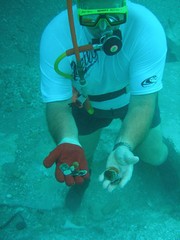
Florida is probably most famous as the Treasure Ship capital of the world. During the days of the Spanish conquest of Mexico and Central America, hundreds of ships laden with gold, silver, and precious gems traveled these waters en route to Spain. Hurricanes took their toll and whole fleets were lost. There are many ships still to be found.
Occasionally you will hear of someone who has found a treasure coin that has made its way to the beach or upland dunes. I am fortunate to live close to the beach and quite frequently walk the shores after storms, nor’easters and hurricanes. I have yet to find a treasure coin but find regularly many items of interest. Many fellow treasure hunters have told me of their stories of finding treasure coins and even precious gems that embellish gold crosses, all from combing the beaches. Keeping your eyes to the ground can train you to not miss any interesting find whether it be a modern day toy, some pocket change, fishing sinkers or perhaps even a Spanish treasure coin.
The same goes for the snorkeler, surfer, scuba diver or even a swimmer. Learning how to identify an EO (encrusted object) can be exciting enough to bring you to the next stage.
One should know what to look for. For the traditional treasure hunter, a metal detector comes in handy. There can be an interesting find just under the surface of sand and you will be glad to hear the ring tone of your detector going off. For others who don’t have metal detecting devices, using your eyes can be all that you need.
Do you know what buried treasure actually looks like? It can be very hard to recognize cannons, anchors, plates, spoons, or valuable coins when they are thickly encrusted with calcium carbonate deposits. Encrustations are usually made up of the remains of small micro marine organisms, mixed with salt and metal corroding in the seawater. These deposits make objects nearly unrecognizable, except to a trained eye.
If possible, encrusted objects are first x-rayed to help in planning a strategy for cleaning the artifacts.
For larger specimens, mechanical cleaning is often the best way. With a variety of hammers and chisels, the encrustation can be detached with little or no damage to the artifacts. For smaller objects, electrostatic reduction is more efficient and less destructive. An electrolyte solution with the ratio of 48:1 (water to any of the three electrolytes: salt, lemon juice, or soda ash) is used. A minor negative current is run through the artifact and the positive charge is placed and run through the solution. Stainless steel clips and anodes should only be used.
It may have crossed your mind about the ownership of finding ancient artifacts.
Some people working for the government don’t think that people should have the right to explore on their own. They tell the ocean explorers to leave what they find in place, rather than investigating it or sharing it with the public. You may hear politicians and local government agencies use the words “to protect the public interest,” when in reality it is taking away your rights.
According to Florida law, cultural material embedded in sand within a three-mile limit of shore is publicly owned. A federal law, Abandoned Shipwreck Act of 1988, reinforces this position. You may be considered a “pirate” if you choose to undertake an action that can be construe d by others as stealing from the public: taking an item and attempting to preserve and study its provenance.
The Isolated Finds Program (IFP) that was started in 1996 was a cooperative effort between the State’s Division of Historical Resources and river divers. The river divers were concerned that their long-standing hobby was being jeopardized by state imposed criminal penalties for removing artifacts from State of Florida owned lands. In 2005, the Isolated Finds Program was discontinued; it is now considered unlawful to remove artifacts from state-owned lands, including river bottoms. For now, in the state of Florida the only way to legally keep what you find is by fighting for your rights. You can ask for a free booklet, “Discovering Artifacts in Florida Rivers” online at
http://dhr.dos.state.fl.us/bar/finds/.
Oh and by the way, if you find an artifact on the beach, well, it’s all yours.
You can learn more by reading “Treasure Diving With Captain Dom.” Go to: www.adventureINdiscovery.com