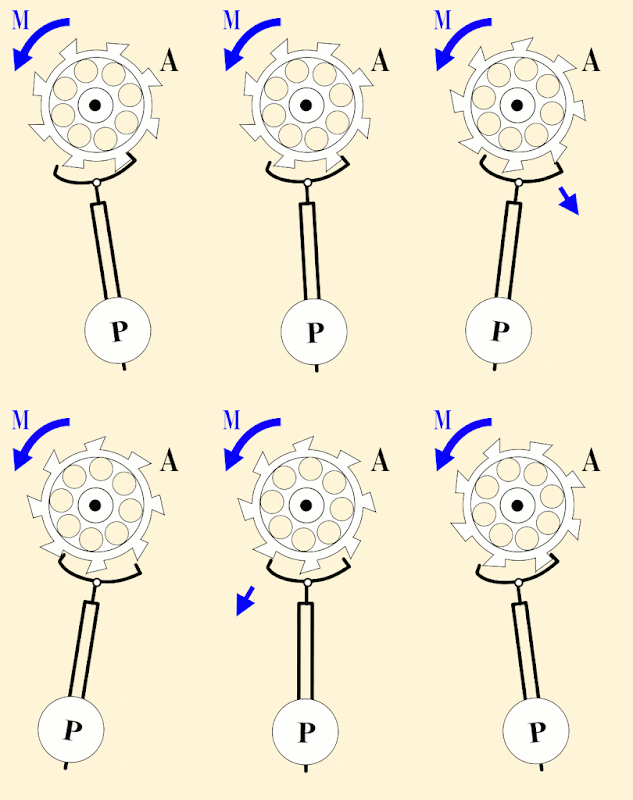
The picture above show perhaps the two most well know physics equations.
1. The top one is known as Newton's 2nd Law of Motion:
F = ma
The acceleration of an object as produced by a net force is directly proportional to the magnitude of the net force, in the same direction as the net force, and inversely proportional to the mass of the object.
[reference: Newton's Second Law]
How often when doing physics homework or taking exams did I write this equation down to get me started.
2. The other is Einstein's equation:
E = mc2
Mass (m) is equivalent to energy (E).
[reference: E=mc2 | symmetry magazine]
Above are a few of the fundamental equations scientists use to describe and model what they observe in the physical universe. And believe me there are many more ...
Which brings me to the first part of a new series - physics
that can be described as "the study of matter, energy, and the interaction between them."
[reference: What is physics?| Explore | physics.org]
How romantic.
But how do we begin to wrap our brains about the universe?
Let's start at the dinner table ... with some libation.
"The whole universe is in a glass of wine."
So Nobel prize winning physicist, Richard Feynman (1918-1988) quoted a poet. [referenece: Goodreads | Quote by Richard P. Feynman]