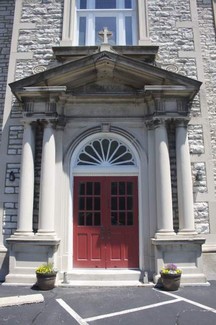
In the school auditorium of this old St. Louis neighborhood church, a popular fencing class is just getting started. The snap of foils and shuffling feet echo down the stairs and throughout the hallways. One floor below the clashing of steel is a group of zen practitioners, sitting silently among Buddha images and Japanese calligraphy. In the church parking lot, a non-profit Bakery that only hires ex-cons, and a mini farmer’s market, do a steady trade in delicious culinary opposites. It is another busy day at All Saints Catholic Church in University city, Mo. and it’s not even Sunday.
As church attendance across the nation continues to decline, parishes from a variety of Christian denominations are struggling to survive. As a result, these parishes and their congregations are forced to create a variety of solutions to keep the doors open, the pews filled, and maintain their aging properties. As bleak as the situation truly is, there are exceptions. All Saints Catholic Church in this historic St. Louis neighborhood was completed in 1936. It sits elegantly among rehabbed three-floor walk-ups among mature oaks that spread out behind a trendy and diverse stretch of Delmar Blvd, known for its clubs, eateries and eclectic atmosphere. It is, like many St. Louis churches, reminiscent of old-world craftsmanship, from the stained glass windows to the hand-hewed beams that arch across the vaulted ceilings. There is also peeling paint, ancient green chalkboards and the comforting aroma of wood with a thousand coats of wax.
The word “church” comes from the Greek word ekkesia which is defined as “an assembly” or “called-out ones.” A “church” by this definition is not a building or specific place but the people themselves. Jesus was the original Church and he didn’t have a fixed address. Where ever he was, there was a church. If you were walking down the street, and Jesus came to you and spoke, you instantly became part of the church.
The understanding of a “church” as a fixed address, confines the congregation away from the rest of those in society and even in their own neighborhoods. We are living in cities of suffering minorities, immigrants and homeless individuals, many of whom are seeking a place of refuge, where they are safe and welcome. By returning to the true meaning of a church as a place where the people, and not an elaborate building, are the refuge, there is an opportunity for great social and spiritual renewal.
This kind of renewal can only be brought about through a creative and progressive style of church leadership. Fish fries and bake sales, somehow aren’t making the necessary connections perhaps they once did. In the case of All Saints Catholic Church, the leadership has reached out beyond the stairs of the altar and boxes of glazed donuts, into the city-wide community. The results are a dynamic and diverse congregation that is no longer just an old fashioned neighborhood church, but an integral part of their city.
When I reached out to Monsignor Witt to hear his story, this is what he told me:
“All Saints would be a poster child for your article! Decades ago the City of University City took a neighborhood, Cunningham Park, and by imminent domain bought out all the houses. Most of those families were members of All Saints. They were scattered throughout the county and our parish was more than decimated. Our school no longer became viable and had to close. Today we are one of the seven smallest parishes in the Archdiocese of Saint Louis, just 135 souls. We survive because of the incredible generosity of the parishioners. We rent out the old school building, have welcomed a farmers market and maintain a great reputation in University City. We host the University City Symphony Orchestra for concerts twice a year. We welcome university students at the beginning of the academic year.”
All Saints Catholic Church is an example of a traditional catholic parish that was able to reexamine their relationship with the community and successfully form new and meaningful connections to include more than just those who happen to occupy a pew on Sunday. The result is a model of success brought about through civic engagement and a sense of togetherness. You may have all the saints but you won’t have much of a church unless it also includes all the people. So, welcome the farmer, the meditator, the fencers, and especially the chocolate cake made by the hands of the reformed. Now that’s a church.