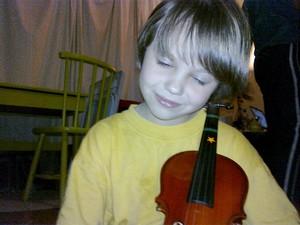
The importance of music in development – upgraded edition
To learn an instrument such as the violin or clarinet takes years. The job opportunities for musicians are scarce and competition is fierce. Then why are more people than ever before paying a lot of good cash to get their children the best music tuition they can afford?
The secret lies in the impact of music on the whole person. Diverse sources detail the influence that learning a musical instrument has on children and even on adults. Occupational therapists are currently recommending to parents of children who struggle with schoolwork, to let them learn an instrument. This, along with horse riding and swimming, has become a bit of a pet recommendation.
It has been found that learning a musical instrument actually increases a person’s IQ over time. Different instruments and different types of music have varying effect, with classical music and the string family (violin, viola, cello) coming out on top, potentially increasing your IQ by up to 12 points! In certain regions of Europe, music in schools is now a mandatory subject once more.
When is a good time to start learning music? Experts have found that even the fetus in the womb can benefit from listening to classical music. Surround yourself and your family with good music from the first. Toddlers love banging on stuff and playing xylophone, or tooting on recorders and mouth organs. The Suzuki Violin Method teaches children from the age of 3 years violin, with two lessons per week, one single and one in a group setup. From preschool, children can learn to read music and play from sheet music. Progress in learning your instrument is directly proportional to the amount of practicing.
Is there such a thing as an unmusical child? Shinichi Suzuki proposes that music is the native home language of all human beings and therefore nobody can be “unmusical”. Of course there are exceptional talents, compared to which others may seem to be slower learners.
(Ref: http://books.google.com/books?id=YQJ5_OpVFNYC&lpg=PA1&ots=-eWpv24ASv&dq=brain%20physiology%20and%20learning%20violin&lr=&pg=PA2#v=onepage&q=&f=true )
Is there any benefit for adults in starting an instrument? Apart from the purely relaxing aspect, yes. Learning an instrument can earn even adults additional IQ points, and as an added benefit it improves your health by reducing your stress levels. Your social life may benefit too, if you are prepared to come out of your box and join occasions such as Ceilidhs (musical get-togethers) or arrange house concerts. It has been established that people who play instruments tend to be more emotionally balanced and more patient with themselves, others and life in general.
So go ahead, sign up for that amateur orchestra, dust off your old trombone or take your first real six-string from the summer of ’69 down from the attic; get out there and play!
*
Add-in (September 2009):
It is a year since I wrote the above article. In the interim I have found, read and remembered even more reasons why music is a good idea. I also spotted various ways in which this article was too brief and not informative enough.
1. Parents and school children should be aware that music is an accepted school subject – for example, if you play Grade 6 via a reputable exam centre, here in South Africa this counts for an additional matriculation subject. In Britain a similar system is in place (except that I think the grade you need to pass is Grade 8. Verify this though). Check in your own home country whether and in which way this applies to you. Having an additional subject on your senior certificate is an advantage for getting into certain university courses (not only music).
2. In some places the school syllabus does not include memorizing poems and similar contents verbatim anymore. While learning things off by heart isn’t everything, it certainly is an important skill. Music gives the student the chance to learn memorizing.
3. I also realized that I never specified why music is so good for children that occupational therapists prescribe it. The amount of focus involved in learning an instrument is enormous. In other words, the ability to concentrate for longer and harder, improves. Besides this, playing an instrument involves a lot of fine muscle coordination, as well as hand-eye and hand-ear coordination. Musical development is also closely correlated in the brain with speech development; I have taught more than one student violin whose main aim was to improve their speech.
4. Performing and playing with / for others: This is a separate area within music that deserves mention. We hold studio concerts twice a year to give our students the added advantage that comes from performing; we also hold “Ceilidhs” (Irish musical parties during which everyone eats, drinks and plays their instrument). The two kinds of functions focus on different aspects of performing. The one is formal; performing for a formal audience teaches the player to deal with stage fright. If you have performed an instrument before people, you’re not half as afraid to step up and deliver a speech anymore. The other kind of function (the Ceilidh) encourages the musician to play up in an informal setting; this translates into being able to speak up and say your say in, for example, a discussion or a company networking event. These are social and career skills.
As you see, there are more than enough reasons to pick up the old “ramkiekie” and play. So “give it stick!”
*
(Lyz Russo runs an active violin studio in Pretoria, South Africa. She has been teaching violin since 1999 and observes on a daily basis the positive impact of music on her students - from the academically excellent to those with learning, self-image and focus problems.
www.pkaboo.net/studio/vstudio.html )