Some Truths About the U.S. Debt
Few people dislike debt more than I do. I’ve lived with it for most of my adult life, not because I like to live beyond my means, but mainly because debt has prevented me from living within my means. But this essay is not about me; it’s about us. It’s about how much we owe, whether that amount is too much, and how we can reduce it in the very best way. It’s still somewhat personal. One of my professors once predicted that I would be teaching and writing about economics at some future time. He was right, and I still think he meant both predictions as curses.
Personal debt and public debt do not work in precisely the same way. Ask a banker or mortgage lender for a loan, and he will want to know first, the market value of the collateral that he insists you must have and on which he will place a lien; second, he wants to know about your ability to repay the loan; third, he inquires about your history in repaying loans; and fourth, he makes a mysterious calculation about the percentage of your income he will use to determine if you are likely to repay this and all other loans. The various methods for making this calculation vary, and many would qualify for entry into Ripley’s Believe it or Not. He is a very stingy and stodgy guy who will protect the bank’s interests against your potential waywardness in ways that you probably have never thought about.
Our national debt has a few departures from the bankers’ rules. First, we (and a few foreign countries) are the lenders, but nobody confers with us about a potential loan. Second, Congress is the authorizer. And third, we make the payments. We benefit only in the sense that we feel good about why we were burdened with it in the first place. Currently, our debt was run up by two wars that were unfunded, plus a longer term trend in a defense buildup, a sustained and large trade deficit (we import more than we export), and we lowered the top income tax bracket 4 times since 1980, and reduced or suspended the estate tax during the past decade. Add up these excesses in prudent money management, and they explain more than 92 percent of our total public debt since 1980.
It’s also worthwhile to distinguish between our national debt and our public debt. They are not the same thing. Our national debt is the total of all we owe (about $16 trillion), while our public debt is what the public owes (about $10.4 trillion). This is the amount that we have borrowed in order to finance our budget deficits. The difference ($5.6 trillion) is called inter-governmental debt. It is the amount government agencies have borrowed from each other. This debt consists of borrowings from the Social Security Trust Fund, the Federal Workers Retirement Fund, and the Military Retirement Fund. Although this debt accrues interest, you and I do not pay it. We did not borrow it, we don’t owe it, and we pay no interest on it, therefore, it is one debt that we should not waste one minute worrying about. It is a government bookkeeping thing, and that is where it should remain.
Our concern is with the $10.4 trillion public debt. We currently pay $224 billion annually on this debt. This amount of interest represents 5.9 percent of our total budget. Would we be better off if it were zero? Yes. Is it a huge burden? No. Why not? Because it is well within our ability to pay. Think about your family income and expenses. What are your total interest payments as a percent of your total income? If you have a mortgage, credit cards, revolving credit, and/or a car payment, your annual interest bill is likely 20 percent or more of your total income. Also think about the security and the reliability of your income compared to that of the government. The government has the legal ability to tax you and me, the legal ability to issue and sell bonds all over the world, and the legal ability to print money. You may not approve of these various ways the government has to raise money, but it can, and it does, and there is not much you or I can do about it. But these facts do not get to the heart of the matter.
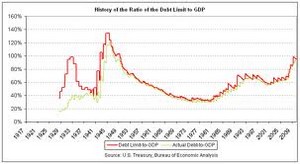
At the heart of our public debt is this historical record that is overlooked: Following WWII our debt-to-GDP ratio was much higher than it is today. Back then it was 113 percent; today it is 77 percent. But here is the important observation: Between 1945 and 1970, our debt fell to less than 30 percent of GDP. And what were the heroic efforts that we made to reduce it? None. We simply grew the economy at a real (nominal rate minus inflation) rate of 2.28 percent. That’s it. And this period enclosed the “guns and butter” period of the Vietnam War. Since 1970 our GDP has grown at a real rate of just 1.26 percent.
Now let’s summarize. Our public debt is not nearly as large as is often reported in the news media. It’s about $10.4 trillion, not $16 trillion. The interest on this debt is not crushing us. It’s a little less than 6 percent of our budget outlays. As a percentage of GDP, our debt was higher following WWII. And we brought it down by growing the economy at the moderate rate of 2.28 percent. Now what?
Looking forward we need to get our priorities right if we are truly interested in bringing our debt down a lot more. First, we must recognize that in order to grow our economy and get it growing at the needed level, we must first encourage those activities that will help—even if that means more government spending. Now is the time to rebuild our infrastructure: rebuild our highways, our bridges, our railroads, our power grids; invest more in new energy sources; encourage more enrollments in the sciences and technology to fulfill the jobs in a revitalized economy; bring the unemployed into the workforce with assistance in job training. Begin to cut spending in those areas that have caused more than 90 percent of the debt: in wars, in trade deficits (especially oil imports), and restore our tax policies to pre-2000 levels.
Once the economy is growing at a sustainable rate above 2.28 real growth, and unemployment has fallen to a level near 5 percent, then we can work earnestly to create budget surpluses—and watch as the debt falls and falls into history.