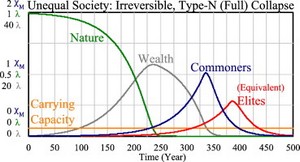
A scientific study funded by NASA using computer simulation shows that the United
States is on course to an irreversible collapse.
A Comment on Simulation and the Collapse of Human Societies
A scientific study funded by NASA using computer simulation shows that the United States is on course to an irreversible collapse.
The computer, used intelligently, can be a vital tool to our survival. Modeling weather patterns and their progression is an example of how we can at least avoid being in the pathway of hurricanes, or when, where, why, and how we need to take cover. Modeling and tracking huge quantities of resource flows and finding their most cost-efficient modes, hubs, storage, and locations is another application. Tracking a hundred million packages moving simultaneously around the world, and determining fair rates that are still profitable is being done constantly. Virtually all disciplines now use simulation models to reveal new ways to save time and resources, or to use them more efficiently. Even a multi-billion dollar business unit can be simulated in advance of actual money outlays to reveal whether it is likely to be sustainable over time or not. Its strengths and weaknesses also can be assessed and improved upon or eliminated even before the first dollar is committed to the business. And that leads to the driving questions behind this essay.
What can simulation tell us about our own survival? Can we know in advance when we are on course to a prosperous future, or to one that portends our own extinction? The answer apparently is yes, but…there are still uncertainties when humans are involved.
Back in the days when the PC was in its infancy, I recall a game called “predatory/prey” simulation. It involved lynxes and rabbits and carrots. The user could plug in different populations and life expectancy values for each, then run a simple simulation to see which would run out of food first in a fight to extinction race. It was painless fun that lasted only for a few minutes before boredom set in regardless of the outcome. After all it was only a game using simulation. But it did portend other kinds of simulation models that could reveal a lot more about human behavior at some future stage of software development and research.
Fast forward 30+ years and to Dr. Safa Motesharrel et al, and the HANDY model of human population dynamics in which accumulated wealth and economic inequality are simulated in a predator–prey model of humans and nature.[1] The model structure and simulated scenarios offer significant implications for our thoughtful consideration. Four equations describe the evolution of Elites (the wealthy), Commoners (all others), Nature (resource use), and Wealth (how it is distributed). The model shows whether, if, and when economic stratification or ecological strain can independently lead to collapse. It can be tested against the historical record to determine the cause of fallen empires. Or it can be used to predict the long-term viability of present ones.
The mathematics and modeling procedures are beyond the scope of my comments. The context in which they reside are my focus.
Before we discuss results, we should at least give some thought to climate change and the various simulation models that consistently show that we need to take action now in order to avoid some of the consequences coming our way. And it would be useful to read about the large-scale computer models of the U.S. economy underway now at the Sandia Laboratories that show how billions of economic actions come together, and how agent-based smart algorithms can show us how, when, where, and why to respond to natural or man-made catastrophes, or how to prepare for them in advance. Concurrently, there are resource use, ecological studies, as well as biological and longevity studies that give us greater insights to our place in Nature.
The HANDY model was important enough to win the funding approval from NASA and the Goddard Space Center. Dr. Motesharrel has published his results, and he has offered them up for peer review. I am not his peer in terms of disciplinary qualifications. But I have scientific credentials, and I know how, when, where, and why to ask pertinent questions.
This study suggests that the rise and fall of the great empires throughout history have followed a boom-and-bust cycle; from the Roman Empire, the Mesopotamians and today, it cites a delicate balance of population, climate, water, agriculture and energy as creating a perfect storm for societal collapse. In this study the investigators conclude “collapse can be avoided and population can reach equilibrium if the per capita rate of depletion of nature is reduced to a sustainable level, and if resources are distributed in a reasonably equitable fashion.”
I have opined in several essays that our future wealth projections are not sustainable, and that we are on course to an economic and societal collapse unless we make significant changes in wealth accumulation and its allocation. I did not predict precise dates, or conditions, or what means we (the Commoners) might employ after we stop and cry “Enough!” That could only be done with credibility when confirmed by a testable simulation, I merely assumed that anyone who is barely alive and with a functioning brain would know that when 95 percent of us are living in squalor, and the other 5 percent are basking on top of a wealth heap in the quadrillions of dollars, society must collapse if only from the weight of the imbalance. And certainly, among the multitudes of hungry, desperate souls there would be many millions who would—at a minimum—stop and demand change, perhaps then march on to our capitol in a huge work stoppage, or in mortal hand-to-hand combat. The clash and the outcome would be very ugly to say the least.
Dr. Motesharrel and the HANDY model predict virtually the same outcome. He merely calls it an irreversible collapse much like the Roman and Mayan empires when wealth, Nature, rich, and poor collide the results inevitably will be disastrous to humans. The first casualties will be the Commoners. Even simulation foretells that the Elites will not see it coming until the very end.
It is another version of how the Goose that lays the Golden Eggs and greed can never find happiness. Unfortunately, you and I (the Commoners) are the innocent first casualties.
[1] Safa Motesharrel, Jorge Rivas, Eugenia Kalnay, “Human and nature dynamics (HANDY): Modeling inequality and use of resources in the collapse or sustainability of societies,” Ecological Economics, Elsevier, Vol. 101, May 2014, pp. 90-102.
|


John
Hopefully, my model (Homo sapiens transformed) will prevail in this century and we will be able to expand outward into the solar system like Arthur C Clarke predicted rather than fall back into dystopian, draconian lifestyles so many science-fiction books describe. Of course, the first step will be sustainability with nature, something that will be very hard to do and will require everyone's cooperation.
Ron
Love ya!
Jane