Virtue, Inspiration, Honor
It seems we are all given obstacles to overcome in this life. Surmounting them builds character and make us stronger. That is a lesson that anyyone rejects at his or her peril. Even the richest person can neither buy character nor simply “become” a beacon of hope for others; he or she must earn it. Most of us can probably name 10 or so persons from the past who embody the qualities of caring, understanding, loving, and forgiving. They are the notable virtues of persons of distinction. Socrates, Jesus, Confucius, Galileo, Joan of Arc, Lincoln, Churchill, Amelia Earhart, Eleanor Roosevelt, and Martin Luther King are names high on my list of those who had them. I suspect that each earned his or status after many centuries of living, learning, and doing—somewhere—in other times and places, and for reasons beyond our understanding. Providence works its will in many ways, sometimes with our understanding; at other times without knowing who, what, when, where, how, or why.
I became a cynic and a skeptic very early in life. They were my first line of defense against a world that seemed to have no place for me in it. Our family of 8 was torn apart when I was 5 when my mother died. My dad turned to alcohol with a vengeance; my oldest brother (disabled and my best friend) was taken and sent to a far away place where he died mysteriously; my only sister got married driven more by need than by love; my next oldest brother went off to war; while my two other brothers and I were sent to an orphanage where we were left unceremoniously out- of-sight and out-of-mind from a world that did not give a damn. It was a hell-hole—to be endured and nothing more. My squashed view of humanity was later augmented by a steady bout with alcoholism when cynicism failed to sustain me. My life as a self-abusive fool endeared me to no one, least of all to me. If survival beyond age 30 was in my future, I failed to see it then.
But survive I did, perhaps by the grace of Providence or by my guardian angel who did not mind working overtime. I mention all this only to lay claim to that part of knowledge known as having “walked the walk” therefore with the right to “talk the talk” about this issue from an undeniable position of experience. I know about the agony of losing those you love very much, too soon, and too young; of post- traumatic stress disorder (PTSD) long before that term came into vogue, and from the lack of caring from others. My understanding is from the vantage point of a battered but sober mind that had been dragged through the flames of hell before I could see them, or feel them, or know about their prior existence.
My point is that it’s probably normal to be both cynical and skeptical in a world where truth, caring, and sacrifice are taught as the lasting virtues, while dishonesty and selfishness are visible everywhere in our limited universe. It is also difficult to accept the scorn from others who cannot see there is a glaring moral chasm between the dreariness of “what is” all around them, with only the receding hope of a better life someday in a different world filled with persons and conditions where compassion exists. Put another way, justice denied is not the permanent condition for a humanity that seeks a better day. Justice demands a reconciliation. Injustice is especially egregious when thrust upon children. Too often this condition leads to despair, violence, and death.
But I have mellowed. Today it is much easier for me to see virtue when it comes along. It is also noteworthy when it is carried modestly by those who have proved their worthiness, and with a quiet certainty that cannot be denied.
Enter Seal Team 6. This is the U.S. Navy’s multi-functional special operations unit with several roles that include hostage rescue, special reconnaissance, direct action, personal security, and other specialized missions. It carries out its mission quietly, anonymously, and without fanfare. They probably have the most difficult training course among all our military organizations. The training lasts 6 to 8 months under conditions that most mortals could not endure. Its purpose is to find those individuals who can develop the will to survive, the knowledge of how to survive, with the conviction to “never quit, not matter what” in completing their assignments.
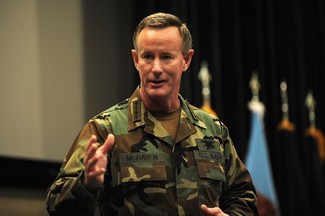
Enter William Harry McRaven, the present Chancellor of the University of Texas, a retired 4-star Admiral in the United States Navy, a 36-year veteran of the famed Navy Seals, and the leader of the team that captured Saddam Hussein and Osama bin Laden. As a young man he graduated from Texas U with a degree in journalism. But that pathway was not to be. Instead he found himself a member of the Navy Seals from their beginning.
That was back in 1978. Since then, Seal Team 6 has been dispersed to all points around the globe whenever tyrants have tried to suppress others, where troublemakers have been out and about doing bad things, or when danger lurks and evil smirks. The Seals are constantly in the thick of a fight somewhere.
Who else has the credentials, the experience, and the humility to be the leader of a university that oversees 14 institutions, that educates 221,000 students, and employs 20,000 faculty and more than 80,000 health care professionals, researchers and staff? His achievements in life are above reproach. His record of leadership is nearly flawless. But it takes sheer brilliance to inspire even the dullest student with the understated elegance of one who has walked the walk—in life, in purpose, and with conviction.
Great public speaking skills also carry with them a bit of humility and the certain knowledge that the speaker is the right person to be voicing them. Braggadocio is not part of that repertoire. Is there any doubt about the time, place, and the words of Abraham Lincoln’s Gettysburg Address? What about Martin Luther King, Jr’s speech “I have a Dream?” or John F. Kennedy’s speech “We intend to go to the moon, not because it is easy, but because it is hard?”
Take the next 19 minutes and watch and listen to the most memorable speech that you are likely to ever hear from a man of distinction, honor, and virtue about what it takes to survive and to prevail in this world where nothing is certain except our personal resolve to find the best that is within us as we try to live up to our own convictions:
William McRaven’s commencement address at the University of Texas, 2014: Never ring that bell.






Love ya!
Jane
I checked out the good Adm. McRaven from your video of his stirring 2014 commencement speech. I don't agree with you that military people make good presidents of institutions. Upon governor's orders after the debacle created by our scandalous benefactor president of Enron, Dr. Priscilla Slade, we were sent a general, a crusty curmudgeon who would let any reasonable energy policy proceed on campus. I also don't trust businesspeople as presidents of universities or the country. But there is a good old boy network of CEOs, generals, admirals and other high-ranking people who make the rounds of boards and cushy jobs in the government.
McRaven's speech was supposed to be short, but it was rather long. It was also peppered with military disciplinary bonding practices, making SEALS the ultimate of followers of orders from higher up. Business organizations are not structured like universities. Military hierarchy is not structured like universities. Universities do best when led by strong academic leadership of those who have practiced seeking knowledge of the highest order. But there are those in state government like in the state of Texas feel that discipline is more important than the freedom to learn. That battle often rages on state run campuses. But rarely does among private school who are not obligated to take leaders from other venues to run their institutions.
I have to commend Adm. McRaven for his accomplishments. And his lessons were sound for life. He certainly is a master of rapidfire speech and read his notes very well.
Ron