Why Enlightenment?
Having knowledge of facts, conditions, and circumstances is the start of human development. Together, they are also the beginning to understanding ourselves. We first learn about them from our parents, our teachers, and from books. Experience later plays a larger role about which of the facts and conclusions we keep, and which we discard in favor of something better. Traversing the rocky road from ignorance to the ability to make wise choices, however, goes far beyond facts, books, and teachers—even religions and experience. Once we are relatively certain of our facts, we still teeter on a tentative footing where more facts may firm up our knowledge base or replace part of it, or we may even need to replace the whole footing. Suffice to say, in time our collection of facts and knowledge changes. Different cultures have different facts, knowledge, experiences, teachers, and religions and thus they reach different conclusions about life on Earth as we know it. But this essay is not about facts, or footings, or knowledge, or religions. It’s about using the best tools at our command to reach a higher understanding of who we are, where and why we exist, and which parts of that mosaic are most important. It’s about personal enlightenment.
What is Human Fulfillment?
Back in the 1940s, psychologist Abraham Maslow introduced us to his concept of human needs. He classified them, and ordered them into a hierarchy ranging from most urgent to most relevant. You may recall the names of each level of human needs as biological, safety, conformance, esteem, and self-actualization. He later added the last need as self-transcendence. This is the concept of our need to give back to humanity what we have learned while living here with no expectation of being rewarded for it. We might label that need as arising from our gratitude to others for their mentoring. Another need might arise from our certainty that we can take nothing with us when we die.
Most of us learn early on that neither our parents, teachers, cultures, nor our experiences come together in a uniform way to bring about a common understanding of who, where, why, and which parts to our mosaics are most important—especially to acquiring or refining a personal sense of enlightenment and fulfillment. There remains a common sense of mistrust among individuals and cultures about many important matters. Climate change and what to do about it is one example. Wealth distribution is another. These perceptions show up most noticeably when we think about the future and “what ought to be” there awaiting our posterity.
Ignorance is the #1 Hindrance to Human Fulfillment. The Covid-19 virus and its consequences immediately come to mind. Despite the great knowledge gap between scholars in the medical profession and all others, about 30 percent of humanity do not trust the medical experts who instruct us to wear a mask, wash our hands often, do not gather in large numbers, and get vaccinated. Large numbers of people cannot identify Africa on the globe, nor do they understand that is a continent. Knowing how to swim, to administer first aid, give CPR (cardio-pulmonary resuscitation) are others. We need to teach how to think critically in every culture starting with Day One.
I could fill many pages with other examples, and describe how and why they inhibit human understanding. They are also the fundamental reason for mis-understandings and much human suffering, But let’s move on.
Greed is the #1 Attribute of Ignorance. There is enough stored-up wealth in the world to pay for the costs of education, for eliminating poverty, and for raising living standards around the globe. Ideologues everywhere are against making significant efforts to change these circumstances. But every culture has too much rigidity in how and to whom wealth flows such that excessive amount of it flow to those already at the top. It was Bernard Mandeville in the Fable of the Bees (1714) who alerted us to a quirk in human nature that having a lot of poverty to see from time to time is a good visual comfort to reminding the wealthy about how well-off they are without the need to touch, feel, or smell it. I guess he was referring to one of those sets of contrasts that appeal to our sensory natures. It has long been my contention that most excessive wealth in the US is both unearned and untaxed, hence it’s existence also rests on logical and morally unsupportable grounds. The same can be said for other countries, but to a lesser extend.
Concluding
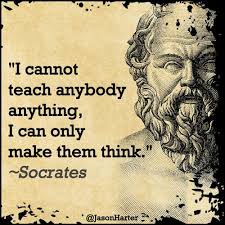
So what is the solution? We cannot rely on poor masses of human beings to educate themselves beyond survival, safety, and conformance needs. But I think it is possible to teach a large number of people how to think critically. I tried in one chapter of my book the New American Challenge. Perhaps a book entitled Critical Thinking for Dummies is long overdue free on the internet for readers in all parts of the world. Socrates did an outstanding job of teaching a small number of others how to think critically without textbooks, income, or advertising. Perhaps that was his mission on Earth—to plant the seeds of knowledge. Still, there is not much evidence that his efforts have won a place in the hearts and minds of humanity.
Today we stand on the shifting sands of knowledge. There is too much ignorance, too much greed, and too few great minds at work in trying to find answers one of the most fundamental questions known to virtually all of humanity: Why am I here?
Let us tell others this much: Science gives us the best answers to everything that is verifiable. Study it. Learn from it. And take care of it. Go to the source. Avoid all second hand accounts. Logic and critical thinking are the way to apply scientific facts in solving nearly all the issues of the day. You have your own moral code that tells you right from wrong, facts from nonsense, and good from evil. Embrace them with your life. Our survival on this planet may well depend on you.





Google is maligned for good reason, monopolization of data. But, if one seeks the truth or the facts on almost anything, a Google search will get you close if not to the original data. Rumors and hearsay have always influenced people, particularly the ignorant, into thinking they know more than the facts show. Mathematical ignorance is so bad, most of that 30% of people you describe cannot logically understand percentages and their importance in determining whether something is correct or not. They throw out valid statistical data because they do not understand it.
While data changes all the time and changes what is fact from fiction. Human attitudes are the hardest to change. Attitudes are deeply seated in memory and must be overwhelmed by information before they change.
Ron