Why Science is Not the Search for Truth
Before I leave this life, I want to articulate a few things I’ve learned—mostly the hard way—in both the school of “hard knocks,” and through formal study. I like the informal essay format, so I have chosen it as my means of communication. Besides, we all need a comfortable starting place when we choose to speak or write.
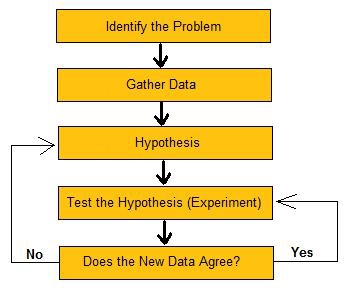
My opening statement does not mean that I have found the truth about life, love, or anything else that is important. Nor have I been searching for them. Rather, it means that I have embraced a way of thinking that satisfies my inquisitive mind about what makes sense to me, and there is a high probability that it could work well for many others. Virtually all the great thinkers since Socrates adhered to a few simple principles of logic. My deeper thoughts begin and end with the Scientific Method.
This essay is not intended as a short cut to enlightenment. It does, however, outline what is useful when up against ne'er-do-wells who believe they can brainwash us in the same way they have been brainwashed. If you now have politics in mind, you have an uncanny gift for knowing where this essay is heading.
Step 1. A fact is not the truth. Those in search of the truth are destined to become trapped by their own limitations when they assert that they have found the truth. They cannot show you or me proof of their truths. A truth is permanent; it is unchanging—yesterday, today, and tomorrow. But in a universe that undergoes constant change as its first and most obvious characteristic, searching for the unchangeable in it is pointless. How can anyone recognize something that is unchangeable when everything is changing? They tend to respond to that question by asserting, for example, that God speaks to them, or that they at least have a special “pipeline in the sky.” Typically, they are an ideologue who is wedded to an ideology. This gimmickry also breaks faith with a stubborn rule of logic: “The burden of proof falls upon the asserter,” not on you or me. Base anything of note on an assertion, and I will turn you off, or tune you out.
More about truth. Astrophysicist Neil De Grasse Tyson once made an interesting observation about truth. He noted that, over the centuries, societies that allowed its members the freedom to inquire openly were many times more likely to become leaders in their fields of study than were those that did not allow freedom to inquire. His conclusion: Believing you have found truth stops all investigation of that subject. The reason: Why search further when you believe you already know what is true ?
Facts are well-supported statements, often backed by lengthy proofs. Many well-supported facts are accessible by search engines based on artificial intelligence (AI) models found online in many forms and formats. Almost anyone can “fact check” most speakers by simply asking your AI model, or machine learning model (ML), or deep learning (DL) model, and others. You do not need to be a genius in order to learn about them or how to use them. Even this composition passed an AI fact-checker. How’s that for confidence?
I recently listened to a good speaker who based his argument about a free society on his belief in “capitalism.” But then he began to extol the virtues of “free markets,” and “competition,” and an economic system based on “free choices” as if these elements were components of capitalism. They were back in 1776. But today, those modifiers are actually the features of free markets, not a part of capitalism. Capitalism is a market system that is tilted heavily toward the few at the top, marked by conglomerates and vertical integration, with huge wealth accumulations by the few, and very little competition. The less competition that exists, the happier are the wealthy magnates. And so he was misleading his audience by pretending to support lots of competition, and fair wages for a fair day’s work, and market prices set almost entirely by supply and demand. Capitalism wants none of that.
Also, neither health care delivery systems nor the legal system are part of free enterprise. They have layers of legal barriers designed to keep you and me out, while they can charge excessive fees for themselves. The medical profession controls its high incomes in multiple ways: It sets standards and fees for medical schools, for hospitals, for specialties, while it keeps you and me in the dark from understanding knowledge much about illnesses, technology, and drug costs and their uses for the typical consumer to have much of a voice in prices. Clearly, most students do have $250,000 for medical schooling; the typical wage earner does not earn enough to pay $100,000 to $500,000 for a short hospital stay; nor can he pay $1 million or $10 million in legal fees needed to defend against a false claim made against him by a large corporation or by the ultra-wealthy.
Steps 2,3, & 4. Facts must also be analyzed, synthesized, and evaluated before reaching limited conclusions about them. There are many ways in which these steps can be done, but none as well as an appropriate set of statistical procedures that lets best answers surface, including those that the investigator may not like. Statistics, however, is not a simple and easy-to-understand subject. There are a large number of models and procedures that can and will be evaluated in peer-reviewed reports. There are many procedures and proofs. Omit them and the scientific community will discard your findings very quickly.
Step 5. Your conclusions also must be limited by your data, your analyses of it, and the carefulness that you have given to each step. They must be accurate, reliable, and useful to others. Moreover, you must guard against letting others tell the world what you have found. That is 100 percent your responsibility. Nonscientific users tend to pick and choose what they like in your findings, and thus misuse them. Accuracy, reliability, and usefulness are also well-defined in the scientific method. Stick to these definitions and you have gone far in mastering the complete set of procedures.
Now, let’s relax a little. So far, this has been only the “pocket” version of the Scientific Method. Back in my teaching days, I called it the “walking around” version. Very few scientists (both in the physical and the social arenas) follow every comma, and every nuance in every step of their investigations. Nor is this brief description intended to discourage anyone from improving on their approach in trying to understand the universe and everything in it. It’s also too late for me to try to smack down theologians and others who profess to hold the truth, the whole truth, and nothing but the truth. Others have done a good job at those tasks. I leave them alone if they are otherwise decent people. And most are decent, although ill-informed about the truth.
Step 6. Usefulness. This is the age of the “Big Lie,” particularly in the domain of politics. Now you can make good use of the fact-checking part of your computer. Even hand-held i-phones have a fact-checking feature to them. Use it. When a politician asks for questions, just say this: “Sir (or madam), my i-phone just identified 17 false statements in your speech. It also rates you as highly unqualified for the office you seek. Do you still intend to run for the office of governor despite being an incorrigible liar?”
Even if he orders his thugs to carry you away and break your knee caps, you made your point. Next time, carry a taser or pepper spray. Or stay away from political rallies.





If politicians would only be so open and honest as those professors in the hated "liberal" institutions were divergent thoughts and ideas are accepted until proven guilty.
As usual, this article is a winner in every respect. The truth is always hard to nail down like jelly. But facts are much better to live by than absolute truths that have no basis in reality when examined scientifically.
Ron