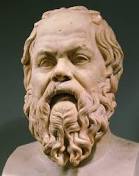
[image: Socrates]
State of the World: 2024
“The greatest way to live with honor in this world is to be what we pretend to be.”
--Socrates (470 -399 BCE)
Pres. Biden is scheduled to deliver his State of the Union address on March 7, 2024. Just to show that I am not a copycat, I chose to write my own version of the State of the World today. What might I write about that he is not likely to mention? My perspective is centered on this subject: What is the fundamental difference between how Progressives see the world, and how Conservatives see the same world? The fundamental differences have little to do with politics, religion, which part of the country we live in, how much money we have, our border security, our place in the world, artificial intelligence, how to live, love, and be happy, or who has the nuclear codes. Instead, this composition will dwell on the differences in how Progressives and Conservatives discern life, liberty, and the pursuit of happiness. The differences are profound and they permeate every aspect of life from fits of anger to walking with zombies, and all pursuits in between. Until and unless we begin to close the important ways in which we view the real and perceptual gaps between the two groups, we will continue to drift hopelessly and certainly toward self-annihilation.
A World View. For starters, our hopes and dreams are the same as humanity’s hopes and dreams. We are all in this thing called Life on Earth together. We breathe the same air, view the same sunsets and the stars, and we must eat, drink, and make do with what he have regardless of our differences in language or location. It makes sense that we must all try harder to get along, and smooth our differences without causing harm to each other. What lies beyond the veil of life is what it is, and we cannot change it. Survival here, however, demands that we look beyond our borders in seeking to find our commonalities in the arts, in science, in work, sports, language, and even to a greater sharing of resources, advances, and goals. To those ends, we must be willing to slow down the immense shifting of wealth from the many to the few. Such gaps exist in every country and culture. They are also a fundamental reason for distrust and isolationism; they also appeal to our greed and our fears, and are a factor in the potential for wars. We need to keep score on all these subjects, and set goals for a better, safer world.
Progressivism and Conservatism. The differences between a progressive and a conservative are many. They are based on how we analyze, synthesize, and evaluate facts and information—followed by how we reach conclusions about almost anything. These differences are deep and profound.
First, a progressive is a critical thinker and a skeptic, while a conservative is a follower and a disciple. A progressive trusts facts that are well-researched and documented. A conservative accepts his facts from authority figures. A progressive relies on empirical evidence in reaching conclusions that are reliable, accurate, useful, and limited. A conservative accepts whatever his or her leaders tell him. A progressive is well-educated (with or without diplomas). A conservative is poorly educated (even with diplomas), and prefers to let others do his thinking. A progressive is a forward-thinking achiever, a conservative is a backward-thinking believer.
How Do I Know All This is Accurate, Reliable, and Useful? Once upon a time, I put together a scientific study of Persuasibility. It sought to identify who is persuasible, why, and what to expect when the two different personality types sat down together and tried to reach consensus conclusions on a variety of issues. Groups were diversified on the basis of scores on, what else?--the Phillips Persuasibility Scale. The complete study involved a fairly comprehensive pilot study, followed by an extensive main study. The findings showed that whenever individuals changed their minds and reached conclusions, shifts were nearly all from those who were highly persuasible vis-a-vis those who were not. The biggest factor behind the two groups was education levels. A more complete profile showed the persuasible group members were highly dogmatic, had lower self-esteem, low sense of humor, high anxiety, high authoritarianism, low self-actualization, low confidence, and a low ability to differentiate between source and message.
Many other studies, in particular, those that sought to find jurors most likely to reach conclusions favorable to their clients use very similar profiles when narrowing down who should sit on the jury. Lawyers try to find strong leaders with open-minds who can lead the others on the jury to their positions.
Looking Forward. Progressivism is the logical outcome of persons well-educated in Critical Analysis. It is a way of thinking introduced centuries ago by Socrates, and refined in the intermediate centuries to what is generally known today as the Scientific Method. It isn’t necessary for anyone to be a scientist to study or to use it. But if we ever expect to see better decisions at all levels, by a huge number of individuals and groups, it needs to be introduced in all grades and in all schools throughout the world. When it becomes a way of life, then, humanity will have a chance of learning how to live together without voting for a tyrant, or becoming any tyrant’s obedient follower.
|


Unfortunately, while you didn't actually write, I believe the actual number of people persuadable is far, far greater than the people who are not "easily" persuaded, critical thinkers.
That's why we need critical thinkers everywhere there are young people, especially in the schools. Teachers, counselors and mentors who use the Socratic method of working with young people to make their minds more critical of what they are hearing from authority figures, primarily on the Internet.
Keep up the good work… I'm reading.
Ron