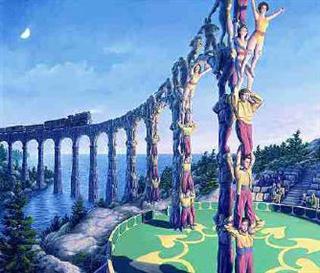
...
This started as a comment to “Becoming Self Aware Becoming Responsible Becoming and Causing Change” – an extraordinary article by Sha’Tara, posted here in AD by our friend and fellow author Regis Auffray, and a reading I most enthusiastically recommend to you all. However, so fascinating and inspiring were – are - the theme treated in the article and Sha’Tara’s offered perspectives, that my intended comment, irrepressibly extended and evolved… into another article - this one, which I’m happy to share with you, and dedicate, with my deep admiration and gratitude, to Sha’Tara – and Regis.
*
Herd, pack, flock and group – these may be synonyms, but they are not at all the same thing. My personal feeling – arguable, as such – is that, primarily, and primitively, mankind’s instinct was not, is not, the “herd” one; it wasn’t and isn’t a “pack” or “flock” one, either. If we observe those closest to us – the other primates – we may understand a little more clearly that, like them, we are basically “community” animals, and our survival, which includes the fulfillment not only of our physical, but psychological and emotional needs, as well as our evolution in all those fields, are, naturally, more easily granted through the conjoined efforts, skills, and support of “groups” – nuclear groups, such as families, within more vast groups, such as, and again, communities.
Within these groups, we will find that variety of elements that provides the natural balance – there will be the robust, the shrewd, the versatile, the caring, the cautious, the determined, and, of course, all of their opposites – there will be the young, the growing, the mature and the old, and we will find roles, all of them relevant for the safety and fulfillment of the needs of the community and its elements.
Among these many roles, we will find the one which may be defined as that of “leader” – which, within its many variables, generally characterizes the attributes of one of the elements with “the power to guide the others”.
So, many may wonder, in what would this particular “relationship of power” – leader/followers – make human communities, or indeed those of primates, any different from those formed by other species, and currently defined as “herds”, “packs”, or “flocks”, since it is common to all of them as “clusters”, and seems to stem – again, and nevertheless, with many variables – from an also common denominator – and I quote, as one of its possible definitions, a certain anthropological theory which suggests “that those individuals best suited to lead the a group (are the ones who) will somehow rise to the occasion and that followers, for some reason, will accept them as leaders or as proto-leaders”?
One of the differentiating aspects in the establishment of “leadership” within human communities may be – and again I quote – “the perceived increasing need for dispute resolution in increasingly densely-populated and increasingly complex societies.”
Another differentiating factor – and now, this is once more my personal feeling, therefore totally debatable – may be… precisely what I believe sets the human species apart (without making it better or worse, superior or inferior) from other Earthian species, and which is… self-awareness.
Which raises the inevitable question – and now I quote you, Sha’Tara – “Who has the power [the most power] in an Earthian world? The individual or the group?”
And I offer this humble answer, among the many possible answers:
In the human Earthian species (which, along with many others within different kingdoms, and the environments in which they live, form the Earthian world) the power of the group – and even its survival – depends entirely on the self-awareness of the individual.
Self-unaware “followers”, like self-unaware “leaders”, will endanger not only themselves but each and every other element of their own and other groups, because they will act irresponsibly – with total disregard for the actual “power” of their individual (negative and positive) influence on the Whole.
Self-unaware humans will, indeed, become sheep in a herd under the staff of a shepherd (or sheep following another sheep to the verge of a cliff down which the whole herd will eventually fall), or the pack of hungry wolves who will eat the sheep and the shepherd, or terrified bulls fleeing, in blind stampede, from a meadow on fire, and trampling all smaller creatures which may happen to be in their way in the process: Sheep don’t “think”, they follow; Hungry wolves don’t “think”, they eat; Terrified bulls don’t “think”, they trample;
In what way, indeed, are human beings any different when they do not use, precisely, what sets them apart among all the other “community animals”, and is none other than self-awareness?
Human beings ought to accept, develop, and encourage this, which is their own true POWER as a species among all others within the Earthian world. And accepting, developing, encouraging such POWER, means… yes, becoming responsible, exerting the faculty of discretion, re-creating oneself constantly through self-criticism, self-forgiveness, self-esteem, flexibility, and the perception of change, questioning what may even seem obvious or beyond any argument, always seeking to learn further, and unceasingly pondering upon such “learnings” -
- So we can stop adding to the strength of the staff which falls on the sheep’s back, to the hunger of the wolves, to the fire which causes blind stampedes, and to the bottomless depth of the pit into which, eventually, the whole herd will fall – these consequences which “looking into both the past and future” teach us – and you, Sha’Tara, have already learned - can only be changed NOW, and by each one of us.
© 2007 Alexandra* ~ OneLight*® - (Image © by Rob Gonsalves)
Sources:
|



We laugh and despise the black-sheep that is getting richer, distracting us from the task of defending our grassy land for survival.
A great piece to call upon awareness, somewhere out there are someone that's not yet deaf?
Georg