|
A paradigm shift on understanding Shakespeare began in 1920 when Thomas Looney discovered that "William Shakespeare" was a pen name of the Earl of Oxford. Two 2013 films set forth a dramatic new theory--that Oxford and Queen Elizabeth had a love child, raised in secret as Henry Wriothesley, Third Earl of Southampton
© 2014 by Helen Heightsman Gordon
The Messy Paradigm Shift in Understanding Shakespeare
Paper presented at University of Utah, Confutati Conference, February 22, 2014.
A paradigm shift, as you know, is a massive re-orientation of a widely-held prevailing concept. It involves the discovery of new information, seemingly contradictory or radically different from the traditional view. It involves the gradual incorporation of that new concept into mainstream thought, accommodating our older way of thinking to the new, more accurate, way of seeing things. Such a shift often takes decades or centuries to occur. One notable example from science is the idea that the Earth revolves around the sun. We still use the terms “sunrise” and “sunset” for everyday conversation, but we are indebted to Copernicus and Galileo for struggling many years against popular misconceptions, to improve our knowledge of how the universe works.
Science enjoys the advantage that its new theories can be tested, or, by using the scientific method, at least established to a degree of certainty when a preponderance of evidence inspires a high level of confidence.
With literature, however, our interpretations are more subjective, and we tend to build upon previous interpretations even if they have been leading us astray. Even in supposedly factual biographical profiles of authors, false assumptions can be so often repeated that they become accepted as fact.
For an author as beloved as William Shakespeare, we hunger to know more about his brilliant mind and playful wit, but the few records we have of his daily life are so meager that scholars have had to fill in the gaps. Because devotees have filled in those gaps with their own imaginations, we see suppositions and assumptions, many of which then get passed along as fact.
The great author has become an icon, worshipped so avidly that the playwright George Bernard Shaw described Shakespeare’s popular adulation as “Bardolatry.” Such deification has prevented openness to new information, thus hindering our understanding of how the author’s life has affected his work. The deification prevents honest inquiry and leaves many mysteries unsolved.
Questioning whether “William Shakespeare” might have been a pen name often generates passionate, mean-spirited, and even vicious attacks upon the questioners. The traditionalists have stifled the questioners by dismissing them as crackpots, snobs, and dunces who can’t understand the miracles of genius. It saddens me to see so much turf-protecting academic disdain, intellectual dishonesty, snobbishness, censorship, and verbal abuse. These thoughtless reactions have also deprived us of hearing the most beautiful love story ever to come out of Elizabethan England. But now, at last, that story can be told.
As more people become educated and think for themselves, the paradigm is gradually changing. The documentary “Last Will and Testament” and the drama “Anonymous” provide a major tipping point for that paradigm shift. I have come to the conclusion from my own research that the film-makers have got the story essentially right—that “William Shakespeare” is a pen name.
But it is difficult for many people today to re-align their perspectives and look objectively at new evidence. So let me begin with a simple exercise that will help to clarify the difference between a real human writer and a fictional pen name.
Suppose someone came to Hannibal Missouri seeking the author “Mark Twain.” He would find scant evidence that anyone of that name had lived there. If someone with a similar name had lived there, but had never published any written work, it would be clear that he was not the same man as the talented author who wrote “Huckleberry Finn.” If a Missouri resident told the seeker that “Mark Twain” was a pen name used by Samuel L. Clemens, he could easily find out that Sam Clemens had the background to create memorable characters and scenes of the American South, even down to his familiarity with the dialects spoken by his characters and the attitudes toward slavery that he satirizes.
Furthermore, if some English aristocrat named “Marcus Twinham” claimed to be the author “Mark Twain” just because his name was similar, we would doubt his claim, because his aristocratic English background would not provide the kind of knowledge that we see in Twain’s work.
Since Twain was a commoner, yet he produced works of recognized genius, that clearly rebuts the frequent accusation against Shakespeare authorship doubters that they “just can’t believe a commoner can write great literature.” It is a truism that writers use their own life experiences, interwoven into a creative art form, to produce great books.
Furthermore, if a student in a composition class brought in a term paper showing literary quality far beyond any previous work he had done, his English teacher would immediately suspect that the work was not his own.
Such is the case with Will Shakspere of Stratford: could he have produced the highly sophisticated narrative poem “Venus and Adonis” as his very first published work in 1593? If not, where are the youthful poems with which he honed his craft?
Alas, we have not a single written document in the hand of the Stratfordian. We have begun to suspect that he was chosen as a “front man” who happened to have a similar name, to cloak the real author’s identity. Clearly, much effort has been expended to conceal the author’s name and to deflect our attention toward the man in Stratford. Those efforts have succeeded for nearly 400 years.
Let’s use our imaginations just a little longer to picture another scenario. I offer it only as a credible scenario, not a “smoking gun” kind of proof. The whole process of research into literature is inductive, yielding only a probable conclusion, not a proven one. A probable conclusion will always be tentative, always open to revision upon discovery of new evidence. Thus we cannot conclude that an inductive conclusion is “true ” or “false” – only that it is “sound” or “unsound.” When evidence accumulates to such a level that it seems highly probable, we say the theory is sound. So imagine this scenario and decide whether it seems credible to you.
A poet that nobody has ever heard of is seated at his desk, writing with a quill pen. He wishes to dedicate a book of poetry to a natural son that he cannot acknowledge for political reasons. This son is in the Tower of London, condemned to death for treason because he assisted his friend, the Earl of Essex, in the rebellion of 1601. The poet cannot leave any legacy for his beloved son except a book of poems dedicated to him, but he assures his son that the immortality of literature is a far better legacy than a few more years of mortal life. He writes a prediction in a couplet at the end of a sonnet: “As long as men can breathe or eyes can see, / so long lives this, and this gives life to thee.”
The poet writes under a pseudonym, because if his name and the name of his secret son appeared on the manuscript, it would be destroyed by their enemies. Those enemies are determined to obliterate the poet’s name and obscure his relationship to the Queen of England. You have probably guessed by now that the poet is Edward de Vere, 17th Earl of Oxford, alias “William Shake-speare,” who is forbidden to publish anything that might lead to speculation about his love affair with Queen Elizabeth.
So he writes a dedication in the form of a riddle, using Rosicrucian and Freemason symbols. These symbols are chosen deliberately, because members of those secret societies might recognize the symbols,even in future generations. The poet voices that hope in sonnet 81, addressed to his son: “Your monument shall be my gentle verse,/ which eyes not yet created shall o’er read/ and tongues to be your being shall rehearse/ when all the breathers of this world are dead.” That is, future generations who understand the symbolism can resurrect the author and his son, thus insuring their immortality.
The poet makes his riddle in the form of three inverted triangles, using all capital letters as might appear on a tombstone. These triangles contain 6, 2, and 4 lines, suggesting the name of Edward de Vere, which has components of 6, 2, and 4 letters. The 28 dots after each word suggest their code systems, both of which used dots in a “pig pen” grid to signify letters of the alphabet.
Using an encryption system recommended by his friend Francis Bacon, (steganography, or “hiding in plain sight”), he embeds the letters of three names in a “plaintext” that resembles a typical book dedication. In the same riddle (phrased in an oddly ungrammat-ical sentence structure to make exactly 28 words), he embeds the mottos of himself (vero nihil verius), his son (all for one/ one for all), and the boy’s mother, ever the same).
He places two gammas at the bottom of his inscription, hoping the censors will mistake them for the initials “T. T.” But he reasons that Freemasons and Rosicrucians will recognize the pair of gammas as representing symbolically the pillars of the temple of Solomon, through which an initiate enters to gain enlightenment. Freemasons will also recognize, from the 28-word limit and 28 dots, that the author is a Freemason at the 28th level, which is dedicated to “Truth.” The name “vere” means “truth” in Latin.
That dedication riddle has puzzled readers and scholars for centuries. The poet would have had to use paper letters to arrange the message and plan the encoding, since there were no computers at that time.
Many people have tried to decode the riddle using techniques such as the ELS grid (equidistant letter sequences), which have enabled decoders to find the name “Henry Wriothesley.” But the poet would probably have used a different method, because the ELS technique was well known to cryptographers in Elizabethan England.
No solution to the riddle has proved satisfactory until we could place it in a meaningful context. We have had to learn about the love story and the trinity of Edward, Elizabeth, and their son Henry Wriothesley, considered by many to be the mysterious Mr. W.H. (with initials reversed) named as the “onlie begetter” to whom the sonnets are dedicated. Logically, we associate the term “begetter” with a father-son relationship, as Dorothy and Charlton Ogburn observed, in their biography of the 17th Earl of Oxford in their impressive work This Star of England [1952].
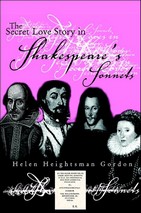
In researching for my book THE SECRET LOVE STORY IN SHAKESPEARE’S SONNETS [2008], I found an encoding technique used by Edward de Vere in an acrostic poem he wrote titled “The Shield of Love.” Using that technique, I discovered in the Dedication the names of Henry Wriothesley, Elisabeth Regina, E. Vere, and the mottos of all three as well.
I also discovered quite serendipitously the words “Twelfth Night” embedded in the last triangle, which puzzled me until I realized that the Twelfth Night holiday of 1573 would have been an important date to assure Henry Wriothesley that he was a child of love.
In exploring the significance of the Twelfth Night holiday, I learned that the twelve days of Christmas began on December 25 and ended in a splendid celebration on January 6. Then it occurred to me that Henry Wriothesley was born on October 6, 1573. So January 6, 1573, would have been the probable date of conception. On that magic night, Elizabeth was celebrating The Revels with her favorite court playwright, Edward De Vere.
And where was the Second Earl of Southampton? Having been arrested for his Catholic sympathies and involvement in the Ridolfi plot against Queen Elizabeth, he was imprisoned in the Tower, where no conjugal visits from his Countess had been allowed. So it might well be that the Third Earl of Southampton was a changeling child, raised by the Second Earl of Southampton in exchange for his release from prison. So now the hidden meaning of the Dedication can be inferred as the poet saying:
I wish you all happiness, my beloved son, for you are a child of love, conceived in amorous play on a magical holiday when anything can happen. Though your parents could not marry, being bound by duties and restrictions, their love for you is genuine and everlasting. These verses are the only legacy I can leave you, without causing you harm or serious losses, but in some far future time they will be rediscovered, and you will enjoy that eternity that only living literature can confer upon you.
My own research has convinced me that the so-called “Prince Tudor” theory (aka PT1) is the most logical scenario to solve the mysteries about Shakespeare. This theory holds that Queen Elizabeth the First had an affair with her favorite playwright, Edward de Vere, in 1571-1573. Despite the anguished denials of Stratfordians and some Oxfordians, claiming there is no evidence for the Prince Tudor theory, actually, there is mounting evidence for it.
I do, however, reject the theory known as “Prince Tudor Two” which holds that Oxford was the son of Elizabeth by her stepfather, Thomas Seymour, in 1548. There might have been a pregnancy at that time, but it could not have spawned the offspring Edward de Vere. That theory is easily refuted by the known fact that de Vere came of age in 1571, so his birthdate would certainly have been 1550. There is much stronger evidence that the queen had a son by Oxford in 1573.
Historian Neville Williams, in his biography "The Life and Times of Elizabeth I," reports a rumor that Elizabeth and Oxford had a love-child who was being raised as Henry Wriothesley, the Third Earl of Southampton [p.111]. Williams considers the rumor “wildly preposterous,” but he established that the rumor existed, whether or not it was true .
The Prince Tudor theory explains the need for a pseudonym, the need for diplomatic secrecy in a time when Elizabeth’s life and throne were being threatened, and the absence of documents that might clear up those mysteries.
I have added some discoveries of my own to the “Prince Tudor” theory, including the involvement of Freemasons and Rosicrucians mentioned earlier, and my analysis of the Dedication, but my findings are still controversial. Uncovering evidence from four centuries of confusing, mysterious, and incomplete biographies would be a formidable task in any case, but my research has been made especially complicated by the deliberate concealment and corruption of documents by the enemies of Edward de Vere – particularly his father-in-law, William Cecil, aka Lord Burghley, and Burghley’s son Robert Cecil, who feared that if the truth were known, Elizabeth’s natural son might challenge the right of James VI of Scotland to succeed Elizabeth.
The paradigm shift in Shakespeare scholarship has been slow to gain acceptance, as often happens with major scientific breakthroughs. Literary pioneers like Thomas Looney [pronounced LONE-ee] were ridiculed and labeled as crackpots, although his meticulous research in 1920 opened a new path of inquiry that yields valuable insights into Shakespeare’s mind and emotional life.
Much of what we thought we knew about the great author had been based purely on suppositions about the Stratford candidate. For example, we assumed that his plays were written between 1589 and 1612 (in forced conformity to the Stratford man’s lifespan), but nobody knows exactly when they were written; we only know when they were published or performed. In fact, the name “William Shakespeare” did not appear in print until 1593, on the poem “Venus and Adonis,” so Shakespeare was known only as a poet, not as a playwright, to the general public.
No one attempted a biography of Shakespeare until 1706. And that consisted only of anecdotes collected in Stratford by an actor, Thomas Betterton, who went to Stratford seeking to learn more about the author whose plays he loved. He was disappointed, however, to find that Shakespeare the author was not known in Stratford. He found some sketchy information about Will Shakspere (pronounced “SHACK-sper”), a grain dealer and glove-maker. He relayed the anecdotes to his friend Nicolas Rowe, who appended them to a collection of Shakespeare’s plays. Although Rowe himself was dubious about Betterton’s information, it became the basis for future biographical efforts. Thus these limited biographical details on the Stratfordian’s life, supplemented by sparse civil records of marriage and lawsuits, have been embroidered and elaborated until they assumed mythical proportions.
The myth is indeed attractive – that of a country boy who dazzled London aristocracy with his vast erudition and a command of foreign languages acquired apparently without formal training. But the myth ignores the fact that genius requires nurturance, and the acquisition of knowledge requires effort. Nonetheless, any doubts expressed about the Stratford candidate today seem to ignite the passions of a holy war.
Even today, prejudice and rancor are limiting or blocking our access to new information. For example, we find flagrant corruption in the online “free encyclopedia” called Wikipedia. Wikipedia’s self-appointed volunteer editors, who are not Shakespearean scholars, have peppered entries on “Shakespeare Authorship” and “Oxfordians” with pejoratives like “fringe group” and “conspiracy theorists.” They have also maliciously erased valid information posted by Oxfordians.
Many teachers and scholars have presumed that the Third Earl of Southampton was Shakespeare’s patron, but no evidence has been found that Shakespeare had a patron. Southampton’s highly-regarded biographer, Charlotte Stopes, after an exhaustive search, could not find any evidence that the Earl of Southampton had ever met the man named William Shakspere from Stratford.
The movie “Anonymous” takes the Prince Tudor theory as the basis for a fictional depiction of the Elizabethan era. The director Roland Emmerich and screenwriter John Orloff have captured that milieu beautifully, although they altered some historical events slightly for dramatic purposes. This wonderful film was sabotaged by some American academics even before it was released in theaters, criticizing it over irrelevant details such as whether the Essex Rebellion involved a performance of Richard II or Richard III. (Fact: Richard II is historical, but Richard III is portrayed as a hunchback, so the scriptwriter could use that detail to show the enmity between Oxford and his hunchback brother-in-law, Robert Cecil.)
The London-based De Vere Society adamantly opposes any thought that the “Virgin Queen” might have had a child. Thus they reacted with vitriolic disapproval of the film, and rejoiced in their newsletters that it lost money at the box office. But the director has done all Oxfordians more of a favor than they realize.
Personally, I loved the film, but I do wish the Hollywood promoters had not sensationalized its publicity so much. I also wish the movie had not brought up the questionable theory that Edward de Vere might have been Elizabeth Tudor’s son by Thomas Seymour when she was 14. That idea, known as “Prince Tudor2” theory, is mentioned in the film but dismissed as a lie told by Robert Cecil to upset Edward de Vere after Elizabeth’s death.
On the other hand, the original “Prince Tudor” theory (PT1) presents a credible scenario, better than any other I have seen, which explains many of the mysteries that orthodox scholars still struggle with. The need for a pen name becomes obvious as a means of protecting the queen, who maintained the persona of a “virgin queen” to hold out the possibility of alliance by marriage to the crowned heads of Europe. Such an alliance might prevent Spain and France from forming a military alliance to crush the weaker Protestant countries--England, Scotland, Germany, and the Netherlands.
My study of Shakespeare’s Sonnets convinces me that a beautiful love story has been withheld from us through four centuries of censorship and misdirection. I see Elizabeth as a flesh-and-blood woman capable of love and desire, whose queenly role thwarted, and yet sublimated, her feminine impulses. I see Oxford as a complex genius whose emotions ranged through all the depths and heights of human experience, a passionate lover who loved Elizabeth all his life. I believe Oxford sired a love-child with Elizabeth on Twelfth Night of 1573, a son born on October 6, 1573. That son was raised in secret as Henry Wriothesley, 3rd Earl of Southampton, until the age of 9, when his father died (probably of poison); Then young Henry became a ward of the court under the guardianship of Elizabeth’s counselor-treasurer, William Cecil.
My most original contribution to the paradigm shift is to recognize that the famous riddle of the Dedication in 1609 was written by Edward de Vere, not Thomas Thorpe as has been presumed for centuries. The initials presumed to be “T.T.” are actually gammas, which symbolize the pillars of the temple of Solomon, sacred to Rosicrucians and Freemasons as a doorway to enlightenment. This symbolic and cryptic scheme was necessary to get around the censors who were trying to sever any connection between Oxford and Elizabeth, destroying any of his writing that might link him to Elizabeth’s court.
Fortunately, Oxford’s youngest daughter, Susan Vere Herbert, hid many of his plays until they could be resurrected by her husband, Philip Herbert, and his brother William Herbert, who sponsored the publication of the First Folio in 1623.
The Herbert brothers were both Freemasons. They employed Ben Jonson to write an ambiguous preface, using the term “Sweet Swan of Avon” which could refer either to Shakspere or to the Earl of Oxford, who also had property on the river Avon. Jonson probably also wrote the testimonies of the two actors, Condell and Heminge, who may have helped to supply some “cue copies” of the long-lost scripts.
The Rosicrucian scientist, Francis Bacon, knew that Edward de Vere was Shakespeare. The sonnets published in 1609 were quickly suppressed, but a few copies remained in private hands. A new edition came out in 1640, sponsored by Francis Bacon’s Rosy Crosse Literary Society, printed by John Benson. Some changes were apparent between this edition and the 1609 printing, including replacing some masculine pronouns with feminine ones. I suspect that Francis Bacon had preserved his own copies of de Vere’s work, knowing that some of the sonnets were addressed to Elizabeth and other women in de Vere’s life.
The 1640 edition of the Sonnets contained a portrait of Shakespeare with an acacia branch in his hand, a plant sacred to Freemasons and Rosicrucians as a symbol of immortality. The black-and-white oval encasing the portrait also symbolizes the good-and-evil mixture found in life. We can also find many symbols in the Tower portrait of Henry Wriothesley of 1603, indicating that he was a Freemason, like his father (Oxford); an impresa on the portrait indicates his ties to royalty, through his mother (Elizabeth). More details are available in my book THE SECRET LOVE STORY IN SHAKESPEARE’S SONNETS and other publications in the suggested reading list.
HOW DID THEY KEEP ELIZABETH’S SECRET SO WELL?
Certainly it was no crime for Elizabeth and Edward to fall in love and create a child in a moment of passion. Yet the need for secrecy regarding Elizabeth’s pregnancy was a political imperative. To protect her kingdom from attacks by foreign Catholic monarchs, she created the persona of the Virgin Queen, holding herself open to the possibility of forming an alliance through marriage. Speaking ill of the queen could invoke serious penalties in the police state that Elizabethan England had become. Yet gossip continually circulated about the Queen’s love affairs [Erickson 1983, 266].
In 1570, some English subjects were tried—and some executed — for slander against the Queen [Erickson, 266]. Some had tongues and ears cut off; some were tortured and imprisoned [Erickson1983, 269]. Though suppressed in England, rumors ran unchecked in other European countries. The Venetian, Spanish, and French ambassadors reported that Elizabeth had several children (presumably by her long-term lover, the Earl of Leicester) [Erickson 1983, 269]. Reports from such various sources as Madam Von Kunow claim that Elizabeth had as many as five children, (presumably including sons Francis Bacon and Robert Devereux by Dudley).
Understandable though it is that English Oxfordians want to preserve the idealized image of the Virgin Queen, that sterile image has been replaced throughout most of the world by a more lovable vision of Elizabeth as a woman with human flaws offset by majestic virtues.
Understandable though it is that for four hundred years Shakespeare devotees have cherished the romanticized ideal of a country lad blossoming into miraculous greatness, it is time that we restored the good name of Edward De Vere, the 17th Earl of Oxford, and credited him with enriching millions of lives with his life’s work.
It is time we recognized the devotion of De Vere’s daughter Susan; her husband, Philip Herbert, Earl of Montgomery; and his brother, William Herbert, Earl of Pembroke, who collected the scattered, suppressed works of Susan’s father and published them as the First Folio of William Shakespeare’s plays, lest these treasures be lost to the world.
It is time that we recognized Francis Bacon – not as the author of the Shakespearean canon, but as one who contributed mightily to the preservation of the author’s anonymous poetry.
It is time that the sacred brotherhoods to whom the poet appealed, Freemasons and Rosicrucians, now proceed through the pillars of wisdom, hear their brother’s long-stifled plea in Hamlet’s dying words, bring his truth from darkness into light, and perhaps in the process find some of the lost Words so long veiled in mystery.
REFERENCE LIST
Ancient and Mystical Order Rosae Crucis (AMORC). “Our Traditional and Chronological History,” 2007. http://www.rosicrucian.org/about/mastery/mastery08history.html.
Anderson, Verily. The De Veres of Castle Hedingham. Lavenham, Suffolk, UK: Terrence Dalton, 1993.
Brydon, Robert. Rosslyn– a History of the Guilds, the Masons, and the Rosy Cross. Midlothian: Rosslyn Chapel Trust, 1994.
Bull, Peter. Shakespeare’s Sonnets Written by Kit Marlowe, 2007.
http://www.masoncode.com/Marlowe_wrote_Shakespeare's_Sonnets.htm.
Charlton, Derran K. “Edward de Vere and the Knights of the Grail,” The Spear Shaker Review, May 1991, 4-10.
Cockburn, John A. “The Letter G.” Ars Quatuor Coronatorum, the Transactions of the Quatuor Coronati Lodge No. 2076 10:40. 1897. Reprinted by the Grand Lodge of British Colombia and Yukon, Dec. 19, 2002, on web site http://www.freemasonry.bcy.ca/aqc/letter_q.html.
Dawkins, Peter. “Shakespeare and Freemasonry” Freemasonry Today, Winter 1998. Reprinted on web site http://www.sirbacon.org/Dawkinsfrmsnry.htm.
____________. “Ciphers of Francis Bacon.” 1999. Francis Bacon Research Trust. http://www.fbrt.org.uk/pages/essays/frameset-essays.html.
Dodd, Alfred. Shakespeare: Creator of Freemasonry. London: Rider & Co., 1933.
Erickson, Carolly. The First Elizabeth. New York: Summit Books, 1983.
Fowler, Bob. “Sir Francis Bacon, Shakespeare, William Tudor, and Freemason Symbology.” online at
http://www.light-of-truth.com.
Gardner, Martin. Codes, Ciphers and Secret Writing . New York: Dover Publications,1972.
Gordon, Helen Heightsman. The Secret Love Story in Shakespeare’s Sonnets. Philadelphia:Xlibris, 2008.
______________________. “William Shakespeare’s Rosicrucian Revelations in the Dedication to the Sonnets,”
Rose-Croix Journal, Spring, 2007. www.rosecroixjournal.org
Guffey, Robert. 2007. “Was Shakespeare a Freemason? Masonic Symbolism in
Macbeth.”
Reprinted by Rosslyn Templars, www.RosslynTemplars.org.uk. Nov. 2006.
Heisler, Ron. “The Impact of Freemasonry on Elizabethan Literature.” The Hermetic Journal. 1990.
Reprinted at http://www.levity.com/alchemy/h_fre.html.
__________. “The Forgotten English Roots of Rosicrucianism.” The Hermetic Journal, 1992. Reprinted with permission http://www.levity.com/alchemy/h_fre.html
Johnstone, Michael. The Freemasons: The Illustrated Book of An Ancient Brotherhood.
NewYork: Grammercy Books, 2005 .
Kahn, David. The Codebreakers. New York: Macmillan,1967.
Leary, Thomas “Penn”. “Friedman,” in The Second Cryptographic Shakespeare, 2004. http://home.att.net/~mleary. Reprinted by Online Books Library,
http://onlinebooks.library.upenn.edu.
____________. “Are There Ciphers in Shakespeare?” 2005.. Personal web page, p. 14,
no longer online. But see www.light-of-truth.com for cipher theory.
Levin, Carole. “The Courtships of Elizabeth R.” Renaissance Magazine 4, no.2, issue 14,1999.
Looney, Thomas. “Shakespeare” Identified as the Seventeenth Earl of Oxford. London,1920. Reprinted online by Shakespeare-Oxford Society, www.shakespeare-oxford.com.
Ogburn, Charlton, Jr. The Mysterious William Shakespeare: The Myth and the Reality.
NewYork: Dodd, Mead and Company, 1984.
Ogburn, Dorothy and Charlton. This Star of England . New York: Coward-McCann,1952.
Prechter, Robert R. “The Sonnets Dedication Puzzle.” Shakespeare Matters: The Voice of the Shakespeare Fellowship 4, no. 3:1-2, 2005..
Price, Diana. Shakespeare’s Unorthodox Biography: New Evidence on the Authorship Question. 2007
Rollet, John. “Interpretations of the Dedication to Shakespeare‟s Sonnets.” The Oxfordian 2 (October 1999):60-75. Reprinted with further commentary in Malim, Richard, ed. Great Oxford: Essays on the Life and Works of Edward De Vere, Tunbridge Wells, UK: Parapress Ltd., 253-266, 2005.
Roper, David L. The Shakespeare Story. 2007. http://www.dlroper.shakespearians.com.
Seiden, Ellen. “Was the Virgin Queen Really a Virgin?”. Renaissance Magazine 4, no.2, issue 14, 1999. Reprint at www.geocities.com/queenswoman/elizaseiden.html.
Smith, Laurence Dwight. Cryptography: the Science of Secret Writing. New York: Dover Publications, 1971.
Tass. Knights Templar web site. www.veling.nl/anne/templars. 1996.
Von Kunow, Ameilie Deventer. “Francis Bacon: Last of the Tudors.” Reprinted by Bacon Society of America www.sirbacon.org/vonkunow.htm
Walker, Mather. “The Troilus and Cressida Puzzle and the Design of the First Folio.” Part I. www.sirbacon.org.
Ward, B. M. The Seventeenth Earl of Oxford , 1928.Reprinted by Shakespeare-Oxford Society, 2003.
Weir, Allison. The Life of Elizabeth. New York: Ballantine Books, 1968.
Williams, Neville. The Life and Times of Elizabeth I. New York, Abbeyville, 1992.
Woolley, Benjamin. The Queen’s Conjurer: The science and magic of Dr. John Dee. New York: Henry Holt and Company, 2001.
Wright, Daniel L. 1998. “Shaking the Spear at Court.” Shakespeare Oxford Newsletter, Summer,1998.
Wrixon, Fred B. Codes, Ciphers, and Other Cryptic and Clandestine Communication. New York: Barnes & Noble, 1998.
Yates, Frances. The Rosicrucian Enlightenment . London: Routledge Classics, 2nd ed. 2004.
Online Resources
Websites
CAUTION on Wikipedia: Oxfordians cannot recommend any information posted on Wikipedia regarding the movie Anonymous, William Shakespeare, Edward de Vere, the Shakespeare Authorship Controversy, or the Prince Tudor Theory. One exception would be as an academic exercise in detecting bias, slanting, or fallacious reasoning. Wikipedia is written by volunteers who may not be knowledgeable on these topics and who often censor any opposing viewpoints.
Anonymous—www.anonymous-movie.com
Young Minds Inspired—www.ymiclassroom.com (For a detailed list of references about the movie, go to the web site www.ymiclassroom.com/Anonymous)
Alan Austin blog: http://alankaustin.authorsxpress.com/
Declaration of Reasonable Doubt— www.DoubtAboutWill.org
Charles Beauclerk’s “Thy Countenance Shakes Spears”— www.whowroteShakespeare.com
De Vere Society—www.deveresociety.co.uk
Shakespeare Authorship Sourcebook—www.sourcetext.com/sourcebook
Shakespeare Oxford Society—www.shakespeare-oxford.com
The Oxford Authorship Site—www.oxford-shakespeare.com
The Shakespearean Authorship Trust—www.shakespeareanauthorshiptrust.org.uk
The Shakespeare Authorship Roundtable—www.shakespeareauthorship.org
The Shakespeare Fellowship—www.shakespearefellowship.org
William Shakespeare ID/Authorship Problem—www.william-shakespeare.info/william-shakespeare-identity-problem.htm
|







Very well written, as expected. I would question that Sam Clemens was well-versed in southern culture because he was clearly a midwesterner. Missouri was a Midwestern state even at that time, with mixed feelings about whether it was to ally with the slave states because some of Missourians owned slaves.
Although I have written some rather controversial stuff, I haven't felt the need to use a pseudonym to protect me from scorn.
Ron