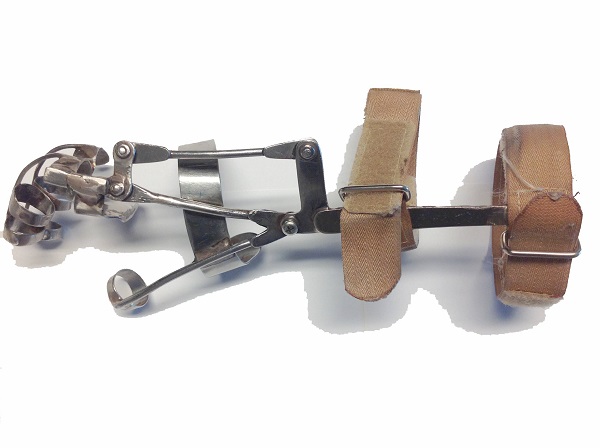
My Hand Sprint Custom Built for Me in 1964
Photo by Beh 2022
Letting Go
“Do not go gentle into that good night,
Old age should burn and rave at close of day;
Rage, rage against the dying of the light.”
–Dylan Thomas–
I am no poet of the caliber of Dylan Thomas, but I am here to rage against the idea, while idealistic, it’s not realistic for most of us who face the loss of function. Not that which comes to most with aging, but remarkably, with up to 40% of the population with some form of disability long before we reach old age.
When you have a traumatic loss of function like I did at 20 years of age, the immediate thought is that you will get better, thanks to the natural process of healing. Almost universally, when healing does not bring about the desired thoughts or goals, such as “very soon, I will walk again,” depression follows.
I was lucky to be born into a loving and hard-working family. I also had a twin brother as a constant companion and supporter of my leadership of him. I was the instigator, always looking into new adventures, and he was the follower who helped me carry out whatever we would do. From the very beginning, I was very independent. Roger and I often took under our wing neighborhood kids who didn’t fit in well. But they were accepted by us for what they could offer and did. Everyone was talented, one way or another, and I intuitively knew that and helped them flourish their own way. With Roger, sharing became natural. Sharing with others often followed.
I also had, probably because of the way my parents behaved as a good example, no inclination to ever ridicule or bully anyone. Especially, if they were born with some malady that made them different or apparently weak in some way.
Although I was always small and skinny growing up, physically I felt unhampered by anything and would always take on challenges that were safe, but often what other kids couldn’t do. Like hanging from a bar with my heels because I didn’t have enough strength in my feet to hang from my toes like my dad could.
I always laughed at lessons that people took and basically learned many things like baseball, football, fishing, swimming and other highly physical activities by simply observing others and never having to wait on doing them. Like getting up on the water the first time I tried waterskiing and going for the highest run the first time I tried snow skiing.
I never was the best, and accepted that, but I was good and confident and that was all I needed to be happy with everything that I accomplished, both physical and intellectual, like my school grades. It wasn’t until my junior year in high school that I got serious about studying to go to college. Before that, I didn’t really have to study to do well in my classes.
My parents taught me never to leave things undone. So, I always took care of things right away, rather than procrastinate, the word I learned in eighth grade English class after reading about Oedipus, The King.
Roger and I always got things done quickly that were required, so that we had plenty of time just to do whatever we wanted to do without worrying about whether we would have an assignment done the next day or something we had promised for someone and not finished. I learned early not to promise something I couldn’t do. Therefore, I experienced very little failure.
In my junior year of college, I was riding high on a very good grade point average that ironically would only be mediocre today. Thanks to grade inflation occurring everywhere by professors wanting to be teacher of the year.
After the first week of school, Roger and I had towed our 1935 Ford hot rod to school, and I was already working on it in an automotive repair class that I took. That first weekend, another student and I had our girlfriends come from our hometown for the weekend. That Friday night we were going to go to the street dance.
Always early, when we arrived at the street dance, no one was there. But my hot rod was parked half a block away, so we decided to take a ride. A mile away, doing about 80 mph uphill as it turned dark, a 16-year-old, driving a panel truck, pulled out in front of me and I slammed on the brakes. The rear of the hot rod came off the ground briefly, as the rod slid to the left across the road in front of a frightened woman coming in the other direction and then off the road sideways until both wheels caught in the soft dirt of the shoulder and we began to roll – over and over and over again.
On the last roll my leg caught up under the dashboard as the car passed over me, my mouth tasting the grass in the space afforded me by the open door the car was rolling on. Left sitting up, I watched it land on its wheels and roll backward a bit down the slope. We were all lucky not to lose anything except time as we got stitched up and the bruises healed. A month later, my girlfriend left me for someone who probably promised to marry her. I hadn’t, and I let her go quite easily, innately knowing she wasn’t for me.
During the Thanksgiving break, I left college early to check into the hospital for exploratory surgery to find out why my left arm and Hand were weaker. A myelogram showed something wrong in my neck’s cervical spinal cord C4-C6 that needed to be diagnosed and repaired if possible.
Thanksgiving Day in the morning, the neurosurgeon sat with my parents and me and told me there was a 10% chance of death and perhaps a 50% chance of some paralysis. But he felt that the problem needed to be corrected, or I would get much worse.
During the operation, I was sitting up in a metal frame. I received too much anesthetic, and my blood pressure dropped to the point where I wasn’t getting blood to my brain. The neurosurgeon removed the frame, lowered me down with my spinal cord exposed. Once my blood pressure had returned, he stitched me back up and ended the operation, checking briefly with me to see if I was okay. I remember saying to him something like, “Yes, I’m okay.”
But I wasn’t okay. I woke in a hospital bed feeling only a tightness in my neck and nothing else from my shoulders down. It must’ve been the morphine, but I felt no pain. I felt rather upbeat when talking to others but couldn’t sleep for about 20 days because if I tried to sleep, I’d fall backward into an accelerating spin where red circles would roll over my body. And then, what was left of my rapidly atrophying arm and hand muscles felt like I was sticking both of my arms into barrels of biting ants for three or four days.
Fortunately, my legs came back without that kind of torturous irritating pain. So did my bowel and bladder function, although they never were the same as before for a healthy 20-year-old. I had just reached the end of my final growth spurt to 5 foot 8 inches, too. Also, in my favor – becoming a paraplegic who didn’t have to be in a wheelchair – but still stigmatized for my apparently useless arms and hands. In the beginning, I thought they were, too. I had to relearn their capabilities as function gradually came back.
Strangely, probably because I was used to accepting my fate when I didn’t get what I wanted, I immediately let go of my ideas to become an architect, an astronaut or both. Thinking they were no longer within my grasp. I knew I would have to settle for something less. Unlike Dylan’s rage, I only wanted to go back to college. But how? I couldn’t write and that bothered me. Never being able to hold a pen or pencil in my hand and write or draw so easily like I had done before.
I focused on adapting instead of whining about what I lost or hoping for what I knew would not come back. I had some grip in my permanently, clenched in a fist, left hand. I was always right-handed, but I found that I could hold a fork or a spoon in my left hand and feed myself. Something I started to do right after getting out of the hospital. Also, with my right hand where my fingers were permanently unable to squeeze anything, by raising my wrist, they would close enough so that I could pick up some things that were light or they would just fall out. I came up with ways of operating switches, cranks, door handles, screw on tops, and almost anything by adapting the way I used my hands to get it done.
At my parents’ farmhouse where I had my mother, my sister and my grandmother to help take care of me, I started taking long walks down to the river to contemplate my future, bleak as it appeared. I found my sister’s unused medium sized, balloon-tired bicycle in the shed and found that I could ride it. A little shaky at first, but there was no way I could swing my leg up on a full size male bike, or ride it for that matter.
Later, I started trying to use the minibike Roger bought and found that I could start it and ride it with some trepidation at first. One time, I remember hitting a bump on the black top road to the river and my hands came off the handlebars as the minibike fell out from under me and I went over the handlebars to my feet. Miraculously, I caught my balance and didn’t take a tumble.
In April, the farmer that owned the land had plowed some fields and needed to have them dragged. He asked me if I could do the job. With my neck brace on, I climbed up on the brand-new Oliver 6. I couldn’t operate the throttle or shift gears, but I could use the brake and clutch with my feet and steer with the power steering. So, he set the throttle at a reasonable speed, about 15 mph.
Once I started the engine, I would use the clutch in second gear to take off from a dead start. Sometimes, the front end of the tractor would rise off the ground four or five feet, before taking off downfield at a rather fast pace. I finished the job in short order, and he paid me. It gave me confidence that I could at least work for money again, driving.
I couldn’t drive my 1957 Ford Fairlane 500 because it didn’t have power steering. So, I put it on the front lawn for sale. I found that I could drive my grandmother’s 1956 Buick Super, and she asked me to drive it occasionally when we took trips that summer. My neurosurgeon was afraid of my neck and told me that he would, “take away your license.”
Instead, I took another driving test with my grandmother’s Buick and the driving tester just chatted with me until the test was over, confident that I could drive just fine. But he restricted me to eyeglasses, power steering, power brakes and automatic transmission. I found that on most cars of the 1950s era, I could operate all the switches and knobs quite easily before they began to become recessed and harder to reach.
So, I was finding ways to gain function back and become more independent at a time when all my contemporaries were becoming independent of their parents and going out on their own. I was gaining, not losing, but still wondering how I would get back to college.
I spent three weeks in the University Hospital in Madison where little was done to improve my situation or outlook until a neurosurgeon there sent me home. But in August I was sent back to Madison where a skilled prosthesis craftsman made a stainless-steel hand splint for me that enabled me to hold a pen tight enough and steady enough to write and draw again.
With some federal rehabilitation money to pay for my tuition, rent a room, pay for my meals and get me an electric typewriter that I could type with my right thumb made rigid by the hand splint, I returned to college in the fall of 1964 with my twin brother doing almost everything for me, including filling out all the registration forms we had to do in those days before computers.
During my first course, I began to write and after that typed all my homework papers. I made special arrangements during classes like physics that required a lab session to work with a lab partner who did the physical parts, and I did all the paperwork parts.
For laboratories that required extensive physical involvement like my earlier auto shops, my advisor, the head of the department, substituted with independent studies that I found very helpful in my education beyond my degree in industrial technology. I learned more about how to do research and then write from my research.
A year and a half later, I completed my Bachelor of Science degree with high distinction. Unable to do the physical work my twin brother was doing, I wrote 60 schools about getting a master’s degree and started at the University of Wisconsin until I received a fellowship to Stanford.
Up until that point, I took a room or joined a roommate, unsure that I could do everything by myself without any help from others. But in the spring of 1967, I got my first apartment by myself and was cooking my own meals because restaurant food was not as good as I could cook and much more expensive.
By 1971, I rented a house with an option to buy. But I left that place to get a doctorate in education at West Virginia University. Graduating from there and working for a year at Marshall University in Huntington, I returned to WVU as the coordinator for research for the Program for the Study of Technology. I bought a small cottage to live in. By 1980, I designed and built a solar passive home in Atlanta. But in 1981, I had left Atlanta and was working in Houston, married to a high school classmate that I met at our 20th reunion.
That was the peak of my progress toward becoming totally independent and totally fulfilled both in career and family life. For the most part, I was just passing for normal. In the 20 years since my initial paralysis, my condition had gradually deteriorated until I was limping heavily and having more problems with bladder and bowel functioning. Making it more difficult as a professor and researcher requiring a lot of travel and involvement with the research community.
I knew I had to give up functions as they came along. There was no “raging” against it. I found that I could use what I called, “just in time technology,” like the rubber tiered bottle opener of all sizes that enabled me to remove the tops of all kinds of screwed on jars and bottles. Often by gripping the container between my knees and bearing down on the top while turning with both hands. I also modified my comb by removing three or four teeth on the small end. Giving me a convenient hook to grab my zipper and pull it up when my left fingers could no longer do the job.
During the summer of 1981 when I got to the lake where my parents had a cottage, I bent over to get something and almost drowned in about a foot of water. Balancing on my elbows and knees to keep my head from going under. I got back up, but I could see my dad watching from his lawn chair to make sure that I made it.
It was then that I decided to give up swimming. When before I had swum like a fish both above and below water, I could no longer even blow up a balloon because my lung capacity had dwindled, and I could no longer hold my breath for very long. As a substitute, I found an old inner tube with a slight leak and paddled all around the lake. At home like a turtle both above and below the water’s surface getting a very nice sunburn.
By 1985, my left foot was dropping down, wearing out my shoe and causing me to trip often as well as limp. The solution was a plastic insert prosthesis strapped to my leg and placed inside my shoe. The 90° turn at the shoe heel kept my foot from dropping but gave me a sliding gait. Shortly after, I was at some place where I was on the second floor and there were metal edges on each stair step for traction. The sliding motion of my left foot had my heel catch on the metal edge as I attempted to step down and I teetered at the top as I heard a loud crack trying to regain my balance. Fortunately, I did, but the prothesis had broken in half. I got a sturdier one and that lasted me several years while I could still walk. It also acted as a shoehorn making it easier for me to force my foot into that left shoe.
Also, by 1985, I had to give up mowing my lawn, pruning my trees, and weeding my flowerbeds. At first, I hired a young high school student and later just hired those ubiquitous yard maintainers. While I still enjoyed cooking, when I would heat up my pre-prepared food in the microwave and carry it upstairs for the evening, I would often burn my hands from the hot plastic plates. At least, they rarely broke when I dropped them. Doing dishes became onerous even with a dishwasher, so I began leaving dishes to be done on Saturday morning. The same with house cleaning, getting more difficult all the time.
By 1990, I was using my office chair at work and home to get around and found that walking required me to have a hand on a wall because I couldn’t use a crutch or any other way of keeping my stability, except perhaps, a walker. I was falling regularly and had many stitches, perhaps over 200 in my forehead when I would fall face first and my glasses would break, the plastic lens cutting me, requiring stitches.
One time, I fell from the second step from the bottom to my living room carpeted floor over concrete and fractured my eye orbit. At least three times I tripped and flew entirely across the room punching a head mark into the sheet rock that softened the blow. I never lost consciousness in all those falls.
It was also 1990 when I went for my annual checkup with my rehabilitation doctor, and she strongly suggested that I give up walking and get someone to help me in the house. I started using a scooter at work and still used my office chair at home, until 1992 when I knew I had to let go of my independence. I ordered and received my first electric wheelchair. But there were a lot of obstacles to remove.
In the summer of 1992, I received some money for three months of attendant care. I hired a plastic surgeon from Ecuador, who was invaluable in helping me do things I had neglected, like go through all my papers and prune the overgrown tree in the front yard. She helped me immensely, morning and evening, with getting up out of bed, dressing, and then, giving me breakfast and getting me off to work. Coming in again and preparing my evening meal and making sure that I would go to bed safely and comfortably.
I also hired a premed student in his senior summer on his way to medical school. He built ramps for my wheelchair to enter the house in the front and to leave the house in the back. He moved my office in an upstairs bedroom down to my large bedroom on the first floor. His father and he installed a wall television and he installed a pool Hoyer lift by my bathtub because I could no longer lift my legs enough to get into the tub to take a shower. Taking a bath had been impossible for some time unless I had fallen and couldn’t get up – a famous phrase, but very real for me. I still don’t have a medical alert system. I call 911.
I had to let go of being totally independent and allow others, under my direction, to do things for me that I needed done so that I could continue to go to work and earn enough money to pay for them. I had to trust that they wouldn’t abuse me or steal from me and that was true . But tended to be untrue with several of the tenants acquired to rent the room upstairs where I could no longer go. I had to evict two of them and throw another one out for pilfering. I was much luckier with caregivers.
For almost every aging person, we reach a time in our lives when we can no longer take care of ourselves. Unless of course, we die before we become unable, disabled by injury or disease. I was doing all this before becoming aged, because my spinal cord was aging, and I was routinely losing spinal cord neurons that would never grow back.
Even with the promise of stem cells that never worked out for spinal cord neurons despite valiant effort to make them work. But there is promise on the rise for reversing spinal cord injury using the newer method of DNA editing called CRISPR.
On my seventh hire in 1992, it was a woman who had recently arrived from Vietnam, lived only a block away and was willing to do all the work that I needed in exchange for learning English and almost everything about living in the United States. Beh’s expertise was altering clothes, so she got a job right away in a bridal shop. By 2001, she had opened her own dry cleaning and alterations business. That was 33 years ago. She is now my trusted partner in everything, and her business is very successful unlike other businesses like it failing.
As I drove home from work for the Holidays in 1995, I realized that I could no longer safely drive my unmodified 1973 Monte Carlo. It was one of the biggest let goes of my life, having driven that car over 500,000 miles between both coasts and across the northern and southern borders. I taught Beh to drive it, and she did for a while, before I gave it to my nephew, and she bought a trusty Corolla.
But just in time, Metrolift, for the wheelchair bound and other disabilities, finally reached out from downtown to my house and I could take it to work. But the times of pick up were often too early and with other riders coming and going, I was often late for work.
Fortunately, a combination of Ford and Chrysler motors creating competing minivans, companies springing up to convert them into carrying wheelchairs, and other companies creating highly modified controls so that a person with almost any kind of physical disability could be fitted with custom driving controls. Even individuals like me, who could no longer drive, could drive again.
Just like the stainless-steel hand splint had allowed me to write again, a special state law using funds from drunk driving fines, paid for the expensive custom controls made only for me to drive again. These controls were zero pressure for steering and greatly enhanced for throttle and brake, and operated with only my paralyzed arms and hands, strapped and locked in my wheelchair. Some minor functions were done by head buttons. All that was required was a month of training to learn how to drive with this very sensitive steering that didn’t forgive small mistakes and required total attention to stay on the road.
But I was fully able to unlock the van, lower the ramp, wheelchair into the lowered van, wheelchair into the drivers’ side and lock in after securing my chest belt and having the van belts come into place. A panel on my right enabled me to start the van, shift gears, and set the climate control and other functions, like retrieving the ramp and closing the door. I was off driving again in all kinds of conditions as well or better than I did before I quit driving.
Along with losing my ability to walk, bend down and sort through papers, my personal and office filing systems had to be done by others. And without good help at work, often got terribly out of order, making it harder and harder to do my work. But I didn’t complain, I just accepted it as a part of letting go.
I had been familiar with word processors since I’d done my doctorate in 1973 and used the first word processor on a mainframe computer, WYLBUR, for 100 pages of my dissertation data. I also had used my secretary’s Scientific Atlanta personal word processor for my papers while at Atlanta University in 1979-80.
In 1987, our computer director gave our department a Macintosh SE and a printer. An assistant that I had wanted to use it to do our work, so I let her and gave her work to do. When she left employment suddenly without notice, I took the computer to my desk and quickly learned how to use it on my own. Soon, I was ordering computers like it for our entire staff, setting up a network for email and printing, and dragging everyone in our department, including our vice president, into the personal computer age.
Where I had given up filing my paperwork before, I was the very first to go paperless and only printed when I had to send something by snail mail or required a signature. It was very easy to file all my paperwork on the computer in a well-organized and easy to find fashion. Later, when someone would call me from the rest of the university or a state agency wanting to know some information, I would easily be able to go to the computer, locate it and give them the answer they sought by email, the phone, or print something that could be delivered to them that they could use for their work.
Computers were enhancing my ability to work rather than just helping me overcome letting go. I acquired an object-based data system and soon had it doing many functions for me, including creating forms, charts and graphs. Stuff used for convincing PowerPoint presentations.
But typing with one finger with all the mistakes was too slow and I saw a dictation solution in 1993. Immediately, I learned the benefit of dictating from the software I obtained from a small Canadian company. In addition to memo and email writing, it enabled me to enter data into Excel spreadsheets and data entry forms with my voice without having to use the number keyboard. Each new system got better in some ways and worse in others. For example, I never found a dictation system that could enter numerical data into Excel as well as that very first system I tried.
As I lost my abdominal muscles keeping me steady and vertical, it became harder for me to write or type, and I lost my ability to write my signature by 1998. I scanned it, but have not used the scanned version very much, sometimes just scribbling whatever comes out. Once again, letting go of one of the most important features of our identity, our signature. With power of attorney, Beh signs for me in most cases.
It is fortunate if someone can retire before age requires them to. I was fortunate enough to work for 60 years until I was 69 and most willing to let go of the routine my work life had become rather than the much more responsible positions I had held earlier.
To fill the endless hours of retirement, I didn’t go the usual route of playing golf like by twin brother and father, hanging out with friends, or joining any clubs, building a workshop or some other hobby. I just started writing fiction from my rich life experience and occasional stories, articles and books from my life like this one. I wasn’t letting go, I was just moving in a new direction that I found very rewarding because I was totally in charge. And, I didn’t have to meet any deadlines or follow any procedures required by the job.
But aging continued, and as I lost reach, stability, and the ability to stand briefly for transfers with my caregivers, I had to accept the alternative, like using a Hoyer lift for transferring. Eventually, I had to give up feeding myself, except at noon where I just have vegetables that are easy to pick up. My reach and the cramped position I had to sit to drive by 2017, told me that it was becoming too dangerous for me to drive that sensitive steering anymore. So, I let go of driving for the last time.
I’ve always been comfortable being alone, so when I left work and all those people there, the fact that they rarely came to see me or that I got to go and see them after I retired was not a problem. With my writing and my connection to many other authors on authorsden.com, I have been content with only seeing my caregivers every day.
As aging takes more of my function away, I look forward to gradually giving up more and more of what I do as time progresses. But the benefit of living longer and living in the 21st-century rather than the 20th, is that the promise of more and more user-friendly technology for the convenience of everyone, like a personal android caregiver, will become a way for disabled people to continue with lifestyles unimpaired by their disability. Basically, the cyborgs and superheroes of fiction today, reality tomorrow.
Copyright 2025 Ronald W. Hull
6/2/25
See My Autobiography: Hanging by a Thread











Thank you,
Myra :)