VISIONS OF SANTA FE
bY H.J. Cruz
I know of no other place in the southwest that can match the history and mystique of Santa Fe New Mexico, which I had the pleasure to visit recently. Unfortunately as I blew into town so did a few twisters. One touched down a few miles from where I was camped, tossing my little camper around like a ship in a gale, but the town was spared and the locals could not recall such an event in recent memory.
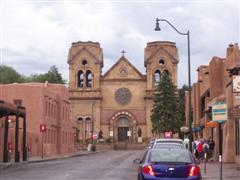
I sought refuge at a Mexican restaurant and poured Margaritas over my tender nerves until my stomach was primed for the fiesta. Upon my recovery I took to the streets of the old market square and marveled at the old churches and countless curios boasting southwestern folk art and Native American wares by the score. Santa fe is an urban artist mecca with a flavor not found in other big cities; it’s drenched in sagua fair and cries tears of ancestry with profound images swathed in contemporary consciousness.
The clouds soon gave way to a mellowed evening sun causing the creatures of the air to belch in favor as sweet pungent aromas engulfed me. Natures powerhouse, the rain starved foliage of juniper, cedar and pinion, along with a myriad if blossoms yet to be defined. Although the culture seems diverse at a glance, upon closer introspection it’s obvious that the U.S. may have won the Spanish American war in 1847 but no one bothered telling these people, for the gwaylo is still an outsider in this clickish town; sort of like certain parts of the south where they still haven’t gotten over loosing the Civil war and still refer to you as “Yankee”. But they’re tolerant enough when taking your money.
I’m sure the early Spanish were treated the same way for a few hundred years after they took it from the local Indians. Rumor has it that this area had been fought over by several tribes since the stone age, so saying it’s the oldest town in the U.S. doesn’t give it the credence it deserves. After the Santa Fe Trail opened in 1822 it became the main portal to the west twenty years before the Oregon Trail. Huge Conestoga wagons laden with trade goods, pulled by twelve team oxen braved the ravages of 800 miles of Pawnee, Cheyenne, Arapahoe and countless swollen rivers, wolf packs and long delays from buffalo herds that took the majority of the day to pass. If you made it over the first desert or mountain pass you were badgered by the Kiowa, Comanche or the crafty Apache.
The early fur companies in search of the coveted beaver pelts also came in droves, having great rendezvous inland with provisions to outfit a hundred trappers for the long season; those rugged individualists who risked life and limb to make a killing in the once abundant beaver habitats, when pelts fetched hefty prices for the fashionable top hats being worn in London and Boston. They made Taos a favorite winter lodge, but as the beaver played out in the Louisiana purchase they began trapping in the mountains, being constantly accosted by Ute, Crow and Blackfeet who took horses, pelts and lives frequently, and if this wasn’t hazard enough, one always needed to keep an eye open for Grizzly, the craftiest killers of the mountains. The meek may inherit the earth but in the early west they were open game and seldom survived. This was the time of some famous mountain men like Kit Carson, Jim Bridger and Dick Wooten.
It was a time of innocence and discovery for both white man and Indian alike as both learned of each others ways by counting coo (enemy dead) or trading. Many a trapper traded heavily in horses, pelts and skull varnish (cheap whiskey) for the squaw wives who could make a lodge in minutes and clean pelts without complaint.
I can go on and on about this time period because it has always been a favorite of mine, mainly the short twenty year period between 1820 and 1840, the wars were more like skirmishes and it had always been the way of the land to weed out the ignorant, control the populations and keep them strong. The 1840’s brought the decline of beaver, the popularity of buffalo hunts, the Great Plains Indian wars and the Spanish American war. The discovery of gold in California late in the decade became the catalyst for rapid change and within twenty years their would be genocide throughout the west and it would become just another piece of the monopoly for the great white chiefs in Washington. Yet Santa fe, even amongst it’s own internal struggles somehow survived it all, as if the hollowed ground added fertilizer for the deep roots of resistance; as if keeping greedy gwaylo at arms length slowed the chameleon of change. One can only guess.
H.J.Cruz
6/16/07




If I was to move out of Texas
I want to live in Santa Fe
Its more beautiful and inspiring place I ever been to!!
I know about that carpenter Oh those spiral stairs
Are just out of this world!!Your words have captured perfectly
That magnificent beauty and spirituality of this place!!
Outstanding Job!!
Love Peace And Happiness to you my friend
Your Friend..Yolie that's my christian Name