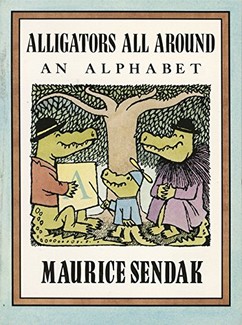
Maurice Sendak’s Alligators All Around: An Alphabet featuring three young alligators is a schoolroom picture-perfect alphabet book.
Each letter displays the alligators accomplishing an activity, such as C- catching colds, D- doing dishes; E- entertaining elephants, G- getting giggles, H- having headaches, J- juggling jelly beans, M- making macaroni, N- Never Napping, O- Ordering Oatmeal, P- Pushing People, or R- riding reindeer, T- throwing tantrums and W- wearing wigs. The book is appealing, child pleasing and alligators or not is not at all alarming.
Maurice Sendak presents an amiable family of three alligators busy carrying out various daily life situations. Alligators All Around: An Alphabet, a work of approximately 60 words text, is not a predictable A B C account. Osage County First Grade likes it.
Each letter is represented on a single page where reader’s see tri-color images shown in boxed panels. Restraining himself to tints, shades, and hues of yellow, blue and green Sendak's matchless practice comes through. Illustrations are pretty simple.
The three toned imageries cause these somewhat peevish critters to be regarded as pretty endearing. Mom, Dad, and The Kid are jam-packed with appeal; the combined artworks engender a full view of the at times, goofy; while pretty familiar family. One way or another, these affable critters capture the eccentricity and peculiarity of human nature better than many other critters might.
Author/Illustrator Sendak is an author who really understands how Little People’s minds work and he knows just what pleases emergent readers. My students have always been captivated with artworks having no backgrounds, the visuals display the alligators doing what it is they are doing, like wearing wigs, or never napping.
The faces revealed all through the book are unrestrained and vibrant: never more so than the catching colds drawing. We see both grown up and child alligator bathrobe clad, hot water pacs atop their heads, enfolded in scarves and the youngster grasping his tissue. Much class dialogue results viewing the page; particularly during the cold/allergy season when we are all stuffy, sneezy and snoffly.
The alligator parents expose a bit of –wild things-. Max the alligator child appears as he tramps across the pages. It is an effective and child friendly technique. The alligators are regularly depicted standing upright, akin to humans; grasping something in their hands and with their spiky tails sprawling behind. Osage County First Grade does not find the alligators to be the least bit intimidating.
Little Learners and Teacher alike enjoy Writer/Illustrator Sendak's alphabet employing pleasurable terminologies and interesting artworks to epitomize letters and sounds. As a teacher I like that Sendak discloses that some letters have more than one sound. Three dissimilar sounds illustrate letter A- alligators all around. Two sounds are portrayed with U- usually upside down.
Osage County First Grade as well as little Learners where I now volunteer to read to Little People now that I am retired from the classroom likes these alligators doing all the things alligators do.
Alligators All Around: An Alphabet is one of our favorites. Happy to recommend for classroom bookshelf, school and public libraries, for their room bookshelf of Little Readers. This is a nice selection for gifting a special child, or for child to gift teacher and fellow students on first of the new school term.
===================================
Reviewed by Molly Reviews BOOKS molly martin
===================================
AMAZON ABOUT THE AUTHOR Maurice Sendak’s children’s books have sold over 30 million copies and have been translated into more than 40 languages. He received the 1964 Caldecott Medal for Where the Wild Things Are and is the creator of such classics as In the Night Kitchen, Outside Over There, Higglety Pigglety Pop!, and Nutshell Library.
In 1970 he received the international Hans Christian Andersen Medal for Illustration, in 1983 he received the Laura Ingalls Wilder Award from the American Library Association, and in 1996 he received a National Medal of Arts in recognition of his contribution to the arts in America. In 2003, Sendak received the first Astrid Lindgren Memorial Award, an annual international prize for children’s literature established by the Swedish government.






Ron