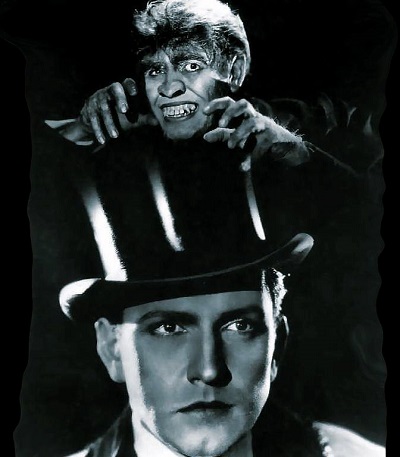
I’m not so sure about that. It seems to me that we all deal with inner conflicts, including conflicting desires. Some of the things that we want make it impossible to have other things that we want. And so we end up choosing between them. Some of us make those choices consciously. Others make them without realizing it.
Now I’m going to ramble a bit about some things that I believe. There are a few of you here who know me as a free-thinking philosopher and observer of human nature who’s major influences are Stoicism, Epicureanism, Buddhism, Freud, Schopenhauer, and Thoreau. Those who aren’t interested in that sort of thing should ignore this post. (I may eventually end up deleting it anyway. I’m not at all certain if it’s a good idea.)
Most of us have been brought up to believe that our primary inner conflict is between good and evil. I’m sure you’ve all heard the story of the white dog and the black dog, and that the one who wins is the one that we feed. I personally don’t believe that it’s as simple as that. (That type of thinking is mostly the result of teachings passed down from primitive cultures. By now we should have a better understanding of human nature than that.)
The primary inner conflicts that we deal with are these:
2. Conflicts within the id (that part of our psyche where our desires come from). These include conflicts between our individual desires, and conflicts between our primary motivational instincts: Eros and Thanatos.
Before I go any further I should mention that although I’m using Freudian terminology I don’t always define my terms exactly as Freud and his followers did. That is especially true in the case of Eros and Thanatos. So I’m going to take a moment to explain what I mean when I use those terms.
I believe that we have two primary motivational instincts which are the source of all of our desires, and that these instincts are often in conflict with each other.
From Eros comes our desires for survival and pleasure. (This is roughly equivalent to the Buddhist concepts of kama-tanha and bhava-tanha.)
From Thanatos comes our desire to avoid pain and suffering. (This is roughly equivalent to the Buddhist concept of vibhava-tanha.)
One might think that the desire for pleasure and the desire to avoid pain would always be in agreement, but that is not the case. From Eros comes our desires for adventure and excitement, while from Thanatos comes our desire for serenity, safety, security. Under the influence of Eros we are willing to risk the chance of pain for the sake of pleasure. Under the influence of Thanatos we are willing to sacrifice pleasure (and sometimes surival) in order to avoid the possibility of pain. This is the source of much of the conflict.
I used to think of Eros and Thanatos sort of like factions within the id struggling against each other. I’ve come to realize since then that the id isn’t organized like that, nor at all. Our individual desires operate independently of each other. (Under the influence of the desire to eat we might walk through fire in order to obtain food. The desire to eat doesn’t care anything about the desire to avoid being burned. It’s only after the development of the ego that we know to walk around the fire to get to the food.) Now I mainly find Eros and Thanatos useful for categorizing desires according to which motivational instinct they sprang from (like a taxonomic system).
That’s all I have for now. I have a lot more to say but I need to think about which direction I want to go next.
(I wrote this intending to post it on Facebook. I ended up deciding not to.)
The Great Dichotomies (an addendum)
Always the conflict between the desire to reveal and the desire to conceal.
From Eros comes our desire for Intimacy (the desire to reveal).
From Thanatos, our desire for Security (the desire to conceal).
Sometimes my desperation is not so quiet.
Sometimes my desire is too strong.
The heart wants what it wants, but I know what I have.
I know I'd rather be with her.
And, the constant struggle between two sides of me:
"I saw a beggar leaning on his wooden crutch.
He said to me, 'You must not ask for so much.'
Then a pretty woman leaning in her darkened door.
She cried to me, 'Hey, why not ask for more?'"
There is one other that may puzzle some people
The trail of les papillons leads to Bozo's last gasp.
But, to understand it, one must first understand .
the message of each page along the way.
Our Primary Inner Conflicts (another addendum)
Here I list our two primary inner conflicts and their various technical and literary representations,
including representations which are often found in my poetry and articles.
(These may help you to understand various things I have written.)
1. Id vs. Ego (two of the three components of our psyche)
Child-self vs. Adult-self
Heart vs. Mind (or The Heart vs. I)
The Pleasure Principle vs. The Reality Principle (Freud)
Mr. Hyde vs. Dr. Jekyll (Robert Louis Stevenson)
The pretty woman in the darkened door vs. The man on the wooden crutch (Leonard Cohen)
Romanticism vs. Stoicism
belief, Love comes from the Mind. It is the Desire for Pleasure, Kāma-Taṇhā, which comes from the Heart.)
(I sometimes use the word Lethe instead of Thanatos. At other times I use it to represent alcohol and drugs: "those little
The Life Instinct vs. The Death Instinct (Freud)
Bhava-Taṇhā vs. Vibhava-Taṇhā (Buddhism)
(I have often mentioned that our desire for Intimacy - our desire to know and be known by others, comes from Eros,
while our desire for Security - our desire to protect ourselves from others, comes from Thanatos.)
From Cohen's "Bird On A Wire":
I saw a beggar leaning on his wooden crutch.
🧙🏻 He said to me, "You must not ask for so much."
Then a pretty woman leaning in her darkened door.
🤡 She cried to me, "Hey, why not ask for more?"
🧙🏻: Anagnorisis
There are many things that I desperately want.
There are many things that I already have.
How happy I am, at any given moment,
depends on which I'm focusing on.
🧙🏻: Anagnorisis II
Even after you have found the answer,
the struggle continues.
There is always a beggar on a wooden crutch
and a pretty woman in a darkened door.
🧙🏻: Accipio res ut sunt. (I accept things as they are.)
🤡: IL CUORE VUOLE! (The heart wants!)
Am I Bipolar?
(There are times when I am satisfied with life -
when I recognize that I have what I want most,
and other times when I think of killing myself -
when I wish for things I want but cannot have,
or worry about what's happening to the world.)
🐁....
Bozo became more and more disappointed
as the years went by. His dreams died
and no one cared, there was little romance
in his life, and he had no one to talk to.
But Roger, he just learned to accept it.
He learned to accept that he was alone
and that no one was interested in him.