This little poem and article expose the main problem in life and will be the theme of a follow-up book to "You Can Have Your Cheese & Eat It Too."
Birth of The Terrible Twins Within (Our Dualistic Minds)
By
Bill Cottringer
“If we never experience the chill of a dark winter, it is very unlikely that we will ever cherish the warmth of a bright summer’s day. Nothing stimulates our appetite for the simple joys of life more than the starvation caused by sadness or desperation. In order to complete our amazing life journey successfully, it is vital that we turn each and every dark tear into a pearl of wisdom, and find the blessing in every curse.” ~Anthon St. Maarten, Divine Living: The Essential Guide to Your True Destiny.
What to Do?
Have this, want that,
Am here, need to be there;
Words are words,
Things are things.
No real connection alone,
Except when rejoined,
From mind to hands,
Somewhere in between.
In stillness and silence,
A hidden truth un-hides,
And finally makes sense;
Words are words,
Things are things,
We live in between,
Where we already are;
Work being play,
Ugly being beautiful,
Unhappiness being okay,
The divided mind,
Unifying fact,
So we have what we want.
Now let me take a feeble stab at speaking the unspeakable in uncovering the main problem in life and its only solution, with the very things that created the problem itself and keeps us hostage—words. Human beings seem to be the only owners of the gift and curse of self-awareness. This added ability to be able to separate ourselves from our direct experiences and think about ourselves in relation to these experiences causes all sorts of problems. For example, animals just experience pain, fear or hunger, but humans can become afraid of pain, fear and hunger, and even fear fearing those things and feeling bad about that all, ending up being caught in a vicious circle to nowhere without any energy left over to escape.
How did such a mess develop in the first place? Before we invented language, we just experienced things though the senses, mainly seeing them with our eyes, hearing them with our ears, tasting them with our tongues or sensing them with our bodies. Things were just different with no quality judgments being made that words later created. But the main sense we had from the very beginning, is that the objects we were seeing, hearing, tasting, touching or sensing were separate from us and our eyes, ears, tongues, fingers and body’s doing the seeing, hearing, tasting, touching and sensing, separated by a distinct space. Eventually, we started noticing things being extremely different from each other, like what we now call up and down, night and day, hot and cold, sweet and sour, and rough and smooth.
At some point, the mysterious development of language came along and we started inventing words to stand for the objects we couldn’t carry around, show others or otherwise just experience firsthand. These words pointed towards the objects like a finger would do to make the experienced object become more real and materialize in our awareness. We probably should have stopped there with putting so much abstract space between the objects and the words we named them with for easier recall when needed. But no, we went on to put another level of abstraction in between, by inventing more words to define the original words further. And then, as if that was not enough hiding of the experiences and objects, we invented private connotations to the words representing the experiences and objects, putting even more distance in between.
Now when we think or say things like I am free or I love you, nobody really has any true understanding of what is actually being thought, said, heard or read. The result of all this is a world of babble, where good communication and understanding are the exception rather than the rule. What makes things worse with all this is the unplanned end result of a dualistic world of extreme opposites in experiences and the words used to represent those experiences, the words used to define those words, and the connotative words that evolve about all that, which end up creating their own new experiences requiring more words and more confusion.
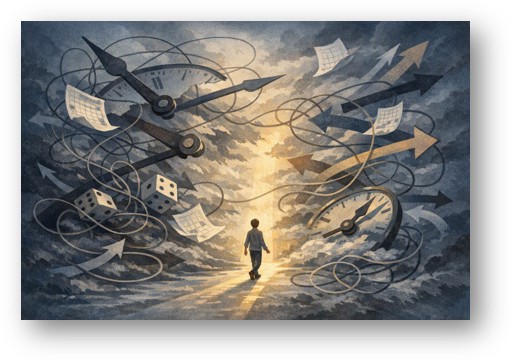
So, we end up chasing after “good” things like pleasure, happiness, safety, success, love, recognition, knowledge, wealth, good looks and so on, while desperately trying to avoid all the “bad” things like pain, sadness, danger, failure, hatred, alienation, ignorance, poverty, ugliness and so on. What has been the end result of giving birth to the terrible twins within our dualistic minds? We have split the world in half, choosing one side over the other and setting up three dreadful conflicts that haunt us for a lifetime: Us vs. life, us vs. them, and last but not least, us vs us. And because we have polarized all the experiences leading to these conflicts, we are trapped inside what appears to be an unresolvable conflict with irreconcilable differences.
Fortunately all this duality and polarizations happened as a little trick we played on ourselves, maybe just to avoid boredom and keep things interesting and challenging. And we won’t rest until we figure out how to solve unsolvable paradoxes we created with our words, such as having our cake and eat it too. The logic about this is, that if we created such paradoxes with words than we can certainly un-create them with different words, especially the extra connotative ones that lock the shackles on our wrists and ankles, and throw away the key.
In my first book 20 years ago, “You Can Have Your Cheese & Eat It too,” I tried to explain how to rejoin the divided self so that one could actually have both sides of the equation—be able to eat you cake and also have some left over at the same time. At this point in my own journey, I am inclined to do a follow-up book—“You Can Have Your Cheese & Eat It Too 2”—to explain how we lose our birthright enlightenment of “wholeness” and how we can heal the terrible twins within once and for all, or at least for the time being. This will take reinventing a new language of word connotations and other words to communicate that, which re-unite dualistic ones. Readers wanting to un-divide their minds can help with their welcome suggestions!
William Cottringer, Ph.D. is Executive Vice-President for Employee Relations for Puget Sound Security, Inc. in Bellevue, WA, along with his hobbies in being a Sport Psychologist, Business Success Coach, Photographer and Writer living in the peaceful but invigorating mountains and rivers of North Bend. He is author of several business and self-development books, including, “You Can Have Your Cheese & Eat It Too” (Executive Excellence), “The Bow-Wow Secrets” (Wisdom Tree), “Do What Matters Most” and “P” Point Management” (Atlantic Book Publishers), “Reality Repair” (Global Vision Press), Reality Repair Rx (Authorsden), and “If Pictures Could Talk,” coming soon. Bill can be reached for comments or questions at (425) 454-5011 or ckuretdoc.comcast.net
|
















They certainly should read yours to understand why they tend to want to polarize everything. I guess that's why we have come to a two-party system of politics. We have real trouble with varying shades of any issue. (Except sex. There we can have at least 50 shades of grey and therefore have more sales of our stupid books) and stupider movies. ;-)
Ron
Thought provoking, compelling read
m