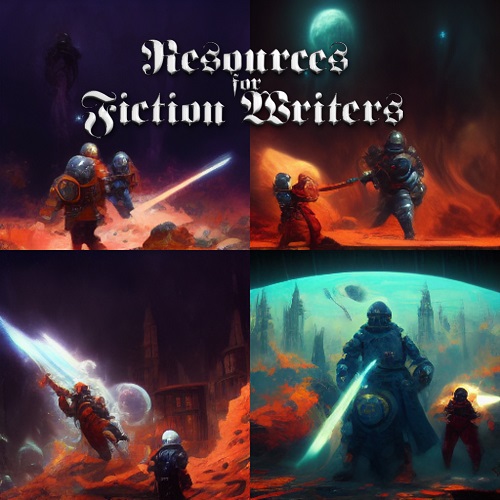
A Christmas present for Author's Den.
I'm only giving out one digital present this year, and it's going to the wonderful folks here at Author's Den.
I know it's not much, but it's the first two issues of my Resources for Fiction Writers blog on Medium. I have it monetized on there, but you're getting it for free.
Happy holidays! [[|:-)
Issue #1
Far away in a land locked in my brain, lies a cache of obscurities and nuggets of knowledge. Far greater in value than any tangible trinket or bauble. A place full of cultures seen and unseen, names forgotten and unheard of. Lore that has yet to be learned and passed down.
A place so mysterious, the source of its knowledge is unknown, rumored to originate from the quanta that surrounds us, and even across the universe from lands that cannot be imagined. A place where wonderment and curiosity never cease.
Okay, enough of the hype. Time to get down to the brass tacks, as they say. This article is the first of many where I’ll be sharing ideas, names, places, spells, etc. Resources for those that don’t have quite the knack that I have for coming up with these things.
My training, so-to-speak, came when I wrote an e-book titled, The Complete Thief’s Netbook, which was for use with Advanced Dungeons & Dragons. It was good enough to get archived on archive.org (https://archive.org/details/thecompletethiefsnetbook).
Later, I would really get into D&D versions 3 and 3.5. I brainstormed so many ideas, but I never compiled them. I would eventually incorporate a lot of these ideas into the tabletop role-playing game I’m designing, and the stories that I’m writing that are based in the game’s settings.
Despite that, I’m a big believer in open source projects. I like the idea of sharing things, and would like to see it evolve into more people brainstorming together to perfect these shared ideas.
More and more, we’re getting to the point to where it’s impossible to avoid using someone else’s word or name for something. I understand that there are infinite possibilities, but within any given lifetime, you will only see and create so many.
Now, before I go any deeper, let’s get to the resources. I’m starting small, but once a week I plan to post one of these articles to help those that struggle to be creative, because creativity does not solely define your intelligence.
Quick note: these ideas are not only for classic, Tolkien-esque settings. I write science fiction as well as fantasy, and a mesh of both.
Abilities
Electrolocation — An innate ability that allows the creature to sense, in some way, the electromagnetic fields given off by most things. This could be in addition to regular sight, but would be most useful in environments where darkness reigns, or maybe even a metallo-botanic environment that helps to conduct these fields so that they are sensed from further away.
Necrotosis — The ability for a creature’s necrotic cells to birth something else, or even a clone of itself. The offspring could be smaller, undead, or diminished in some other way. This could be applied to several creature types, or even a virus that causes zombies and the like.
Names
First Names
Rhyn
Bwenneth
Wendra
Ulgren
Xaygar
Last Names
Hammerfoot
Belgen
Titanson
Lynwyr
tyr Vallon
Place Names
Kylthrea
Tetherwood
Kilnport
Degomere
The Arzhin (insert biome here)
I’m going to end it there for this edition. I hope it gives you a good taste of what I’m capable of producing.
Issue #2
Hello, and welcome to my open source project. A weekly blog where I share ideas and resources for writers of any fictional genre. This includes: names, items, abilities, and more. I don’t expect you to use them verbatim; more like, I at least want these ideas to invoke inspiration.
To clarify, these are ideas I’ve brainstormed specifically for this blog.
“All that is not shared is lost.”
— The Rigveda
Items
Mage’s Friend — A small object made of a magicborne alloy of electrum, silver, and feldspar, that can be of any design. Typically worn as a medallion, this semi-mundane object collects energy data from spells cast by the wearer, even if they’re unsuccessful. During their studies, the mage can go over this data to improve future spells. For instance, if the mage successfully cast several Magic Missile spells, the next one could have an extra missile, or maybe they do extra damage. In the case of an unsuccessful casting, the mage might overcome the same kind of interference the next time they cast that spell.
Great Kilt — Some of you might know what this is, as it’s an actual thing. However, a few years ago, I learned more about their utility as an outdoorsman’s survival item. The highlanders of Scotland are famous for using them, and I feel it’s something that is overlooked in the realms of RPG’s and fantasy settings. I learned about this from a Youtube channel: Fandabi Dozi. Check out his video (https://www.youtube.com/watch?v=YbAKRffKsPs) in particular if you want to know more about the great kilt. He has a lot of other cool videos, too.
Abilities
Necrobiosis — The ability of a creature to cause itself to die, secreting a foul odor, or some other type of deterrent to prevent being eaten. This creature is able to store an electrical charge that can later be used to jump-start it back to life. There should be a period of recuperation, and maybe some binging of nutrients.
Radiosynthesis — The ability of an entity to create the energy it needs to function via the absorption of unfiltered radiation. An example of filtered radiation would be: a sun’s rays going through an atmosphere. This would likely be used by underground denizens that live near pockets of uranium or other radioactive elements.
Creatures
Star Fiend — A type of massive plasma elemental that is berthed by supernovae. They rely on radiosynthesis and are known to camp in orbit of a star’s first planet, lazily absorbing it’s radiation. There is no known maximum size of these entities, and they can become so large as to blot out the sun. They are incredibly apathetic unless agitated, whereby they will release a fury that has no equal.
Orch — An orch is a type of elemental that resembles a will-o-wisp, but is simply an orb of light. They come in a range of colors, and live by photosynthesis specific to fires. The hotter the fire, the more nutritious it is to them, requiring less time to be revitalized. When their light dims and their movement is sluggish, they are hungry. When it dims and flickers, they’re dying. When satiated, their brightness is equivalent to a torch, and the brightness can last for six to eight hours.
Substances
White Powder Gold — Now, this is a real substance, but you may not have heard about it. I mention it, because it is quite an interesting substance with strange qualities, which includes levitation and a disappearing act. It is widely known as, ORMUS, or Orbitally Rearranged Monoatomic Elements, and gold is by far the most widely used. There is a lot of information out there, but here is a link to the video where I learned of it: https://www.youtube.com/watch?v=gLFytyjV7h4
Waterdust — Rumored to be the dehydrated remains of waterborne fae, this dust is attracted to water. Simply throw it into the air, and it will drift toward the nearest source of water. Typically used by miners and tunnelers to avoid digging into underground aquifers.
Names
First Names
Ingawyn
Thelladonius
Brekk
Zeymus
Kalain
Grenda
Dilthwin
Mindra
Flink
Nyrian
Last Names
Dragonfall
v’Dein
Skell
Goldenfield
Braidbeard
Ferenvold
Akka’Kir
Sorrizan
Hammeron
Thiel
Place Names
Uhlal Beleen
Thylkland
Regalwood
Dliwin’s Pass
Ikryl Moor
|





Ron