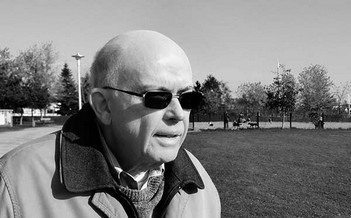
Richard French, click
here to update your pages on AuthorsDen.
Blogs by Richard French
Heart Surgery...Five Novels 4/3/2018 6:14:08 PM
About 6 1/2 weeks ago, I had open-heart surgery at a nearby hospital. The surgeon replaced a defective valve and performed one by-pass.
I stayed in the hospital for a month, much longer than I'd expected, and then spent two weeks at a Toronto retirement residence for what's called respite care. I came back to my apartment three days ago.
During the six weeks I was away from my familiar routine, I was able to work on a novel I'm writing now with the help of a Samsung tablet I recently bought and also read five novels by other writers.
I've had "Prester John" by John Buchan, who also wrote "The Thirty-Nine Steps", among my books for several years and brought it from the shelf to my overnight bag. The story and charcters surprised me. A young Scottish man travels to Africa and becomes involved in trying to stop a tribal war. It's not at all politically correct by today's standards, and I had trouble gettting into it. Later, however, some passages were very well written.
Tom Colson, who runs The Book Exchange in Toronto's west end, brought me "Waiting for the Barbarians" by J. M. Coetzee, a writer from South Africa who's moved to Australia and whose work has won the Nobel Prize.The main character of the novel is a former government official who can't escape a conflict between a brutal government and a band of so-called barbarians who despite living under cruel oppression are actually more civilized than the people with the advantage of power. I found this book not expecially pleasant to read, while the point Coetzee wanted to make about the behavior of powerful empires is unmistakably clear.
The longest book I read was Gore Vidal's historical novel "Lincoln" which a friend named Leif Laakso gave me. I hadn't read any of Vidal's writings, and won't go on a search for another, but this work held my attentiuon throughout. Vidal was a skilled writer, and this novel reminded me of something I've observed sevral times -- that work intended for popular audiences can be examples of high quality. I can't say that I'd join a standing ovation for "Lincoln", however, for by the time I got to the last 50 pages, I finally understood that Vidal wanted to demythologize the 16th American president so that he comes across as unusually capable but still only a Washington politician. I prefer to believe, like many people around the world, that Lincoln had special gifts of mind and spirit that Vidal didn't wish to examine.
The next novel I read was a murder mystery by the British writer P. D. Jsmes called "Cover Her Face" -- entertaining, competent, with a surprise ending I didn't foresee, and unexpectedly memorable, I suspect. I enjoy reading mysteries now and then, and this one has plenty to recommend it. I'd be happy to read another that featured P. D. James' detective Adam Dalgliesh.
I borrowed the last novel I read from the library at the retirement residence - one of Ian McEwan's, another British writer, called "The Innocent". Set in Berlin during the cold war, the story concerns a team of British and American spies and an undergrround facility for capturing Soviet communications on tape. There's also a romance between an unworldly Brit and a German woman. I've enjoyed later McEwan novels more than this one, and though for me it got better in the last chapter, I didn't think it could stand next to LeCarre's stories. I wondered why McEwan would even try to compete with the acknowledged master of cold war spy fiction.
I was grateful for the chance to keep in touch with good writing during the early weeks of my convalescence. It's true the stories I read were about war and murder but there's a vast difference between reading about calamity and taking part in it. Moreover, a good novel can show us that while trouble is part of life, it doesn't rule everything or even blot out good parts entirely.