It is the business of the benevolent man to seek to promote what is beneficial to the world and to eliminate what is harmful, and to provide a model for the world. What benefits he will carry out; what does not benefit men he will leave alone. Mozi
It was a cavernous dining room in an old converted Chinese Restaurant with many of the original square tables crowded with people save one, where sat a grey-bearded old man alone, writing in one of those old general journals in which bookkeepers used to keep accounts.
“Excuse me, may we join you?” asked a rather plump matronly woman who had approached the old man’s table with her twin sister. “There is nowhere else to sit.”
“Of course,” said he, looking up with reddened, tearful eyes, “please sit down, you are quite welcome.”
“Are you a bookkeeper?” she asked, pointing at his journal as the ladies seated themselves across from him.
“This is my diary, ma’am” said he, his voice cracking as if he were about to cry.
“Oh, what is the matter?” asked the other twin. “You seem very sad and lonely. Has something bad happened?”
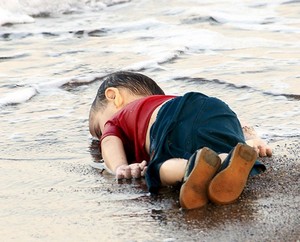
“My family will have nothing to do with me, but I am not lonely, anymore, just facing the end alone, as we all must, and I realized that history is a mistake. It is too late by the time anyone becomes wise to it. I was remembering that little Syrian boy who washed ashore lifeless with other refugees, and my heart became heavy.”
“Yes, that is sad,” said the first twin. I saw that boy on television. His mother and brother also drowned, leaving the father to gather the coffins and weep.”
“It is as if the world aborted that boy, a sign of the woeful end of our race,” said the old man, looking down at his book.
“Come now,” she said, “cheer up, we hear enough of that sort of thing from the fundamentalists who would like to see it happen. Have you ordered yet?”
“No, I have been waiting for the waiter for a long time.”
“He should have at least brought you a glass of water,” she observed.
“There is severe drought, so you have to ask for water although people are literally drowning in floods in other parts of the world.”
“Indeed, it is ironic,” she looked at her twin and rolled her eyes almost imperceptibly.
“Yes, the earth is parched by fire and quakes as typhoons and hurricanes rage east and west.”
“No locusts?”
“No locusts,” he answered, not at all insulted by the facetious question, “but a plague shall wipe out half the world’s population after it is halved by world war.”
“Maybe we should try another restaurant, Jane,” said her twin.
“You know,” said Jane, “I had a professor in college who said that wars are human storms, natural events that can be predicted like the weather, and that some animals naturally make war on their own kind.”
“We are animals,” he pronounced, turning a few pages back in his journal, “but unlike animals we have foresight, the ability to think creatively and avoid doom. In this we have failed, and are plagued by guilt.”
“Therefore the apocalypse,” Jane concluded.
“Exactly.”
“How depressing,” said Jane’s sister, unsympathetically. “You are such a sad old man, sitting all alone here, writing in your old book.”
“Now be nice,” said Jane. “We will feel better with some food.”
“I beg your pardon, ladies,” rejoined the old man. “You asked to join me. There is an old man like me in every age. I was saddened by the sight of the dead little boy, reminded by my own mortality of the fact that history is a mistake leaving much good undone to be done, and if not done, then doom.
“The boy could be the culmination of millenarian migration, a sign that the savior is about to appear,” Jane said hopefully. “It is too bad that the migrants are suffering so along the way.”
“They would not be suffering if those who do not want them now had loved them before.”
“What?”
“If the people who would not have these refugees in their countries now would have cared for them in Syria and elsewhere there would be no refugees. What is required for salvation is universal love.”
“So you are Christian?”
“I am nothing because nothing is permanent. Practical universal love means that we should care for those who are afar as much as those who are near and dear, for, if we do not care for people equally, they may come to burden us as refugees or enemies. We should take up arms, in self-defense of the race, for all people, when they are unjustly attacked.”
"Christians are supposed to love their enemies."
"It is your self in another whom you love when you love him. The more you care for humankind the more you care for yourself," said he.
"Animals are slaughtered and plants are harvested for our sake, and sometimes humans are sacrificed wholesale according to the will of God," said Jane's sister.
“Good grief, where is the waiter?” said Jane.
“Here he comes,” said Jane.
“Hello, my name is Thomas, your server. Thank you for your patience. We are short-handed today. May I bring you some water?”
# #


 Share
Share Save
Save