June 14, 2014
By David Arthur Walters
Miami Mirror
MIAMI BEACH—President Nicolas Maduro of the Bolivarian Republic of Venezuela will probably be assassinated in the very near future, not by agents of the United States, but by his own people, most likely in a coup d’état effected by his security force or army. That is, if his spouse, the First Combatant, lead counsel on the team that saved Hugo Chavez in 1994, does not save him along with the nation.
After all, if ordinary Venezuelans cannot trust the military and the police with the human right to life, why should President Maduro trust them in respect to his own life? Therefore he has more than one good reason to be paranoid. People are out to get him for various reasons. One reason being he would establish a dictatorship of the so-called proletariat.
Well, “Little Venice,” called the “Land of Grace” by Christopher Columbus, who said he saw signs there of a “Terrestrial Paradise,” has a tradition of dictatorships or banana republics established by one coup or another, with barely a democracy in between. Now Fascism may be the antidote for both liberalism and the permanent revolution of communism.
Pointing the finger at the “historical enemies,” meaning the imperialists up north, is propaganda designed to rally the troops. If the C.I.A. wanted President Maduro dead, he would all ready be dead if it were not for the fact that the imperialists are actually governed by Law instead of dictators. As General Simon Bolivar, who visited the United States and studied its constitution and who was much admired by liberals the world over, eloquently declared at the Act of Installation of the Second National Congress of Venezuela in 1819:
“A corrupt People, should it gain its liberty, soon loses it again, for in vain are the lights of experience exercised in showing that happiness consists in the practice of virtue, and that the Government of Laws is more powerful than that of Tyrants, because they are more inflexible, and all ought to submit to their wholesome severity; that good morals and not force constitute the pillars of the Law, and that the exercise of Justice is the exercise of Liberty.”
Alas that the Chavistas, having seized the liberty promulgated in the Fundamental Principles of the Constitution of the Bolivarian Republic of Venezuela, did not understand that constitutional liberty hangs on orderly process, on how a state is functionally constituted, so that everyone, not only themselves, rich or poor or in between, may enjoy it. When they rendered the Supreme Tribunal of Justice a political tool of the president’s party in the National Assembly instead of an independent branch of the Republic, and politicized prosecutors and public defenders and police as well, they unwittingly renounced their own liberty, only to march in lockstep against the rest of the nation, perverting the very meaning of the words “right” and “liberty” and “independence.”
Unless something is done now to realize the liberating concepts in all the particularities to which they are intended by the general will to apply, the tables shall turn violently against Chavismo in La Guerra de Mesas. It may be admitted upon trial that the officials had good intentions, as far as they were concerned. Nonetheless, the means and therefore the ends were evil when constitutional rights were violated; wherefore the officials must be rehabilitated for their particular transgressions against the whole. After all, the 1999 Constitution that Mr. Maduro helped draft does provide for the personal responsibility of officials for their violations of civil rights.
For example, Article 29 provides that “The State is obliged to investigate and legally punish offenses against human rights committed by its authorities. Actions to punish the offense of violating humanity rights, serious violations of human rights and war crimes shall not be subject to statute of limitation. Human rights violations and the offense of violating humanity rights shall be investigated and adjudicated by the courts of ordinary competence. These offenses are excluded from any benefit that might render the offenders immune from punishment, including pardons and amnesty.” Under Article 30, “The State has the obligation to make full reparations to the victims of human rights violations for which it may be held responsible, and to the legal successors to such victims, including payment of damages….”
President Maduro has good reason to be paranoid, to be hyper-vigilant, but he is looking in the wrong direction. In the United States, where federal judges serve for life on Good Behavior, meaning until they are impeached for mental infirmity or crimes, one statute willingly obeyed prohibits the Yankee imperialists from assassinating leaders of sovereign states.
That statute is one of several reasons why the anti-social socialist Bashar al-Assad, Regional Secretary of the Arab Socialist Ba’ath Party and President of Syria, is still alive to be President Maduro’s fellow traveler, and why Saddam Hussein, a sociopathic assassin and leading member of that revolutionary socialist party, survived as President of Iraq to kill so many of his own people until his people were liberated to hang him, and the same might be said of the anti-imperialist Muammar Gaddafi of the Arab Socialist Union, whom President Maduro supported as Venezuela’s foreign minister.
Yes, it appears that Iraq is going down the tubes now that the liberators have pulled out, devolving into chaos pending the emergence of another brutal strong man. It is said that some people are just not ready for “democracy” or “socialism” quite yet or will never be attuned to it temperamentally. They are too uncivilized as of yet, or just too wild by nature or culturally diverse to voluntarily bring their freedom into order. They need a strong man, a tyrant, a despot, a dictator, a general, to tame and lead them so they can live virtuous and moral lives fighting for some higher cause than their own survival until he retires or is assassinated.
We recall that Simon Bolivar, Dictator and Supreme Chief of the Republic of Venezuela, resigned and delivered his powers back to the legislature. Now Venezuelan socialists cultivate him for their Socialism of the 20th Century, but it should be remembered that he was a nobleman of a wealthy Creole family, and a great student of the ancient classics, modern republican literature, and military strategy, the very sort of person who should be honored and protected by President Maduro along with everyone else in his capacity as tribune of the people.
Given the wisdom of his first-hand experience on the battlefield and as president of Peru, Bolivia, and a union of nations (modern Colombia, Panama, Venezuela, Ecuador, northern Peru, and northwest Brazil) known as Grand Colombia, Bolivar did not believe South American countries were ready to unite in a grand centralized state given their diversity, vices, and ignorance. Neither would a confederation of sovereign states along the lines of the one that was inadequate to the purpose of union in North America be practical. In fact, Gran Colombia was ridden by dissension and would eventually break up. Of course, he was blamed for its woes. He resigned his presidency of Gran Colombia in 1830, and died of tuberculosis before he could leave for exile in Europe.
“The people of America,” he observed, “bound with the triple yoke of Ignorance, Tyranny, and Vice, could not acquire, either knowledge, power, or virtue. Pupils of such pernicious masters—the lessons we received, and the examples we followed—were the most destructive. We were governed more by deceit and treachery than by force, and were degraded more by vice than superstition. Slavery is the daughter of darkness, and an ignorant person is generally the blind instrument of his own ruin; ambition and intrigue take advantage of the credulity and inexperience of men totally unacquainted with every principle of political and civil economy; the uninformed adopt as reality what are mere illusions, they mistake licentiousness for Liberty, treachery for Patriotism, and revenge for Justice.”
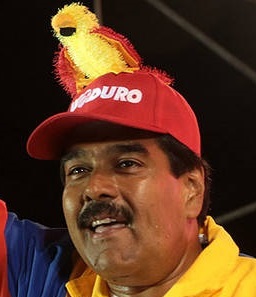
Humankind is by nature bound to revolt against every order when it no longer serves nature’s purpose. Today President Maduro no longer basks in the enchanting aura of the charismatic Hugo Chavez. Unfortunately, he misinterpreted the warning song and fluttering of a little bird, a pajarito chiquitico.
The highly esteemed Chavez, as everyone should know, managed to persuade the Lord to have a Latin American pope elected and named Francis for sake of liberation theology, which advocates Love as the cure for Strife. The pajarito chiquitico messenger sent from Heaven by Chavez, who had been conversing with the Christ, was indeed blessing Candidate Maduro’s campaign. At the same time, it was warning him that Socialism for the 21st Century must not be forced on people, that its evolutionary ideals can only be realized nonviolently, through a gradual change of heart. The pajarito chiquitico wants him to fly around the world, so to speak, examining the degree of happiness of various nations, to discover where the greatest happiness of the greatest number of people may be found.
That place is no Utopia, which means “no place,” for Nothing and only Nothing is perfect. Yet it is a better place, a place where everyone wants to be, where “socialism” for the many instead of the elite is evolving. Where, for example, the means of production are directly owned by multitudes of shareholders. Such means to prosperity are indirectly owned by consumers; therefore capitalists denounce boycotts as a mortal economic sin. It is a better place where the right to complain about reality is recognized as the right to progress to shared ideals; there would be no advance of civilization without it. Departments everywhere, including a vast justice system, are set up to address complaints.
That would-be Utopia provides incentives for greed by organizing it so that everyone who really wants to participate can get a piece of the action. It feeds, clothes, and houses those who cannot participate. Even freeloaders who do not want to participate are supported at a subsistence level, something the society can afford to do given the advantages of participation, which are preferable to welfare, not only because people generally despise mooches, but because every poor slob has an opportunity to get filthy rich, and many of them do. Whom do we really love the most when we love others? And we love them all the more when the shelves are well stocked. Exchange is relatively free and property is relatively safe; the wealthy may complain that welfare entitlements are too costly before donating billions to charitable causes. Dissidents can complain with impunity that they live in a police state although they have never experienced a real police state.
No place is perfect if there is no Heaven, the final Better Place, yet this mundane place would get there even without a Ministry of Happiness, leaving the definition of Good Living up to the living.
If this better place is so bad, why do its worst critics vacation and invest there? Perhaps President Maduro will enjoy a mansion in Miami one day, visit a churchyard where he may glean much from the screeching of little green parrots. And then his favorite movie may be Rocky IV. But for now his advisers are working his doom, unwittingly or not. He acknowledges the symptoms of a potentially fatal social disease, for which witchcraft cannot cure because no one really believes in the magic catchwords where they have opposite effects than desired.
President Maduro acquired a reputation as a great union negotiator. Why, then, has he not negotiated a deal that puts inherently industrious and ingenious Venezuelans to work? Idle hands belong to the devil. They would stab him to death in the vestibule.
On the other hand, there are plenty of little birds in Venezuela that would help him make the Constitution worth more than the paper it is written on, and gainfully employ the nation. Saved from assassination, he could get credit for saving the nation, in the form of posthumous statues erected in every town and city—we always admire people more dead than alive.
Hypocrisy is the underlying crisis of our thinking kind, found in the difference between word and deed, our reality and ideality, between who we really are and what we would be. If our scant account here were well balanced, we would have to recount the bitter accusations of the opposition, including the full text of the blistering 10 March 1824 assessment of the President Marquis of Torre Tagle of Peru, that the General was the representative of desolation and death, the greatest tyrant of all, and not a savior from tyranny.
“I shall never be dazzled by the false glare of chimerical ideals,” said the Marquis, “which bewildering the deluded people only lead to their destruction, and to make the fortunes and satiate a horde of adventurers, On every side we seen nothing but ruin and misery, In the course of the war, who but those who called themselves defenders of the country had ruined our fortunes, devastated our fields, relaxed our morals, oppressed and distressed the people? What has been the fruit of this revolution? What is the positive good that that has resulted to the country? The total insecurity of property and individuals.”
At least we should mention, for President Maduro’s sake, the disaster at Porto Cavello, which “wounded Venezuela to the heart,” and how General Bolivar handed his friend, Francisco de Miranda, the freebooting dictator who won the First Republic of Venezuela, a veteran of the American Revolution, over to the ravening royalist wolf, Juan Domingo de Monteverde, to be shipped off to the prison in Cadiz, left to die like a dog begging for his liberty.
Now whether Dictator Bolivar or Dictator Miranda or Dictator Maduro is blamed as a villain or praised as a hero, we should remember that no one is god almighty or the devil. They are not masters of fate: they are influential coincidences of circumstances, generals in their labyrinths. We find their faults within ourselves.
“In the epoch during which I presided over the Republic,” reminisced Simon Bolivar, “it was not merely a political storm that raged, in a sanguinary war, in a time of popular anarchy, but the tempest or the desert, a whirlwind of every disorganized element, the bursting of an infernal torrent that over whelmed the land of Venezuela. A man! And such a man as I am! What bounds, what resistance, could he oppose to such furious devastation? Amidst that sea of woes and afflictions, I was nothing more than the miserable sport of the revolutionary hurricane, driven to and fro like the wild bird of the Ocean. I could do neither good nor evil; an irresistible power above all human control directed the march of our fortunes, and for me to pretend to have been the prime mover of the events which have taken place, would be unjust, and would be attaching to myself an importance I do not merit. Do you desire to know the sources from which those occurrences took their rise, and the origin of our present situation, consult the annals of Spain, of America, and of Venezuela; examine the laws of the Indies, the conduct of your ancient Governors, the influence of Religion, and of foreign Dominion; observe the first Acts of the Republican Government, the ferocity of our enemies, and the national character. I again repeat that I cannot consider myself more than the mere instrument of the great causes which have acted on our Country.”
General H.L.V. Ducoudray Holstein, Simon Bolivar’s chief-of-staff who immigrated into the United States, where he became a professor of modern languages, asked of Colombia under General Bolivar the same questions we might ask of Venezuela today, since the faults under Bolivar’s dictatorship he listed in his 1830 Memoirs are similar to the ones we now observe:
“What is to be the result of such a state of things in Colombia? Are these people free? Or is their welfare deferred for years, perhaps for centuries? Where is protection to be found for persons and property; for the culture of arts and sciences; for liberal institutions, schools, industry, agriculture, the train of blessings necessary to the existence of prosperity and freedom? Were the inhabitants in a worse condition under the dominion of Spain, bad as it was, than they are now, under the bayonets of the Dictator-liberator? These questions will be decided, according to the view that may be taken of the subject.”
# #


 Share
Share Save
Save