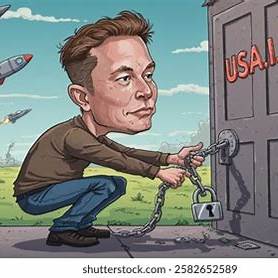
Elon Musk is Shocked, Bewildered, Confused
His feelings are hurt. He would rather be thought of as a DOGE genius, using the insightful methodology of Donald Trump. And that is simply to assert: “Musk is a genius.” His DOGE methodology, however is best described as coming from the single page methodology of shopping mall robber/thugs: Smash, Grab, and Run.
Sam Walton was a far better candidate for the genius title. He built a multi-billion dollar empire from the ground up. After 18 years, he left his offspring $23 billion in a stock portfolio, which grew to over $200 billion, and neither he nor they paid one dime in taxes to the government.
Below is a seriously flawed outline of an investment methodology. I am showing it, not for its utility, but to suggest that the US economy is much bigger, more complex, and it takes a lot of study, application, revisions, feedback, modifications, comparisons, and hard work to get a good grasp on your subject matter. It is nevertheless light years ahead of Musk’s S-G-R method. What makes me believe I am smarter that Musk on this subject? Answer: 3 academic degrees, 40 years of experience, investment returns in the top 1 percent of my peers. And modesty, of course.
Note to Elon: The keys that would help you the most are humility, learn to speak clearly in public, learn how to optimize a huge database of performance data, use Monte Carlo simulation extensively, plus have at least two artificial intelligence models, own a super computer; accept pay that is commensurate with your results, and pay your fair share of taxes. Believe you are a prima donna and you would be modest to declare yourself delusional; and seek long-term professional help with your delusional flaws.
Master these steps, then throw them away, and build a unique model of the US, showing all worldwide interconnections, test and modify it several hundred times, and do not report your conclusions until they are producing results that are accurate, reliable, useful, and limited, and can be duplicated by others. See you in 2075. If you choose to let others do all the work while you take credit and the lions share of profits add another 50 years of experience along with a memoir about what made you believe you had any talent to offer the world at all.
Portfolio Management
1 Introduction to Investment
a. Concept of Investment
b. Speculation and Gambling
c. Investment Objectives
d. Investment Environment
e. Types of Investments
f. Investment Process
2 Securities Market
a. Introduction
b. Primary Markets
c. Initial Public Offerings (IPOs)
d. Secondary Markets
e. Indian Stock Market
f. Different Stock Markets
g. Securities Exchange Board of India (SEBI)
3 Risk and Return
a. Concept of Risk
b. Systematic Risk
c. Unsystematic Risk
d. Risk Measurement
e. Risk and Return Trade-Off
4 Investment Theories
a. Investment Theories
b. Basic Concept of Market Efficiency
c. Forms of Market Efficiency
d. Empirical Tests of EMH
e. Anomalies in EMH
f. Implications of EMH
g. Random Walk Theory
5 Economy Analysis
a. Fundamental Analysis
b. Fundamental Analysis and Efficient Market
c. Economy-Industry-Company (EIC) Framework
d. Economy Analysis
e. Measures of Economic Activity
f. Economic Forecasting
6 Industry Analysis
a. Introduction
b. Structural Analysis
c. Industry Analysis
d. Industry Life Cycle
e. Characteristics of Industry
f. Techniques of Industry Analysis
7 Company Analysis
a. Company Analysis
b. Valuation of Stocks
c. Forecasting Earnings Per Share (EPS)
d. Financial Analysis
8 Technical Analysis
a. Meaning of Technical Analysis
b. Difference between Technical and Fundamental Analysis
c. Types of Charts and Patterns
d. Methods of Technical Analysis
e. Market Indicators
f. Elliot Wave Theory
g. Limitations of Technical Analysis
h. Fibonacci Analysis
9 Valuation of Securities
a. Time Value of Money
b. Valuation of Bond
c. Valuation of Preference Share
d. Valuation of Equity Shares
e. Price-Earnings Approach
10 Portfolio Analysis
a. Introduction
b. Need for Portfolios
c. Risk and Return
d. Expected Risk and Return from a Portfolio
e. Portfolio Analysis
f. Portfolio Selection
11 Portfolio Selection
a. Risk and Investor Preference
b. Generating Efficient Frontier
c. Efficient Set
d. Sharpe’s Single-Index Model
e. Other Portfolio Selection Models
12 Capital Market Theory
a. Risk-Free Assets
b. Efficient Set with Risk-Free Lending and Borrowing
c. Capital Asset Pricing Model (CAPM)
d. Arbitrage Pricing Theory (APT)
13 Portfolio Revision
a. Need for Portfolio Revision Strategies
b. Portfolio Revision Strategies
c. Portfolio Revision Practices
d. Techniques of Portfolio Revision
e. Rupee Cost and Share Averaging
14 Mutual Funds/ETFs
a. Introduction
b. Investment in Mutual Funds
c. Organization of Mutual Funds
d. Types of Mutual Funds
e. Evolution of Mutual Funds
f. Investment Process in Mutual Funds
g. Portfolio Revision
h. Systems and Control
15 Performance Evaluation of Managed Portfolio
a. Methods of computing portfolio return
b. Components of investment performance-stock selection
c. Benchmark portfolios
d. Risk Adjusted Rate of Returns
e. Limitations of risk-adjusted methods
Plan 2
Go home, take care of your 12 kids, and leave the world’s issues to those who are qualified to do more than procreate.


 Share
Share Save
Save