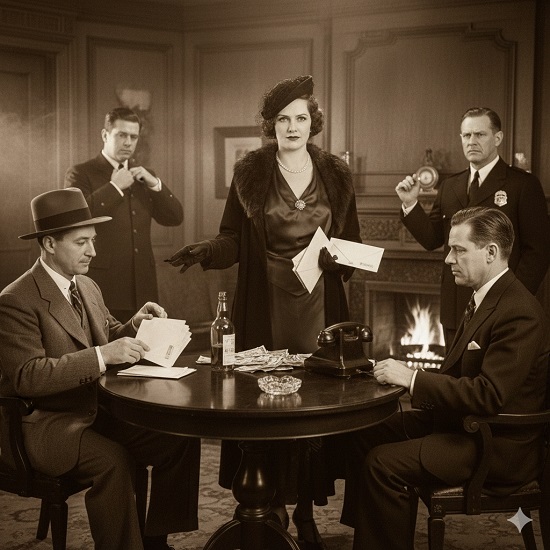
At Christmas time in 1930s Wilmington, Harold Witsil prepared between thirty and forty envelopes stuffed with cash. The rates were fixed: patrolmen received $5, sergeants $10, captains $20. Captain George A. Black got $25. Witsil wasn't working for a legitimate business. He was the bagman for Edna Powell, the madam who ran 811 Tatnall Street—and who would eventually burn the whole system to the ground.
Powell operated at the peak of Wilmington's vice hierarchy, a world with its own rigid class structure. At the top sat Mom Grimes' establishment at 602 French Street, which Bill Frank described in a 1973 News Journal retrospective as "the most dignified of all." Mom Grimes furnished her house like a middle-class Victorian parlor, complete with overstuffed chairs and plush accoutrements. She employed more mature women and catered to an older, wealthy clientele. When she died in the early 1940s, Frank noted that "some thought she deserved a civic funeral for services rendered."
Sadie Miller's operation at 502 Orange Street occupied the opposite end of the spectrum. Her place ran on volume—fresh young women rotated in every two or three weeks. No obviously drunk customers. No military men. "Sadie's place was all business," Frank observed. "Little or no hanging around and talking. She was serving only one commodity: sex."
Powell carved out her own niche, distinguished less by her clientele than by the sophistication of her protection system. She testified to meeting Captain Black regularly on West Street or Tatnall Street near her home, handing over the $25 payments that kept her operation running smoothly. The madams of Wilmington had learned to vet newcomers carefully for police informants, and some houses went further—the Evening Journal reported in 1925 that one establishment had installed a false wall to conceal clients during raids.
But Powell's warning system was more elegant. One member of the police bureau would signal approaching raids by dialing her telephone three times. If there was no response from the sending end, Powell knew raiders were coming. It was a simple, effective arrangement—phone technology repurposed for criminal enterprise.
The system worked beautifully until it didn't.
In 1936, a man named Dewey Bartlett died at Powell's establishment. The details of his death don't survive in the newspaper record, but the consequences do: Powell had to temporarily close 811 Tatnall Street. What happened next revealed just how embedded the protection arrangement had become. Powell met Captain Black at Ninth and Orange Streets to discuss reopening. According to her later testimony, Black told her that if she didn't receive a telephone message from him, everything would be all right. When no message arrived, she resumed business.
But the Bartlett death had drawn attention Powell couldn't shake. Authorities eventually arrested her, and in 1936 the court handed down multiple sentences: six months for illegal liquor sales and a year for running a disorderly house.
Powell might have served her time quietly and returned to business as usual. Other madams had. The pattern in Wilmington stretched back decades—periodic raids, modest fines, temporary relocations, then back to normal once public attention drifted elsewhere. As early as 1874, when authorities raided Kate Mackey's "notorious house of ill fame" on Madison Street, they simply put her under bonds and ordered her to vacate. Such orders rarely stuck.
But Edna Powell wasn't the type to go quietly.
Facing prison, she chose a different path: she talked. In detailed testimony to Attorney General Percy Warren Green, Powell laid out the entire protection system—the regular payments, the Christmas envelopes, the telephone signals, the meetings with Captain Black. The News Journal reported that her revelations created "a big stir around the public building and among persons uptown."
The men who had taken her money for years suddenly found themselves exposed. Powell's testimony prompted a complete overhaul of the Wilmington Police Department. More importantly, it effectively ended the city's organized brothel system. The tacit arrangements that had allowed houses like hers to operate openly for decades collapsed under public scrutiny.
Prohibition had already been repealed three years earlier, forcing the vice trade to adapt. Call girls drifted back to bars. Seedy hotels replaced the once-grand houses. Streetwalkers became more visible. Wilmington's red-light district—that cluster of establishments operating with what one reporter called "tacit police approval"—faded into memory.
Powell served her time and gained release in 1939. A less stubborn woman might have retired. Powell simply shifted her enterprise. By 1941, she was running a bookmaking operation.
On October 3, 1941, the Morning News reported that authorities had arrested her again. When detectives raided her new operation, "she threw her arms around Detective Berry in an effort to prevent seizure of the evidence."
That desperate embrace—a final attempt to outmaneuver the law as it closed in—marked a fitting end to her public story. After that arrest, Edna Powell's name vanished from the newspapers. Her era was over.
But she had already accomplished something remarkable. The madam of 811 Tatnall Street, facing prison, had chosen to bring down the system that had sustained her rather than protect it. Whether from spite, calculation, or simple refusal to be the only one who paid—Powell made sure that when she fell, she didn't fall alone.
—————————————————
This post is adapted from "Delaware Behaving Badly: First State, True Crimes," available Jan 1.
|






 Share
Share Save
Save