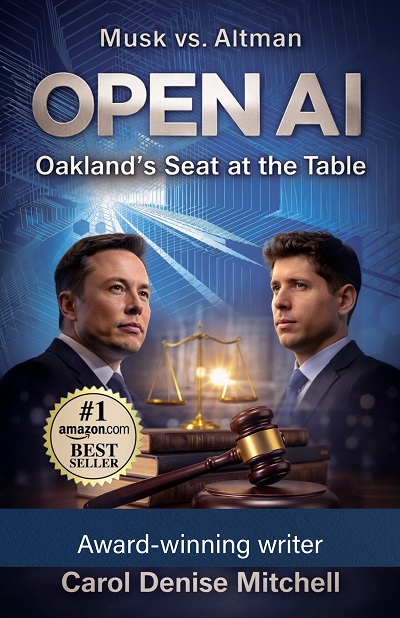
OpenAI: Oakland’s Seat at the Table –Oakland Propped Up for a Landmark Trial
By Carol Denise Mitchell
What makes OpenAI: Oakland’s Seat at the Table unlike any other book that will ever be written about the Musk v. Altman trial is simple: I was there. I considered Elon Musk’s absence during closing arguments and how it may have felt to a jury. Not in theory, not through secondhand notes, not through transcripts mailed across the country — I was physically present in Oakland, California, just a few blocks from my home on 24th Street and Telegraph.
From my wheelchair, I exited the front gate of Northgate Terrace Senior Homes in a broken chair that needed a new battery. Nonetheless, I was in awe of this moment in history. Sam Altman would be testifying on my 71st birthday, May 12. History was in the air, on the ground, in the city where the trial unfolded. Four blocks from my home, I witnessed the movement of people, the tension of the courthouse, the contradictions in testimony, and the eerie silences that only someone standing in the room can truly understand.
Oakland, California itself shaped the story. The city is quiet now — almost solemn. Downtown is nearly a ghost town. Nothing leading to the federal courthouse suggests class, status, or wealth. You pass shuttered theaters. The Emporium is gone. Sears is gone. The old J.J. Newberry’s on Telegraph stands in a wind‑beaten defensive posture, fighting to remain upright. Oakland today is a semblance of what it used to be, a memory held together by a few stubborn landmarks.
It felt almost as if someone had propped Oakland up, put lipstick on her, and sent her out the door to get her ready for the landmark Musk v. Altman trial. A city worn down by time tapped an old woman on the shoulder to write a book that would end my furtive writing career. Suddenly, Oakland found itself hosting two men with massive amounts of money, locked in a battle over the future of artificial intelligence, while I prayed my battery would not fail me before I could cover the trial. And then, at 1301 Clay Street, everything changes. You turn the corner and step into an arena that looks nothing like the city surrounding it — and that was the moment I knew I had to be here.
Other writers will rely on summaries, depositions, and reconstructed timelines. I relied on presence, sewn into the fabric of Oakland, California.
Being there — whether inside the courtroom or standing outside its doors — shaped this book more powerfully than I ever realized at the time. Only now, months later, do I feel the full gravity of what I captured and why it was imperative that I be there. It is wind in history: gone with the moment, preserved only in the memories of those who stood witness and in the pages of this book.
One of the most striking elements of the trial was Elon Musk’s absence during closing arguments. The Musk v. Altman federal trial held its closing arguments entirely on Thursday, May 14, 2026. The Plaintiff was gone. This was his case, his fight, his narrative — yet he was not in Oakland. His absence became louder than his presence. Readers feel that tension: Where is Elon? Why is he not here? Why is the courtroom waiting for a man who is fighting for the life of a nonprofit who is somewhere else entirely? I recall bowing my head. Outside, I looked into the sky. Next, I wrote furiously in my handbook to preserve this memory.
You could feel the air change. You could feel the argument unravel. You could feel the quietness settle over Sam Altman as his team pinpointed inconsistencies with surgical precision. I recall how I turned my wheelchair — no juice, a dying battery. “You can do it,” I said to the chair as she churned in the opposite direction of Jack London Square and the Federal Courthouse. Fifteen minutes later, I was home. That night, I wrote furiously, feeling the reality of the great divide between the very rich and the very poor.
The saddest oddity of all is this: even in a loss so significant it will be remembered as a whisper concerning Altman — who respected the courthouse enough to be there, who applied no pressure as to why OpenAI became an 852 billion‑dollar business — the pall still lingered in the air. If Musk didn’t care enough to show up for closing arguments, who needed to contemplate this case further?
This is why OpenAI: Oakland’s Seat at the Table is perfectly set. It is not a book written from afar. It is not a book built from commentary. It is a book born from proximity, presence, and the truth of two very different realities that do indeed separate the rich from the poor — and after May 18, 2026, both worlds were divided again.
It is the rare record of a moment that will never happen again — and no two books about this trial will ever be the same.







 Share
Share Save
Save