Silently in the Night (Book) - 7/22/2018 12:15:10 PM
'Silently in the Night' is a compilation of short stories of differing genres, with most leaning towards fantasy and outer space. I do not consider outer space one of my favorite genres, however, the writing is full of colorful details regarding the scenery and characters. I will admit that somewhere throughout the book, Clayton Graham must have won me over with the excellent writing as I thoroughly enjoyed 'Daniel's Revolution,' a story towards the books end with outer space flavor.
The author has an abrupt way of ending a story leaving the reader to ponder and reflect on it's meaning.
All and all, I enjoyed 'Silently in the Night.' The material is interesting, easy to follow and very entertaining. Regardless your favored genre, the book covers many topics and is an enjoyable read!
Silently in the Night (Book) - 2/24/2018 11:20:54 AM
An interesting excerpt, followed by great reviews…
It doesn't get any better than this.
Ron
Milijun (Book) - 12/30/2017 5:34:53 PM
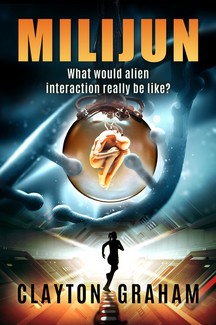
As I opened and started reading the book, it became apparent there were a series of storylines and heading for a big gathering. And gather they did. As the story progressed, a mother and son, a government officer with a chip on his shoulders, a secret installation with advanced technology, and then the mother makes a startling discovery. There is secrecy, violence, intrigue, and of course, surprises. The story line starts on the Moon and comes back to Earth. They is a lot of the story line that is worth the read. There is some of the story line that will just tick you off and then there is the story pieces that will make you crazy for more.
Two things I did not like. The first was while the story was detailed and kept moving, there could have been more explanation. I cannot say more without “Spoilers.” The second things was I looked for the next book and I cannot find the next installment. That drives me crazy.
If you like mystery, Sci-Fi, a little Fantasy and a solid explanation, then I highly recommend this book!
Milijun (Book) - 3/14/2017 6:53:12 AM
Thank you for the brief view of your novel. It certainly is well-written and full of real characters and action. The kinds of things your professional reviewers have stated so well. I'm sure that you will garner much readership because readers crave this kind of excitement while reading.
As one who has attempted to tackle first contact in a highly different way, I would like to point out a couple of discrepancies that I've seen in this small peek. First, you seem to ally with Stephen Hawking and his conclusion that any life that would reach us from the stars would be totally alien and therefore, very destructive, perhaps similar to HG Wells first depiction of creatures from Mars in War of the Worlds. You, on the other hand, have picked up on the off repeated, alien look that has evolved from the mythological 1947 alien spacecraft crash near Roswell, New Mexico. The one deviation is the wings. Making these creatures reminiscent of angels, dragons, and vampires.
In spite of lots of good science, you talk about the aliens being encased in "plastic." On earth, merely by sight, polymers (plastic), quartz (crystals including diamond), and organic materials (cornea and jellyfish) could serve the purpose, but plastic would not be "alien."
The wings, unless they were similar to solar panels or antenna, to collect energy from distant stars (or reflected light sources?) would be useless in the vacuum of outer space. So, I have to assume that they have a dual purpose… Both flapping for flying (crudely?) in atmospheres and gathering energy for fuel and sustenance for interstellar space travel power source. Then, why would they have to hibernate under the moon's surface for millions of years?
Your reviewers mention world building. I certainly would be interested in that. I don't think humans are anywhere near that capability considering how we have deconstructed our own planet for rather childish reasons. As far as creating hybrids is concerned. It is certainly a good fictional ploy to make a good story. But its scientific purpose, unexplained in these two chapters, does not make a lot of sense except to create a drama of a loved one being kidnapped.
So, my conclusion is that you have created an action thriller that is more fantasy based than scientifically based in spite of very good science.
Ron
Teleportation (Article) - 9/10/2017 8:51:20 AM
I have met Michio Kaku and he is an amazing person with a good grasp of the future. His latest book is a result of him interviewing the 100 prominent scientists to learn what they think will be the next innovations. Teleportation is just one of them.
On a less scientific or quantum viewpoint, we begin teleportation of documents with facsimiles. Now, we can teleport many physical objects by their physical characteristics converted to digital and then reconstructed by 3D printing.
Ron
Mars Odyssey 2030 (Article) - 3/29/2017 5:49:43 AM
A good, conservative view of our expected exploration of Mars in the near future based on facts provided by NASA sources. I wish you had gone a little further with speculation. But you will probably do that in future installments.
You mentioned the Moon, briefly, and then moved on. I remember asking people at the 1977 20/20 (20 years since Sputnik) conference in Huntsville about when and why we weren't actively going to Mars. But I have changed my mind since I wrote my novel, Alone?, in 2003. While Mars and the Moon are very interesting for advancing our knowledge of the solar system and may, perhaps be exploited, very carefully, for resources, I believe they will remain scientific outposts like Antarctica for a very long time where people will rotate in and out because conditions on both of these places are not conducive for human existence.
Gravity was my focus in graduate school in 1966. But there was little research at the time. Valeri Polyakov spent 438 days on the former Russian Mir space station. Still, the long-term effects of being weightless or impartial Earth gravity for so long have not been fully understood or evaluated.
While Elon Musk has grand plans for Mars colonization, I favor in space colonies in Earth orbit (equal amount of sun exposure properly screened for radiation) with artificial 1G gravity where people can live out their entire lives in space with near Earth conditions. From there with a zero gravity well compared to the one we have here on earth, we can move out into the solar system very readily and return.
Ron
Alien civilizations - Contact Probability (Article) - 3/21/2017 6:03:25 AM
A very important point when considering other intelligence existing in our vast universe. It is not only distance that would keep us apart, it is time.
My premonition is that any intelligent life that developed into a civilization that moved out into its solar system would stand a much better chance of a longer lifespan. However, given the perils to our fledgling intelligence, still bound by Earth, from the Earth's geological evolution, from outer space, and from our own misguided behavior, the span of our civilization could easily be ended. So, we can assume that intelligent life has ended abruptly many times. However, once a civilization has reached between two stars, I would think that it would have a very long life and also be far superior to our own in unbelievable ways.
I don't like the word "alien" even though the structure of life might be silicon or some other strange chemical makeup. Intelligence is intelligence, and we should be able to communicate in positive ways.
Ron