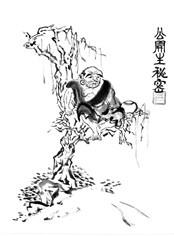
One day, Zhi Xian, the celebrated Chan master, was
testing a group of his disciples. "In search of the truth,"
he said, "we are like a man hanging by the teeth from
a branch of a lofty tree.
Another man sitting under the tree asks him a question,
"What is the meaning of the 'Patriarch coming to China
from the West (India)?' He will look less intelligent if he
dare not answer. Otherwise, if he opens his mouth,
he will certainly fall to his death. So, tell me," questioned
the master, "what should be done to find a way out?"
Among the others there was a monk by the name of Hu
Tou Zhao (Best Recruit Hu) who stood up and said,
"We don't care what the man is doing there on the tree.
We want you say who he was and what he had been doing
before climbing up the tree."
After hearing this, the master broke out in laughter, feeling
quite satisfied.
Brief Comment:
Most people are used to thinking in such a way of two
distinct halves or opposing concepts of "to be" and "not to
be," "is" and "is not," "have" and "have not." A task of a
Chan ('Zen' in Japanese) master is to destroy any concept
of duality, bringing his disciples to Oneness or Dao, also
translated into English as 'the Way.' The world becomes
limitless when the relative boundary of two opposing sides,
two concepts, is destroyed. Once there are no distinct halves,
no relative boundary of duality, there are no obstacles on
the way to the nature of one's self. Only monk Hu Tou Zhao
was able to see the point of Chan, attaining a high state
of mind. As for the master, he saw the potential for the
immediate realization of the monk and thus was very
satisfied with his disciple's answer.