Iuka Rebel
William and Tyra had their fourth child Rufus on September fifteenth eighteen forty three in Iuka Mississippi. Iuka was a small rural town in the far northeast corner of the state. William had just heard the day before of a story in the Clarksville “Northern Standard” about the latest insult to the Texans in their continued hostilities with Mexicans even after winning their independence seven years before. Some said they should become the next state in the United States rather than an independent country. William was not sure about either possibility and could only hear these things as neither he nor his wife Tyra could read or write.
Rufus and his siblings grew happy but working on the farm as all such families do, through the years to young adults in this southern farming environment for the next eighteen years. Learning to farm, hunt and fish until he and his brother James enlisted in Company H of the First Mississippi Infantry four days after his eighteenth birthday on September nineteenth eighteen sixty one. With the same personal fire as many he knew for the defense of the Confederacy, including his father William who had enlisted separately.
During the next five months he became brutally aware of the harsh rigors of warfare up to his being one of the many now stationed in defense of the newly built earthen walled Fort Donelson during the bitterly cold winter of February eighteen sixty two.
On the fifth of February 2,500 more men joined them from Fort Henry twelve miles away which had just been taken by Yankee General Grant and the Yankee navy commander Foote with his ironclads on the river.
On the twelfth two Yankee regiments showed up outside the defensive lines around the fort, batteries and town of Dover. The fort and its defensives sat 100 feet above the river and the batteries included ten 32 pounders, a 6 ½ inch rifle and a 10 inch columbaid. Plus there was wooden abbatis outside the earthen defenses. And by now there were about 17,000 confederate soldiers encamped here.
During the twelfth the Yankees tried several probing attacks, all unsuccessful. Including one on the southeast where the cannon fire ignited a grass fire and many of the Yankee wounded and others burned to death. The acrid smell of the burned flesh made many wretch even though they were resolute in nature and now accustomed to battle. Then on the thirteenth the same probing attacks continued even though there was a heavy snow during the day blanketing everything.
The winter air was freezing and sleep at night came fitfully with the little heat some could get from small campfires where possible. The next day that Yankee ironclad commander Foote showed up and tried to do what he had done at Fort Henry. But the forts batteries decimated his ships and caused him to retreat up river after hours of the shelling on both sides.
On the fifteenth over 1,000 men were killed on both sides during the heated attacks all day long and that night many more froze to death. There were heated discussions being heard by some from the commanding officers area over trying to escape, how many and eventual surrender. Food stores were low and the Yankees had a vastly superior number of men. The food was so low that Rufus was there when some of those with horses were in a drawing of lots to see who’s horses would be killed to feed as many as they could.
During the night General Pillow escaped on a boat and then General Floyd escaped on the last steamer there with two regiments of his men. In the early predawn General Nathan Bedford Forest escaped out the east side of the defenses with 700 of his Calvary by way of Lick Creek. By the middle of the day General Buckner who was left in charge, surrendered to the Yankee Grant.
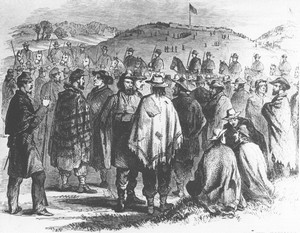
In fairly quick order 7,000 confederate men were mustered, disarmed and corralled up as prisoners of war. Over the next few days all of them were marched off in different groups to Yankee prisons across the river and further off through the bitter winter weather. One of these was Rufus.
Rufus ended up after the long march with men he knew and many he did not at Camp Morton in Indianapolis, Indiana. It was a cold and inhospitable place where not much care was given to Rufus or many of his comrades-in -arms, they were definitely the losers.
The sufferings, dying and somewhat hale were all cramped together without much except guarded throughout the winter, spring, hot summer and following fall. Until finally Rufus and some were again selected and marched off to Aiken’s Landing and exchanged for Yankee prisoners in a prisoner exchange there between different Generals on November tenth.
Rufus was now once again into the war, serving where he was sent, doing all he could for the south. But in January, only two months later he was sick and sent to the hospital in Jackson, Mississippi. Here he was recuperating for two more months until his release and back to duty. He served until General Lee’s surrender at Appomattox in 1865 when he returned to Iuka along with James his brother. Unfortunately his father William did not return. His mother Tyra already had the news of his death in 1864.
By 1868 Rufus had met and married the love of his life Josephine Farrar, a beautiful young lady four years his junior. They diligently and untiringly tried to make a life farming even through the hard times around Iuka with the reconstruction and debasing efforts of carpet baggers and taxes following the end of the war.
In 1868 they had their first child a son named William for Rufus’s father. Then a year later their second, a daughter they named Lula was born. The next year though, the young couple made a hard decision to move to Texas; along with James and a neighbor Mr. Terry. They all packed up all their worldly possessions and children for a long journey by Ox wagon and headed cross country for Texas hoping for a better life. On October 6 1870 the three Ox wagons started rolling in that direction. Everyone’s hope was to be as situated as they could be in Texas before the bitterness of winter set in.
With little money and none of them having ever been to Texas, but hopes for a better future, everyday was met with optimism. Ox wagons did not make many miles in a day, and food had to be gathered or hunted to feed everyone. The men hunted Wild Turkey, Rabbits, Dear (when possible) and any other game they could find. Tubers and herbs were gathered as they were seen. When not they had to rely on what little they had in the wagons. Nights were spent sleeping on the ground under the wagons in their blankets. The three wagons always camped as close to fresh water as they could.
Finally they came to the Mississippi River across the river from Helena Arkansas. They made arrangements with the ferry operator there who charged fifty cents a head for every person, head of livestock, chickens, etc. for the trip across the river. Rufus’s brother James refused to pay the toll for his hunting dog, so as the ferry pulled away from the Mississippi River bank the dig was still sitting on the bank. When the ferry reached about mid river James took out his hunting horn and blew his call on it. The dog hearing his master’s call jumped in the river and started swimming to it. The Mississippi River here was about a mile across with a current heading for Louisiana and the Gulf of Mexico. As the ferry docked on the Arkansas side James’s dog was just catching up and walked out onto the Arkansas bank of the river drenched and soaking but getting a warm rub down by James.
For the next several weeks the small group plod its way across the Arkansas countryside west until it crossed into Texas. Slowly the terrain altered slightly from heavily wooded and intertwined mountains to rolling hills and more open skies sparsely studded with more moderate trees. The game changed also there were no turkeys in abundance here and the deer appeared to be smaller in size. With the less dense tree cover there were fewer squirrels and the rabbits had a different look. Creeks and rivers did not run as wide nor deep and they seemed to be not as clear always.
Finally on Christmas Eve they pulled into Osceola and Rufus found a job splitting fence rails for a local farmer who was starting a grove and wanted a fence around it. This blessing meant some much needed money after the journey of 88 days traveling here.
A few months later Rufus found a small farm between Osceola and Itasca to rent, now the real settling in began.
Over the next few years Rufus and another transplanted southerner John Reed from Athens, Alabama became antagonistic with one another and their feud lasted for many years. Although this feud was not the violent kind as many sometimes became.
Rufus and Josephine had eight more children here and all lived to adulthood except one son. Josephine lived another thirty nine years after their arrival in Osceola that Christmas Eve and Rufus another twenty five after her in or near to Itasca surrounded by neighbors, friends and family.
A few years before his death Rufus started drawing an old soldier’s pension for his service in the war. A final chapter to his time as one of the Iuka Rebels.