HOW TO DO ABSOLUTELY NOTHING ON THE SABBATH
BY
DAVID ARTHUR WALTERS
I BELIEVE THE SABBATH should be a day of absolute rest, a day to do absolutely nothing. How do I begin to do absolutely nothing? I cordially invite you to join me for your edification, as a vicarious I in my answer.
I certainly have a most arduous task ahead of me because doing nothing is impossible for most if not all-living beings. Thankfully, I have the opportunity as a human being to turn on myself and to shut down my operations forthwith. I am afraid, however, that my inactivity might extend forever, to an eternity I do not propend, at least not at this moment, although sometimes I think anyone in their right mind would terminate themselves forthwith. So my goal is a day of absolute rest, not a permanent vacation or vacant eternity.
To do absolutely nothing on the Sabbath and survive for the rest of the week will require the me that I merely think I am to become nothing for the time being. That would require a lot of doing for which there is hopefully some technique or the other, which I hope to discover without submitting myself to the prejudices of a bona fide spiritual master.
Again, where shall I begin? I shall proceed with the alpha and omega of everything as far as I am concerned: I mean myself, my very I. Perhaps I may, by focusing on my I, obliterate the objective world that demands my reactions and actions.
"I, I, I, I, I, I, I, I, I, I, I...." I might reiterate, despite the uncomfortable diphthongs; me, me, me, etc, would be in poor taste.
I could go on and on redundantly with that clumsy litany to my I in order to exclude everything except the unconditional I that is no-thing, not even a projected universal I. But those discrete I's are inadequate to the purpose regardless of their number, for the I that I want is the undivided unity that is not a multiplicity of I's. Even if diphthongal "I" were eliminated and replaced by a continuously sounded vowel, say "O", the continuity would not rid my O of its possible moments in time or the perturbing imperfection of its fluctuations.
Alas, there is no way I can realize the no-thing-ness of the unconditional I, or become the free, not-a-thing that I must be in order to do absolutely nothing, by repeating myself, no matter how sincere or deadly serious my effort might be. Those multiple I's are not the unconditional I that I would be to save me from the objective conditions requiring my action, for each I as a unit depends on the existence of another I for its own existence as an I. No, I do not want the identity of a repetitive I, nor do I want the numerical differences of the repetition.
One might say of my repetition of I (I=I) that the I is identical to itself, so I am really doing nothing but reminding my I of my I. Alas, there are three I's in the statement (I is I): the subjective I, the objective I, and the holy I that recognizes their equality relation. In other words, in the identity statement ("I=I") there is a difference between the I's because it takes time to make the statement, therefore there are two I's, not to mention a third I observing the relation between the two. Now that is precisely what I would avoid on my Sabbath of freedom from activity in the unconditional I, for I want to do absolutely nothing on my Sabbath of absolute rest. No, ladies and gentlemen, I am hardly satisfied when I am not the indivisible I in absolute freedom from multiplicity and therefore from activity altogether.
I hear a voice commanding me: "Shut up and be quiet, for silence is golden! Think not and be free, you fool, for all your thinking is just symbolic doing!"
Ah, but what a formidable task that command presents, an arduous task for which an effective technique is required, just as I suspected in the first place! It seems freedom must be pursued against one's own will. Objective silence might be obtained with a real or virtual gag, of course, but the inner chatter would persist and the thoughts would persevere; both would run rampant without some method to harness them in order to reach the ultimate goal: to do absolutely nothing. Therefore, one must compose an argument, a disciplined conversation with oneself, that a narrow course may take one more swiftly to the limitless I, the ocean of bliss or perfect rest requiring no further selfish actions or repetitious, discrete, neurotically perseverated I's. If life is action, then successfully doing nothing implies being nothing in virtual death, obviously by technical means of virtual suicide.
It would appear to the uninitiated that I have hopelessly entwined myself in self-defeating contradictions. Nonetheless, I am positive that, once the unconditional I beyond both subject and object and their relation is realized as the no-thing that it unconditionally is, then by that reality the adept also realizes that everything necessarily gets its existence and its coincidental activity by virtue of the unconditional I doing absolutely nothing. Furthermore, when not-being is not-doing, only then is being free from existence in the pregnant no-thing-ness or absolute spaciness that posits the Concrete Universal, i.e. the Universe with disparate contents in unity. Only then are the mutually conditioned subject and object (the polar moments of conscious activity) dissolved in freedom from the known.
Indeed, it is in the unconditional I that we have freedom from knowledge, which is only needed by inferior beings for self-defense; the Supreme Being or Absolute Nothing has no need for knowledge. Knowledge is always problematic because it does not dispense with the ultimate problem of existence: its particularities. Therefore nothing, most honestly signified by an ineffable Name, is posited as the true faith, the only catholic faith plausible. That faith sometimes appears in its dogmatic form as an absolutely skeptical attitude. Yet, ironically, that dogmatic skepticism, or forced faith in Nothing still requires doing something instead of the doing nothing preferred by adepts of unconsciousness under the instinctive sway of doing absolutely nothing (the so-called death instinct). Besides, Nothing is not nothingness, nor is it Being, the limit of beings, and that is to say something.
Although I have made the foregoing perfectly clear, I suspect many people did not understand it because it requires a prodigious intellectual effort to arrive at the final cerebral abstraction of doing absolutely nothing for the time being, even for a moment or two on the Sabbath.
That endeavor, incidentally, has, if successful, the seemingly insensible but actually rapturous effect of ataractic catalepsy. That marvelous state of doing absolutely nothing is what moves me after recovering from bliss to continue with the exposition of My Struggle to regain it, such as this demonstration before you, drafted for the sake of those who desire the ecstatic privilege of doing absolutely nothing.
I realize that the superficial contradictions of my periodic efforts to do absolutely nothing might discourage some people from embarking on the flight to the perfect self-identity of freedom through the mystical dissolution of illusory objects, hence I shall consider writing, in plain English, an disquisition entitled, 'Disquisition On Doing Absolutely Nothing' for the edification of the masses, and to raise funds for further research. I intend the Disquisition to be a sort of bible, if I might call it that, to dispel biblical contradictions and to bring all persons into the direct intuition of the unconditional I that supernaturally "transcends" logical contradictions.
My enlightening Disquisition will be illuminated with figurative illustrations that uninitiated, inquisitive minds require for edification. For example: since to realize the unconditional I, one must rid oneself of all not-I objects, both real and imaginary, I shall include an illustration of a men smashing things and images of things with a hammer as their leader shouts, in the caption provided, the classic iconoclast's motto: "Smash everything! What is left is Good."
Finally, whilst looking forward to the next Sabbath, I am, in the active interlude between nothings,
Very Truly Yours,
I-I-I
Important Notes: Nothing exists. Nothing is the gap or Chaos (chainein: to gape) we fill with fiction. The impetus to creation is the horror of nothingness. Myth and fiction fill Nothing with signs in a way that Being continues to conceal Nothing as an impetus to further creation.
Narcissus closes the gap with the unity of subject and object: the subject and object of his desire are one. He could not live in unity with himself, thus was it said by the blind seer that Narcissus could not know himself and live. His horror of nothingness gave way to that of Dionysus who tears everything to pieces and is torn to pieces. So myth fills Nothing with signs in a way that Being continues to conceal Nothing as an impetus to further creation.
We are projected from and into Nothing, and without a sense of the unconditional Nothing there is no selfhood or freedom. The essence of Nothing is that it presents Being to beings for the first time. Nothing is not, as Descartes had it to defend his concept of a perfect god, a negative, a deficiency or defect. Rather, Nothing is a positive, pregnant with all meaning.


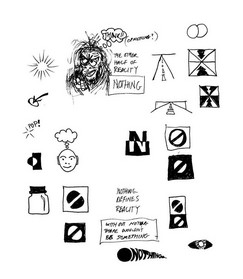 How to do Nothing on the Sabbath
When confronted with doing nothing Sunday, I say, "My eye!" The Sabbath is a holy day, that, while I'm not religious at all, was set aside so that people could go to church one day. I am grateful for that because I was able to leave my gainful employment for both Saturday and Sunday to do something with my time instead of theirs. While there was a time on Sundays during my college years when Sunday afternoon became a kind of, "nothing,"period of trying to figure out what to do, I no longer have that problem. Thanks to the Internet and you.
Ron