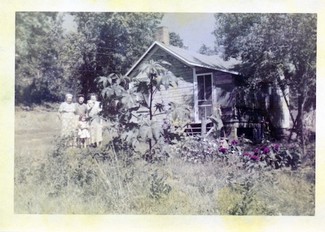
My grandparents (on left) at their truck farm about 1950.
Showing the small old farm house.
We always worked. My first recollection was helping out in the kitchen. Shucking corn, removing peas from the pod, and removing the pits from cherries to can, very badly. Later, in winter while eating the canned cherries, it became a game where Roger and I would vie to see who would find the most pits while eating our dessert. We also washed dishes, very badly. Gave up that task gladly later when our sister reluctantly took over when she was old enough.
Our first job in our new house in Wausau was to mow the lawn. We had one of those push lawnmowers that was very old with a very sharp blade that we would get spinning at a high rate of speed as we pushed it up and down our long yard in a nice pattern, showing where we had mowed by neat rows of clippings. We never raked the clippings, although some people did. That yard was too narrow and short to play ball. But we did play football there a time or two. We had a basketball and a football, but no hoop to shoot the basketball through, so just dribbled it and passed it around like a football.
We also raked our fall leaves into piles. There were lots of trees on Jefferson Street so there were lots of leaves to pile up. The piles of leaves were fun to play in, as well. Some people burned their leaves and you could smell it in the air. I don't recall us ever burning leaves or even putting them in the garbage cans. But we may have had them hauled away.
The new/old home in Wausau presented a new task. We had a newfangled hopper and electric drill coal feeder in the basement that fed the furnace continuously through the long winter months so that, unlike others, it wasn't necessary to continually go down to the basement to the furnace and shovel coal. We had a coal room where a truck would pull up in the fall, and with a chute, dump the entire load into the coal room. Usually enough for all winter in one load. I don't know what it cost. But probably was stressful for our parents to pay.
Roger and my job was to, about every other evening, go down to the coal room in the basement by lifting up a trapdoor over the stairwell in the large pantry off the kitchen. Once at the furnace, we would open the door to the hopper and shovel coal until it was full. The drill operated automatically and Dad made sure that we were warm, if very dry, with a hot air furnace driven by a fan to all the rooms. I don't recall ever having to remove the clinkers (residue after the coal burned) but we may have had to. Our neighborhood was dark with coal smoke in the wintertime and the white snow soon turned black with soot. By spring, we hoped for rain to wash the soot off everything.
We had trash pickup in the alley, but a burn barrel for paper. We didn't have a fireplace and didn't use our furnace to burn paper. Since I was the designated firebug, I was given the task of burning papers about once a week. I got very good at lighting fires. Helped me later while lighting campfires for Boy Scouts. Roger and I were often asked to go to the corner deli at Scott and 6th, to buy cigarettes for Dad, and very rarely, items for Mom. She was very frugal and didn't buy from that corner store because the prices were more expensive than where she shopped like at IGA.
For all of the work we did, we earned treats from Mom… Cookies, cake, homemade candy, ice cube tray Kool-Aid popsicles, chocolate milk fudgesicles, and sometimes, candy bars. And, of course, our allowance of 10¢ a week. I don't recall ever going to the deli for candy like the other kids did. We saved our money for bigger things when we got a dollar or two. Some, Mom even put in our savings accounts for us.
The summer we were 8, our grandparents had a truck farm west of Eau Claire and just south of Elk Mound. It was 100 miles on Highways 29 and 12 from Wausau, so always was, quite a trip that took at least two hours to get there. The summer we stayed there we slept in a makeshift bedroom in an old barn because the house was quite small. The barn had a lot of dusty old hay, hornets and spiders.
Our grandparents grew all kinds of exotic crops: sweetcorn, Indian popcorn, peas, green beans, potatoes, peanuts, four kinds of strawberries, cantaloupe, watermelons, onions and spices like dill. There were more but I can't remember them all. We started work by picking black caps and wild raspberries in the brush that surrounded the place, and then, mostly picked strawberries every day as they came ripe from the various beds and varieties.
The sandy soil was very rich and grew a lot of produce. Most of it, we ate, but some they took to the busy intersections on weekends and sold from the car. I don't recall ever going with them to sell. Grandma told us that we, "Ate 100 crates and sold 100 crates of strawberries." They also had about 100 watermelons about ripe to sell when, one night, someone came with a trailer and stole about half of them. It was devastating… One of their cash crops to sell.
At the end of that summer, we went to town, Chippewa Falls, and in a department store, Grandma bought us a small bat, a softball, and two $2.95 mitts that were about as good as they cost and had to be replaced later when we wanted to play serious hardball.
By mid July in our 9th year, we were through with play. We were up at 6 am. Mom would make us lunches in brown paper bags and we would go to our schoolyard a block away where at 7 am a number of school buses, trucks and cars would gather to pick up kids willing to go pick beams in the fields of the Wisconsin River Valley, often about 30 miles away.
We usually took the bus to one of the big farms with huge fields. The farmers would then tell us what rows to pick and we would always run to see if we could get the best rows from what we could see. We were given a bucket to collect the green beans or string beans in and then, when full, empty them in a gunny bag that was provided at the end of the row we were working on.
Unlike some of the kids, Roger and I were diligent pickers taking handfuls of beans quickly and moving on down the row as fast as we could to pick as much as we could before the day was over. It was very hard keeping up with the 15-year-old girls, but I tried. Mostly coming up short with about three quarters of a gunny bag of beans by the end of the day.
The farmer usually stopped everyone picking about noon and gave us about a half-hour to eat our lunch in the shade. But the rest of the time was out in the hot sun and rain when it occurred. I don't recall ever having to get undercover in a rainstorm, but I do remember that some kids were hit by lightning one year in the fields. No one was killed but some were injured. Cold water and a single dipper was usually provided from farmers' wells and placed in the fields in milk cans for us to drink. If we had to do any business, we had to go out in the woods or, sometimes, to an outhouse and do it. I do recall one time eating so many string beans (they were very good raw) that I had to rush to get rid of some of them. But after I got rid of the problem, I still ate more raw beans.
At the end of the day, we would take our gunny bags and beans to an outdoor scale and the farmer would weigh them and then pay us. The usual rate was 3¢ a pound. Most days, Roger and I would pick somewhere in the range of 80-90 pounds and bring home $2.50 to $2.90. Most of the guys our age would pick less and earn less. And, as soon as they got off the bus, would head to the candy store and buy candy with the money they got. We went straight home and gave our money to our mother so she could buy our fall school clothes and put the rest in our savings accounts.
Weigh-in could be interesting. I do recall the time that a farmer found rocks in one guy's bag and sent him home without any money and told him not to come back picking again. One day, when I was, 11 or so, we had an especially good field and I picked 105 pounds. I took home $3.15, more than even the older girls that day. I was proud of my accomplishment. But that wasn't my best day. Another day, when we were paid 3½¢ a pound, I picked 100 pounds, exactly, and took home $3.50! For young kids, close to $15 a week was good money in those days.
When there was a lot of rain (there was no picking on rainy days) or the beans were bad or near the end of the season, we sometimes took the cars where they offered more for wax or yellow beans, sometimes as much as 6 or 7¢ a pound. The worst thing was when beans were wet they developed brown spots called "rust." Those beans weren't accepted by the canneries and were used by the farmers for feed for their animals.
One day, when we took a car with the promise of higher pay per pound, we all piled, maybe eight or nine of us, in the farmer's big sedan and rode to their small farm. After about an hour or so picking, the youngest girl in our group began complaining that she had to pee. The older girls told her to go out in the woods and go. But she refused, saying she was afraid, and continued to complain while trying to pick. Eventually, she quieted down and kept picking.
I recalled she also complained again later in the day, and the girls again told her to go to the woods and she refused. By the end of the day she had both done number 1 and 2 in her pants and was very eager to go home. We all got back in the car. I was, luckily, in the front seat. Everyone had all the windows down, but she stunk to high heaven. And she sat on one poor girl's lap while everyone in the back seat scrunched to the side with their heads out the window. After over a half hour enduring that stench in the car we arrived back in the schoolyard and her parents were there to pick her up. Needless to say, we never saw her again.
One winter, when we were 10 or 11, rather wealthy neighbors up the street went to Florida for the winter. They entrusted us to keep their sidewalk and driveway clear. So, whenever it snowed, we were both up early and at that house cleaning the long driveway past the house to the garage in the back, the front sidewalk, and the walkway and steps to the front door clean and clear like the owners were still at home. Mom diligently recorded the inches of snow on the days that we worked. I don't recall what had been agreed, but when they came back, they paid Mom what we made for that winter. I don't know what it was, but the money went into our savings accounts. They never asked us again to shovel snow, probably because it cost too much. It snowed a lot that winter.
To be continued…
Copyright 2019 © Ronald W. Hull
9/30/19