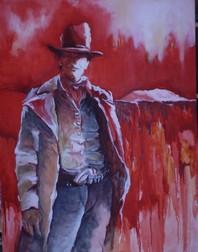
“You can’t win boy,” the Impaler hissed, “don’t know why you even thought you could?” Dark light flared.
The Law, The Light and Jadakankar
In a pallid sky, the smeared orb of the sun cast eerie spectral light; thin as a silent scream in the throat of the dying, thin as love is sometimes thin, thin as blood in water.
He stood alone, cold and shivering in strange light. Fear ached his throat and clamped his gut, the fever bright eyes of him wild and staring. He was in shock, deep traumatic shock. He couldn’t move, he just stood there beneath a leaden sky, vapid as a corpse. He willed himself to breathe and to keep on breathing, sucking down lungs full of frigid air until the natural rhythm of his body kicked in. Weird atavistic fear clotted his blood, numbing his mind and all but not quite, stilling his heart.
A moaning vampiric wind nipped his flesh, sucking out his failing body heat. He had no idea where he was or how he’d gotten there. I was asleep in my bed, is this a dream? He hoped it was because sweet Jesus, the alternative was too terrible to contemplate.
It’s too real to be a dream, he wailed inside. A scald of terror and foul tasting bile seared his throat. He looked up at the smeared sun in the strange sky. It looks like the baleful eye of a hooded crow shining through a hole in the eye of a ghost. He shivered and tugged his coat tight against his chest. The moaning wind took on a dirge like sound, the cold of its breath stealing him away.
“I don’t think I’m supposed to be here,” he said in a small, lost voice, the sound muffled and flat, as though the very air of the strange place absorbed sound even unto the faintest echo. His heart flip-flopped. His mind gibbered. He stood on a narrow road running Roman straight towards a distant hazy horizon. And he just knew that if he turned round, if he looked over his shoulder he would see the same strip of road running off clear to the same smudgy horizon. The road stretched across a flat, featureless plain of ankle high, withered grass bending in the wind. He could hear voices in the wind; and behind the voices something deep and dark rising and falling like the swell of the ocean.
The vampiric wind nipped his ears. The cold wind moaned in his flesh. The smeared sun looked down through a hole in the sky, a hole in the eye of a ghost. He willed his feet to move but nothing much happened. A meld of dismay and despair flooded through him. I shouldn’t be here, he thought. But he thought wrong, He was exactly where he should be the problem was he couldn’t remember a damn thing. He had no idea who or what he was.
Sometimes when evil comes knocking it sweeps you away and kills you inside. He was just a boy not yet in his teens and probably wouldn’t live to grow older. He gave a promise to a Trace of Blue and was given a promise in return, long and long ago in a different life in a different when. Now he stood on a lonely road and couldn’t remember who or what he was. Not that it mattered, it was already too late. Evil would keep the appointment in this other place and sweep him away. The Light Impaler cared nothing for remember. He was coming ready or not.
“Going to Memphis,” the boy sang to himself, “going to Memphis an’ Graceland ain’t but 3,000 miles away, going to Memphis an’ Graceland ain’t but 3,000 miles away.”
The sound of a 9lb steel hammer hitting track went off like a shotgun inside his head. The boy shivered and shook like an aspen in the wind.
He peered through the gathering gloom, the strange light taking on a dark almost oily sheen. He could smell fire and burning overlaid with a throat catching reek of decay like raw sewage baking in the sun. A distant figure like a scarecrow on stilts pounded towards him, boot heels flat cracking against the road. The boy stood bemused, fear knotting his gut, he was a confluence, but alas he failed to remember that he was. He failed to serve and protect and now he would die. At least in body, but he would return, that was the nature of the promise that was given to him, until another came to replace him and he moved on.
“You can’t win boy,” the Impaler hissed, “don’t know why you even thought you could?” Dark light flared.
II
The hot, red sun hung in the west like a fabulous bauble against the blue throat of a painted woman in the temple.
He sat in the shade of a flowering Acacia tree gazing out across the desert. The midnight blue of his eyes pooling in their sockets like tears of the deep ocean trapped in flesh.
The smoky red sun slid down towards the earth throwing out long purple shadows questing the cooling sands as they lengthened, reaching out towards forever.
The border wars had ended more than two summers ago but his homeland yet remained uneasy as though peace could find no place to rest in the heart of his troubled people. He blamed the king. The Locust King of Ethiopia thrived on civil discord and unrest.
He knew you had to look beyond the shadow and if you couldn’t see the blue you needed to at least imagine it was there waiting for you to reach out, waiting for you to recognize its presence.
It wasn’t as if God had never lived here or walked the streets. Everyone knew, not so long ago, God lived in a white house down by the sea when he came down from the Evening Star.
Where did all the kindness go? What happened to love and friendship?
He wasn’t sorry for what he had done. He considered it to be his civic duty, a sacred trust he refused to compromise. No, he did not regret his defiance for all it was in hindsight too little, too late to make any difference. The price of his action was of course his life. The Locust King like his counterpart in Egypt the Scorpion King, would settle for no less. That he hadn’t actually incited a riot or fermented rebellion wasn’t an issue, his peaceful, though solitary act of defiance was in itself more than enough to warrant his death. And yet all he had done, all he had asked, was that the sacred texts written in the ancient days be made available, accessible to anyone who wished to read them.
He was a scholar and a poet, a warrior of a different kind. The many pillared Temple of The Rose with its gold washed walls and roof of enameled blue tiles housed the ancient texts. They waited like pieces of Light to illuminate.
You couldn’t ignore what was written, at least he could not, but regrettably the Locust King and his honeyed words had turned the people against the sacred words. He lamented their loss and worse the Locust King had all but turned the painted Blue Priestesses into so called sacred whores rather than upholding the Blue Priestesses position as servants of the Divine Principle, custodians of the Word made Light.
Beneath the flowering Acacia tree the young man stirred, easing his aching limbs, the stone of his soul weighting his body to the earth. The Red Sun smoldered low on the horizon shadowing the desert in smoky blood light.
“Sometimes,” he said to the air, “evil takes you by the hand, whispering sweet nothings in your ear, cajoling, bribing, and swaying, until little by little it has seduced you away from all you hold dear, even unto family and friends.”
The young man was dying but not from any wound you could see. The Locust King was not so crass not so blatant in the evil of his deeds that he would murder in cold blood. He simply stole everything the young man held dear in life. He stole the young man’s reason to live unto the least of his books. The young man was barred from entering a library, barred from entering schools of learning. He was denied pen and paper whilst yet remaining free to roam the streets. Nor was he permitted to converse with anyone above the station of the unlettered field worker. The Locust King took away his will to endure, weighting his soul with pestilence, binding his spirit in tightening bands of regret, of grief and futile remorse, not for his defiance but for the unthinkingness of the act, knowing he could have planned it so much better.
He dreamed of a blue stone, a faint trace of blue shimmering above. He dreamed of promise and affirmation he dreamed of trust and obligation he dreamed of God in a pillared, rosy hall, its corners filled with blue dusk and lacey streamers of translucent blue light. But he never came to promise he never made a choice. He was a scholar and a poet and never thought outside the wonder of one or the other. So it was evil gathered him in ere promise blossomed to challenge the darkness of the Locust King’s rule.
Thus it was that the poet ignored the dreaming in his soul, and the scholar in his head did not care to notice that he dreamed at all, yet dream he did, night after night, year in year out, the same dream played out in his head. Evil is like that, sometimes reaching out and in, to blind you to the presence of dreams inside your head and your heart, inside your spirit and your soul. The young man did not choose, he did not reaffirm his ancient promise, he did not rise in light and so evil chose for him, gathered him in and took away his life.
The sun was rosy gold now, with an aching orange heart as it slipped down the deepening sky, setting the underbelly of a few lost clouds on fire, streaming the rim of the earth, gold and vermillion.
The young man in flight, the young man in turmoil, the young man dying in the unreason of no reason to live, as the lurking evil of the Locust King leeched away the light in the spirit in his soul leaving behind a windy hollow where not even a dream might grow.
The young man fled to the desert finally coming to rest in the welcome shade of a flowering Acacia tree, the Tree of Life.
The red sun burned, smoldering in the hole in the eye of a ghost. He knew he was dying.
“I failed,” he muttered, “but at least I failed grandly. A promise in blue, too late to help me now, I’ve been asleep too long; maybe next time round I’ll do better.”
Evil, he thought, it just doesn’t care about ready or not. Evil, he realised, stabs you in the back because it doesn’t care about fair, and laughs till it cries when it sneaks in and wins.
Cool shadows, the vast silence of the desert, from here to there and back again, distance in stillness. Fading light, he could almost hear the sound of its colour, revelation redeemed, too little too late. He wondered if God still lived here. He didn’t think so but he liked to think that maybe some vestige of God yet lingered. A small, sad smile tugged at his mouth; after all it wasn’t all that long ago when God came down from behind the Evening Star, when God stood in this very land dispensing law and justice, when God said “Do not look for me in heaven.”
Thus it was written in the ancient days. The name of God is Jadakankar, the Evening/Morning Star who came down from heaven, but I expect his name is different now. God lived in a white washed house by the sea. At least so it is written, he thought with a rueful sigh.
Beneath the Acacia tree, in the light of the westering sun the young man sat in the shade, slowly dying.
“We come in light,” he whispered in the gathering dusk, “and we go in light.” The truth of his dreams was known to him now, death affording strange clarity of vision.
I lived in one world and dreamed in another. Did I live two lives, one in the world of the Locust King and one elsewhere, and I don’t know if one world is real and one is not.
Thus it was written in the ancient days.
“Both are real,” a choral voice belled in his head. “Both are real and true as it is true you are dying here in the desert beneath a flowering Acacia tree, yet draw a breath of life elsewhere.”
“What must I do that I have not done? Who am I? What am I?”
“Confluence,” a choral voice amped, “confluence, through you Light and Darkness reach out.”
“Will I dream, will I dream in the blue? Am I promised to return? I failed,” his voice trembled, “though I can’t say I tried, not really, I was sleeping; sleeping in scholarship, sleeping inside the poet and when I awoke it was too late. I couldn’t remember, I just couldn’t remember promise. Why is that? He was too strong; he smothers Light from a distance. He took everything away, I wasn’t ready. Evil takes you by the hand and whispers sweet nothings in your ear and steals away the Light,” his leaking breath fluted in his throat, a sense of outrage, swept through him lending him a brief resurgence of strength. “I will return, it is promised,” his heart faltered as the surge of strength bled away leaving him weak and failing.
He wore a piece of polished turquoise, suspended from a thin, beaten silver chain, around his neck. The blue stone caught the evening light and blazed blue fire against his throat. The Acacia tree, symbol of returning life, of hope and renewal, turquoise, breath of the spirit, Light in Light passing by, Jadakankar, child of Heaven’s Blue, of Heaven’s Gate.
The dying man smiled, he sat in the warmth of the waning sun beneath the tree of life, wearing heaven’s breath against his throat. With a glad sigh he realised he had not failed. His was the promise and sometimes he simply did not win, balance, he thought, weighted on scales of truth, truth, the blind goddess, the unutterable law balance by a feather, a breath, an exhalation of accord in the rite of conciliation. His heart stuttered. His smile broadened, streamers of turquoise and amethyst light flared the deepening sky. His eyesight dimmed. And try as he might he just couldn’t remember his name. The young man was weary, weary unto death. It can be like that sometimes, when you don’t know why you failed, when you lose everything, when evil takes you by the hand and you think evil is your friend, only to find out that evil deceived you, sometimes there is no strength left. The young man did not fail nor did he win, there was just no place left for him to go.
He wondered if the voice was still there, maybe it is always there, maybe we just don’t listen and when we do we are never quite the same again, something is lost and something is gained.
“Rise up, rise in Light,” the choral voice urged.
“Will I return,” his fading reason ventured?
“Of course, it is promised, you are confluence, balance of Light in Light, against Darkness,” the choral voice replied, “thus it was written in the ancient days when Jadakankar walked this very earth.
No one knows nor shall they know when, where or how it began, else no question remains to be answered and reason atrophies. Thus it was written in the ancient days. No one knows when or how it began, that is all there is, the sum total of what is known concerning the law, concerning, before the beginning.
In the beginning there was no Light, no Darkness, and no void.
Before the beginning there was Law.
The statement of Law was in all things, the constant and the principle.
The Law was confined to the Otherside.
The Law opened Heaven’s Gate and passed through.
The law begat the void it entered.
The law begat Light in the image of Light.
The Law begat Darkness in the image of Darkness.
The Law begat creation in the image of Light and Darkness so each had reason to exist in the universe of the Law that orders life in all things, that accords motion, weight, measure and number whereby life might order itself.
The Law begat contestation,” the choral voice said, “and you rise so shall you remember.
The Law is not a secret; the Law is the mystery preceding the greater mystery that guards the mystery behind which mystery begets mystery without end.
To understand endings first must you unlock the mystery of beginnings; to unlock the mystery of beginnings first must you unlock and understand the mystery of before beginnings. You must know the right question to ask. To know the right question is to hold the key that opens Heaven’s Gate. To pass though Heaven’s Gate is to enter the Otherside universe the Law passed through creating void for Light to shine in, for Light to begin. The Law opened Heaven’s Gate so the before the beginning could begin.
Thus it was written in the ancient days. Thus it is written in the Book of Jadakankar who came down from behind the Evening Star.
It is written in the Book of Jadakankar.
An thou comest to Heaven’s Gate, an thou possess the key (question?), know you this and beware, know sometimes choice is unredeemable, know this and beware.
And thou open Heaven’s Gate and pass through harbour thou no expectation of passing this way again. Thou mayest never return whence thy footstep led.
Thou risest in light, knowing in light thou mayest return but thou can’st never go back.
To understand the Law is to understand beginnings.
To understand beginnings is to understand endings.
Endings are always in beginnings. Beginnings are endings thou mayest regret to seek.
Beware then should thou rise in the fullness of time to stand before Heaven’s Gate.
Thus it is written in the Book of Jadakankar.”
Thus is was written in the ancient days.
Before there was light there was Law.
Before there was darkness there was Law.
Light and Dark translate Law.
Dark is the hyena of Light.
Light is the devourer of Dark.
Light and Dark are aspects of Law, divisible but not disconnected from Law.
Law is not Light. Law is not Dark. Law is not the lapis blue sky. Law is cognizant in itself. Law does not exist to sustain itself nor yet does Law create Law.
Light and Darkness translate Law as Law is viewed via the extensionalism of Light and Darkness that may not be extrinsic, nor yet intrinsic.
Thus it is written in the Book of Jadakankar.
Thus it was written in the ancient days when God came down from behind the Evening Star to live amongst men in a house by the sea before (returning?) travelling elsewhere.
In the beginning there was Light.
In the beginning there was Darkness.
Before the beginning there was Law.
Law came from elsewhere to create void to exist in.
In the void Law set Law in motion creating Light.
Light formed the universe.
Law set the universe according to weight, measure, number, movement and increase, devoid of boundary.
All things are Light.
All things return to Light.
Thus it was written in the ancient days.
Evil is the perverse twist intrinsic in the nature of Light Darkness perceives the Law to be.
Evil is not commensurate to Light, evil is the insanity in Light evil strives towards.
In Light there is hope, in hope there is freedom to walk in Light.
Thus it was written in the ancient days when ensoulment of the specie was cause for celebrating joy, the divine insoluble.
Law occupies all the space there is unto all the space that can be.
Law is the little death in the universe.
Law is motionless in movement.
Before the beginning there was Law.
In the beginning there was creative Light.
Creative Light is and continues.
Creation is flux in Light.
All things are Light.
Thus is was written in the ancient days of Jadakankar, who came down from behind the Evening Star.
Thereby is confluence mindful of task and promise. Confluence is the hope in the reality where Darkness and Light sometimes meet.
In the end of days the universe creates itself according to Law, thus in the beginning there is Light.
An ancient Sumerian legend speaks of a before time, a first time before the beginning. It says the colour of Law is blue like the sky is blue when storm winds sweep it clean and Law created void from an elsewhere place to move in, and so on. No matter how it is described, worded, explained and so forth and no matter what language is used, the further we go back in time beginnings (creation myths, legends) seem to remain much the same, sort of hauntingly familiar, almost as if at some time our entire specie shared the same thought or perhaps the same event, and about all we have done since then and now is rewrite, so to speak, the same thing over and over again in any way shape or form we can, a sort of atavistic trace memory that yet lingers in our genes, odd is it not?
I liked the strong atmospherics and surreality of the piece, but I wasn't sure at times if I was reading a story or a philosphical/metaphysical discourse. I think the concepts will come over smoother if you keep one constant POV (point of view) through out and if the narrative were shifted to first person so that all the abstract observation can come in as internal thought linked to the main POV. I feel these changes would make a power piece even more effective.
The most difficult thing that two humans can attempt is to communicate. No, not talk, communicate! Most relational problems are either caused by or aggravated by a failure to communicate properly. Learn how to do just that, communicate. See how much
A touching, loving and spirtual insight of the dying process, filled with peace, smiles and starting on their journey, taking me with them as far as I could go, returning back with something I didn't have before. Will be out early in 2010..on Kindle
My Colorado Journal continues with the Pambling Roads collection of US state journals, helping readers spark their interest with historical trivia and tidbits about Colorado. It's an interactive journal designed to nurture creativity and self-motivat