“You’re instantly enfolded by the soft arms and ample bosom of the voluptuous (if slightly sweaty) beauty called Indonesia.”
The feeling I get when I disembark from a plane in Sumatra is always the same. The humid, tropical air contrasts so strongly with the air-conditioned airplane that it feels as if you are getting a warm hug when you step onto the tar. You’re instantly enfolded by the soft arms and ample bosom of the voluptuous (if slightly sweaty) beauty called Indonesia. At sea level Sumatra is hot, moist and fertile, with pungent smells everywhere.
In Medan where I had landed, the sweet scent of flowers mingled with clove cigarette smoke and the more distant odor of open sewers. This fusion of aromas sums up the whole of Indonesia for me: natural beauty is everywhere and is so diverse, but it is un-sanitized; the place is real and unadorned.
Indonesia, the world’s most populous Muslim country, is spread out over a huge tract of ocean, more than 5000 kilometers from east to west. That is greater than the distance between Seattle in the northwest of the USA and Miami in the southeast. Straddling the equator, Sumatra is Indonesia’s western-most island and the fabled Mentawai Islands are spread out just off its coast, facing an almost endless stretch of the Indian Ocean. This archipelago was where I was heading. On most maps of this part of the world these little islands are represented by just a few tiny dots, but there are about seventy of them, some of them so small that they disappear at high tide, others large enough to support substantial towns and large expanses of rainforest. They are bathed in the warm, clear water of the strait that the local people call the Selat Mentawai and they are fringed by coral reefs with an inordinately high percentage of world-class waves breaking along their shores. I was on my way to surf them, but first I had to cross Sumatra and everything hidden in its interior.
I have always liked to rough it while travelling. Shoestring travel forces you to really experience life on the ground in the area you are discovering, to get to know some local people and to find those magic places that package tourists never get an inkling of. The most interesting things happen when you have to live by your wits with only the help of the people you meet on the street. Sometimes you will get taken for a ride, but at least the ride should be an interesting one!
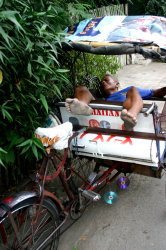
So I dragged my board bag and rucksack away from the throng of clamoring taxi drivers outside the airport and loaded them into a tricycle becak (pronounced “beh-chuck”). You find this cross between a bicycle and a rickshaw all over Indo. It’s cheap and flexible, able to stop anywhere, and it can go places where cars can’t. Whereas it can be difficult to fit a bunch of surfboards into the average taxi, the becak driver simply lets them stick out at an angle and uses the protruding parts to keep pedestrians out of his way. The downside, of course, is that you are very vulnerable on open roads and Indonesian drivers aren’t exactly subtle when it comes to overtaking. My driver pedaled into the kind of heaving traffic you find in most large third world cities. I’m always surprised by how these guys just glide between the oncoming cars and trucks and manage to survive. My driver crossed the lanes, negotiated the turns across oncoming traffic and avoided the cops with a placid expression on his face. There was a Zen-like quality to him in the midst of all this hectic chaos; I never felt scared at all, even though there were some close calls with trucks whizzing past mere only centimeters away. Some people trust in Fate to keep them safe on the roads. I trust in becak drivers.
A well-written travelogue. From the sound of it, it looks like you had many adventures. From my brief trip around the world, sometimes staying in local homes, I understand your love for getting down and dirty rather taking the tourist route. I feel the same way. My only experience with these vehicles, I called them, “cycle rickshaws,” was in Bangladesh. Unfortunately, my host there was the local car repair king, so we always had the advantage of a small car. I'll never forget driving home to the compound from dinner at a restaurant with thousands of these vehicles in the street navigating traffic circles on broad, divided old British avenues with lanterns hung underneath giving the impression of a flowing river of light, each one swinging back and forth as the driver peddied.
An account of adventures in Scandinavia that involved flying dragons, Russian and German submarines, old WW2 era battlefields, Finnish foxes (female kind), Finnish-Mexican cuisine and much more. Written for the most part with a light touch, it ends o