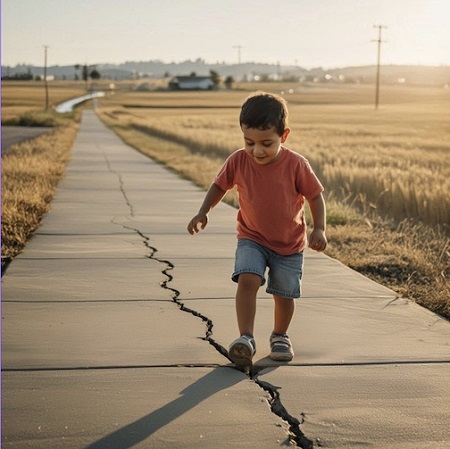
Earl as a young boy, avoiding cracks in the sidewalk
It was the middle of the night, and I was dreaming. The rattling of the sliding glass door to my balcony interrupted my dream. I thought, That must be a very strong storm.
Then my cupboards were rattling the same way. Earthquake! I thought, Where are my pants! But then the rattling stopped. I didn’t have to jump up and find my pants in the dark to hurry out of my studio apartment. I shared the place with no one and liked it just fine, because I wasn’t bothered by anyone else when working in the evening on my computer.
When the rattling stopped, I drifted off to sleep again.
Earthquakes were expected. I lived in California where my company’s inspection and construction projects were located. We had to build to earthquake standards, and part of my work was to make sure that we did.
Morning arrived. I got up, ate breakfast, and made lunch for my lunchbox because I would be in the field all day, and I was tired of fast food. After a quick shower and change of clothes, I was out the door—almost. The doorframe was twisted, and there was a large crack near the top of the door that ran halfway down its side. I could see light on the other side coming through from the hallway. I almost put my finger up there but didn’t . . . Don’t step on cracks or touch them, either!
That wouldn’t do. That wouldn’t do at all. I would have to find another, safer, and better constructed apartment. I reminded myself to drop by the apartment manager’s office and tell them I was breaking my lease. I knew it would cost me, but I didn’t care. I couldn’t tolerate those cracks every day, seeing them coming and going.
As I came to the place I parked my car at the back of the building, I saw some of the stucco on the back wall had fallen off, and there was a zigzag crack on the concrete block wall all the way to the foundation.
I reminded myself again to tell the managers about that situation as well before I packed my things and left what I had thought was a wonderful place to live. A place with a swimming pool, close to a grocery store and the main drag. Where I could get to the freeway within five minutes. I was disgusted with myself for having moved here in the first place. I should’ve been more diligent.
# # #
I was always obsessed with cracks from early childhood. I knew something bad existed wherever there were cracks. In the winter, the cold wind penetrated cracks in the flimsy walls of the farm workers' shack we lived in the Salinas Valley. I remember my mother stuffing old newspapers in those cracks to try to keep us from catching colds as we huddled under old worn-out blankets and shivered through many a cold night. Other nights, it could be stifling hot.
One of my earliest recollections was when I was about four or five and found those dried-up puddles that kids played in during the winter rainy season. I didn't. They became my summer stomping ground. When the mud dried, it left all those cracks that I joyfully stomped on with my bare feet, creating clouds of dust in the wind and causing my mother headaches to keep my trousers clean.
She often chided me, “You’re gonna break my back from having to carry all this heavy laundry you cause me!”
She was joking of course, but I heeded her and stopped stomping out those dried mud cracks. I still wanted to, but I didn’t tell her.
I was determined to do better than my hard-drinking dad, who seemed unable, while unemployed most the time, to put siding on or even insulate that wretched place we lived. Where the old barrel-made wood stove emitted choking acrid smoke into the single room. With no privacy except some sheets hung across our kids’ corner where we could still listen to him come home drunk, making ugly noises as he made my mother quietly take his advances and try to keep from disturbing us when we were asleep.
He was very good at debt, buying fancy cars he couldn’t pay for, gambling and losing more than he won. Always looking for women in bars who generally took him for whatever money he had at the time. Then, one day when I was seven, Mom had to tell us they had found him, face down in an alley, robbed and beaten to death in a place called Las Vegas.
I grew up that day wanting to make sure that Mom as well as my brother and sisters would be able to leave that shack as soon as possible. The next day, I got a paper route. It wasn’t a good one and I didn’t have a bicycle. But after giving Mom all the money I could, I earned myself a used bicycle and started saving for college or technical school each week.
I got good at throwing my neatly folded newspapers right where I wanted them to land. Usually, I aimed at that crack between the steps and the entry to the houses. I vowed to myself that there wouldn’t be any gap between steps in houses I would build and own. It would be seamless construction, no gaps or tripping points for bare toes to get stuck in.
When I had time, I found some old rock wool behind a lumberyard on my route and brought it home. I stuffed it in the cracks and covered it with some construction tarpaper I also found. Gradually, all those cracks disappeared, and the shack became much warmer, requiring much less wood to heat. I got very good at finding wood on my paper route and chopping it for our wood stove. I sealed all the cracks in the stovepipe where the smoke got out, too.
Mom didn't have any technical skills, so she began working as a cleaning lady. We didn’t have much, but we had each other and that was enough. She wanted us all to do well, insisting we do our schoolwork before anything else after coming home from school.
I found it easy to fill in the cracks in mathematic problems others couldn’t seem to figure out. Likewise, through reading library books, many that were adult books that I wasn’t supposed to read, I learned what words to use to fill in the cracks of a sentence, so it had a meaning that was mine and mine alone. I liked that.
During the little time that we had to play games, my two sisters would find a sidewalk where they would chalk out a skipping pattern and then skip to it all day. For my own reasons, I had to check their patterns and make sure they didn’t step on any cracks. I heard the other kids chanting, “Step on a crack, break your mother’s back!”
There certainly was some truth in that rhyme, we learned one day, when old José who lived two shacks down tripped on a crack in the sidewalk, fell, and broke his hip. I got home from school on my bike to find an ambulance there, hauling him off to the hospital where we heard later, he died. Cracks were dangerous. His accident confirmed it for me.
After that happened, I found some caulking material at a local lumberyard. Along our street with its old sidewalks that had seen better days, I began filling every crack I could find with caulk. It didn’t make the uneven slabs even, but it was all I could do with what I had at the time.
I was determined to get a good job as soon as I could, so I took shop classes rather than college prep courses. I didn’t have the money for college, and it would take me too long, four years, to graduate. But when my grades gave me a full scholarship to the nearby state university, I couldn’t pass up the opportunity. By that time, my sisters had good jobs after high school, and my younger brother had taken over my paper route and my bicycle.
Once in college, I took more shop courses and the construction management major that was offered, finding that I excelled particularly in math and creativity when it came to solving technical problems. But I was a washout when it came to social life on campus. I stayed pretty much to myself, merely tolerating a series of dormitory roommates of the playboy mentality. They came and went each year when we didn’t get along.
Right out of college, I got a good job with a major construction company in the Bay Area 100 miles away. I put together a down payment on a small house, bought a used car to get to and from work, and invited my mother and my siblings to come and stay with me.
My two sisters followed me to the same state university and decided to stay in the dorm like me. But my mother didn’t want to leave her house-cleaning and laundry jobs and continued to live in that shack until she died. My younger brother got hooked on opioids and died from an overdose before he was 21.
With my dream for my family dashed, I sold the house and moved into a studio apartment.
# # #
Bayview Construction Company took me in first as an intern, and then when I graduated, they moved me around on all their jobs where I learned a lot about both residential and commercial construction. I did everything from framing houses, roofing them with shingles and tiles which were common in the area, and working with high-rise ironworkers, plumbers and electricians until I learned the codes that made everything safer and functioning correctly.
It was a lot to learn, but by learning all those trades, I was better able to manage crews I was promised. Was, until the day I was called in to see the president and vice president for a conference. I must admit I was scared. I thought I would be fired. They were already in President Joe Myers’s office when I arrived.
As I came through the door and closed it carefully behind me, Joe called out pleasantly, “Have a seat, Earl.”
I nodded and took a chair in front of his desk next to his brother, Randy, the VP. It was a family-owned company.
“Would you like something to drink?” Joe asked. “You look a little pale.”
“No, sir, I just had my second cup of coffee. Just a little nervous, that’s all.”
“You needn’t be nervous, Earl. We’re here to decide what part you may play in our company going forward now that you’ve had a year of working with all our crews. It has been a year, hasn’t it?”
“No sir, it’s been two years, but I enjoyed working with every one of them. Learning something new every day.”
“You seem to be a guy of many talents but a master of none. Is that a correct assessment?”
Randy nodded in agreement with Joe.
“I guess you could say that, but I do have one real concern,” I told him.
“What’s that?” Joe said, puzzled.
“Cracks. If I had the time and money, I would’ve become a structural engineer. I see cracks in construction everywhere, and I’m very interested in making things safer, more precise, and stronger . . . I think of my mother carrying a heavy load on the sidewalk in front of the place I grew up. She might trip and break her back or hip. I want to buy her a car.”
“That's laudable, Earl. We do need an overall inspector of the work we do. What would you say to becoming part of our quality control, checking on all our jobs to make sure they’re the best quality they can be?”
“That sounds like a job I would like to have, sir.”
“Well, I guess that’s what we’ll give you then. Randy will set you up with an office, a radio, and a secretary, along with a company car. You’ll report to him and make regular rounds to all the construction sites, making detailed reports of what you find that needs correcting.”
I got busy. With Randy telling me where to go each day, I appeared, unannounced, at our various job sites with my level, my camera, and a devout ambition to find any anomalies or cracks and stamp them out.
At first, the work crews, who generally only saw their slave-driving bosses, welcomed me since I was from the company headquarters. The foreman would usually come up to me and shake my hand, then whisper in my ear, “Give us a good rating. We’d like the company to know we do good work. And a good word about us wouldn’t hurt, either . . . You know what I mean, buddy?” Still shaking my hand vigorously and patting my right shoulder with his left hand as his form of assurance in the deal, looking me straight in the eye as he blew his smoker’s breath in my face.
I was determined not to play favorites, so I kindly shrugged off deals like this, telling them, “I can’t guarantee you anything. I’m just doing my job like you are. Please let me get to it, okay?”
That usually got them off me. I really hate those over-friendly guys. They’re generally just schmoozing while others do the work. Talkers, not doers like me.
Those first few inspections turned up a lot of inferior materials, poorly constructed structures, bad joints, and many cracks caused by poor fit and finish. The job was like heaven to me as I jotted down each one in detail, numbered it, and took a picture.
When I got back to the office, I would create a meticulous account of what I found and even work late before dropping it off in Randy’s in-tray on his desk. I didn’t trust my secretary or any of the other secretaries to type my work. I typed it myself.
Randy got me a cute secretary who looked to be about 18, but she couldn’t type very well. I asked her for a thermos of coffee in the morning before I headed out, told her to make sure my office was neat and clean, and to answer my phone if it rang.
In a couple of days, the poor girl went to Randy after I left for the day and complained. He reassigned her. When I arrived at the office the next morning, he called me into his office.
“Earl Hamilton! What are you doing? We gave you a secretary and you’re rejecting her! Don’t you know you’re upsetting office politics?”
I slid down a bit in my chair, making myself smaller, but it didn’t work. “I’m sorry, sir, but I just don’t need her. She’s nice, but the kind of work I do and the way I must report it, with charts and graphs, she just can’t do.”
“Why can’t you teach her?”
“Some people just can’t work with the computer like I do. Besides, I don’t trust anyone to do my work. I do my best work in my apartment after work.”
“Okay, Earl. I reassigned your secretary and will use your office for someone else more deserving. You’ll report here every morning for your assignment, and I’ll give you any equipment you need at home to finish your nightly reports. And my secretary will give you some of the best coffee in the whole place. Deal?”
I walked out of his office with my thermos full and with an assignment, feeling a bit relieved, but I didn’t like his tongue-lashing about my way of doing work—I was saving them money.
To be continued...
Copyright 2023 © Ronald W. Hull
7/19/23