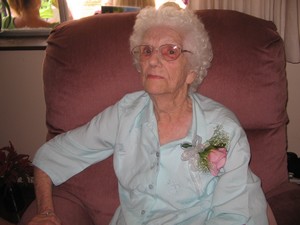
This is a story told by my wife's aunt about what it was like traveling from a rural area in West Virginia to high school in the 1930s.
Margaret
My wife’s aunt— Margaret Adkins— told me once about her ninth and tenth grade years of school in the 1930s. She had grown up at a place called Raccoon Creek in West Virginia, a community with three one-room schools. There, students were educated in grades one through eight. After that, however, their schooling ended at Raccoon Creek because parents couldn’t afford to send their children to high school in Barboursville, nor was there any means for transporting them. The summer after she finished her eighth-grade year at Raccoon Creek, though, a change took place. The Cabell County Board of Education made arrangements for these students to continue their education at the high school level. As a result, a used, flat-topped bus was acquired by the board for the daily trek to Barboursville. Its interior contained a long bench on either side and another across the back. Down the middle was another row of seats that accommodated two students each. In all, the bus held twenty-five or more pupils and their driver, Steve Ramey, also known by all as Ripgear Ramey. Margaret’s testimony regarding some of the hardships she encountered follows:
The winters were the worst. Nobody has any idea how bad things were. I had to be ready to get on the bus by five in the mornin’. It was bitter cold because there weren’t any heaters, so some of us would sit on our feet to keep ’em warm. Sometimes I’d take off my mittens and put ’em on my feet to help keep ’em warm in that way.
It took about an hour and a half to get to school, and we were nearly always late. The road from Raccoon Creek, up Bowen Creek, and all the way to Salt Rock was muddy and axle deep. Sometimes we’d get stuck on Green Valley Hill, so the boys, they’d get out and help shove the bus up the hill. One time Ancil Ramey— that was Ripgear’s boy— slipped and fell underneath it, but the bus was sittin’ still at the time, and he was lucky it didn’t roll back on him and maybe kill ’im.
Besides me, the others that rode the bus were: Tessie Keesee; Hattie Adkins, Ancil and Alfred Ramey; Ruth and Estel Bartram; Sue Adkins; Willis Adkins; Harry and Lorna Adkins, who walked to Bowen Creek and caught the bus from off Hickory Ridge; Ethel and Vernon Lucas; Thelma and Halsie and Verlie Childers; Iona Jenkins; Edithe Parsons; Verda Childers; John Ross; Thelma Walker, Ruby and Ritzel Lucas; Jane and John and Dorothy Holton; and Mabel and Nellie Bias.
On the way to Barboursville, we’d get off in Salt Rock at DeJarnett’s Store and wait for the driver to make another run. Then he’d come back and pick us up and take us on to school. We didn’t have any money to buy anything at the store either. And once we got to school, they’d let us go and clean the mud off our shoes. Nobody ever complained, though. We were just glad to have a way to go to school.
A few of the kids treated us different, but not many. Everybody was poor then. Most of us did without lunch almost everyday. It was the ’30s. There was no money. Some took their lunch, but a loaf of bread cost ten cents, so I couldn’t afford to take mine. They had homemade soup, homemade pie, and hamburgers for five cents each, but I couldn’t afford any o’ that either. My mother called me into the kitchen one mornin’ and gave me eight cents for lunch. And one day during lunch at school, I was standin’ in the hallway lookin’ out the window. Mrs. Spellman, one of the teachers, asked me if she could buy my lunch for me. I wouldn’t let her do it, though. I had too much pride. Now, Harry— we were just goin’ together then— he took biscuits to school but went to the boiler room to eat ’em. You see, he was ashamed to eat ’em in front of the other kids. Oh, we always had a hot breakfast before leavin’ home in the mornin’ and a meal waitin’ when we got home at night, but for the most part, we did without lunch.
On the way home from school, we’d stop at Hatfield’s Grocery over at Roach, get off the bus, and wait there for the driver to come and pick us up and take us home. We’d stop in Salt Rock to fill up with gas, and the driver, he’d fill up two five-gallon cans with gas and put them on the bus, too, so we’d have enough for the trip back the next day. Imagine how dangerous that was. But, like I said— nobody ever complained. We didn’t get home till way after dark in the winter. Sometimes it might be as late as ten o’clock before we’d get home, and our parents, they’d be headin’ out lookin’ for us.
When I was in the ninth grade, they gave us an I.Q. test. Fourteen out of the whole class made above average, and I was one of ’em. I quit school after tenth grade, though. Me and Harry got married. He wanted so bad to finish school, though. One semester, he went to Grayson, Kentucky, and attended Christian Normal School, a place where he could work his way through. He was the only one old enough to drive, so his job was to make the runs for supplies. Harry, he got too homesick, so he came home and finished up at Barboursville, He was twenty-three when he graduated.
Once Margaret had finished her story, I thought, Maybe our having to get off the bus daily to walk across that rickety bridge at Martha when I was a student at Barboursville High in the early ’60s wasn’t so bad after all.
Margaret Kohel Evans invites her mother's grandchildren to a delightful visit with their grandmother, sharing charming memories of her across eighteen life themes.
Jack Kelly was a child performer, son of New York model, Nan Kelly, brother of actress, Nancy Kelly, brother-in-law of actor Edmond O'Brien and cinematographer Fred Jackman, Jr. On TV, from 1957 until 1962, he was James Garner's brother on the show,