Lindsay Joy Odom, aged 10, who lives in Fullerton, California, talks about her first day of Oak Hill Elementary School's special program called "Disability Awareness Week", in the hopes of teaching children about accepting people with disabilities and make them realize that they are more alike than they may think.
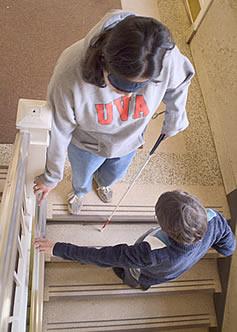
Hi! Lindsay Joy Odom here. I wrote to you yesterday and told you about a program that our school is currently putting on. We are to have a "Disability Awareness Week", which started today, and let me tell you, it was a very enlightening and eye-opening experience...and it was just the first day.
To choose the disability we were to have for the day (for several hours, at least), Miss Gage, our teacher, had us draw pieces of paper from a jar she had, and it had letters on them, letters like W/C, BL, CR, H/I, or M/D, and whatever we chose, that was what we had to be for several hours. The letters stood for "Wheelchair" (W/C), "Blind" (BL), "Crutches" (CR), "Hearing-Impaired" (H/I), or "Mentally Disabled" (M/D). Well, I got "C", meaning I had to use crutches for several hours. Even though I am perfectly capable of walking on my own two feet without any problems whatsoever, I had to use a pair of crutches that attached below the elbow by an armband, and the crutches had a handle that you held on to as you walked. They weren't like the regular crutches most people used when they did something like break a leg or sprained an ankle; these crutches were shorter in length, and, as I was soon to find out, they were a lot harder to use. First of all, I put the crutches on my arms backwards, so that the handles were facing towards my back before Miss Gage said, "Lindsay, you have them on backwards. Please turn them around, so that the handles are to the front!", and when I tried to walk on them, I kept tripping myself. When I got a little bit used to them, I started walking on them, and I had to have them with me at all times whenever I got up. When I was not using them, I had to put them on the ground, but not before some of the kids tripped over them or fell on them since they were in the way. I then put the crutches against my chair, but then they fell over and made a terrible racket when I accidentally bumped my elbow against them. I was supposed to be a person who had something like spina bifida or cerebral palsy that caused me to have to use crutches in order to walk, and it was quite interesting, to say the very least.
By the time the few hours were up, I had gotten pretty good at using the crutches, but it was hard having the other kids in the hall staring at me and my classmates as we navigated the halls with our "handicaps", and it made me uncomfortable. I felt like I was a bug, and it bothered me when people started whispering or pointing at me. It made me think of kids like Guillermo Estevez, Opal Joy Witnowski, and Richelle Graham, all of whom used crutches because of one thing or another, and it made me see them in a new light. While I could walk perfectly, they had been born with disabilities that severely curtailed their ability to walk or get around, and so they relied on crutches (or for longer trips, wheelchairs), and things that seemed effortless to me seemed like unsurmountable obstacles to them. I got to thinking about how they struggled about on their crutches as they tried to carry their lunch trays (often they would spill food or their drinks and would make a big mess on the floor, drop their books or their papers, or fall when they would fall over their crutches if they were carrying anything; their crutches would swing), and it made me feel kinda' bad. They couldn't help the fact that their legs didn't work as well as mine did, and they couldn't help that they needed help in their walking. But they still tried desperately to "fit in", and they tried desperately to prove to other people that they could do things too, they just happened to do them a little differently.
I never was so glad to get rid of the crutches after the experiment was over for the day, but it sure got me to thinking about people who had to use crutches every day and how hard it was for them to walk. By the end of the experiment, my arms were sore from the crutches, and my shoulders were, too. I didn't like my experience on crutches very much, and I was hoping that tomorrow's experience would be somewhat less intimidating for me.
I am hearing impaired,and peoples reaction to disabilities is well worth writing about.This was really good Karen and like so much of your work very interesting too.What loving characters you can create.You have a lot to say which is lovely.And is NEEDED in societies today.Even here in Europe.
Thank you for this.I am a starter,,and someone once told me a looong time ago,a good story should make the reader happy,sad,angry and compassion.
is this true,im reallt elemntary so I WOULDNT KNOW.
ANYWAY,THANKS AGAIN FOR THIS kAREN
Friendly regards Rita
EXCELLENT, informative, educational piece! She learned what it was like...but she had the luxery of putting them down and being "normal" at the end of the day. Thank you, Karen, for writing this--this is one of your best yet!
What would you do if your friend copped off with the man you loved? Wouldn't it break your heart? Abbie is heartbroken when Richard prefers her lovely French pen friend Colette over her.


 Hi! Lindsay Joy Odom here. I wrote to you yesterday and told you about a program that our school is currently putting on. We are to have a "Disability Awareness Week", which started today, and let me tell you, it was a very enlightening and eye-opening experience...and it was just the first day.