A recent art therapy retreat showed me how our images can be a source of wisdom, insight, healing and growth.
I attended a wonderful three-day Women’s Art Therapy Retreat in the Georgia mountains with Virginia DuPre an Art Therapist from Atlanta this fall. She says art therapy invites us to create and reflect on our art work to gain insight, growth and healing. Her role is to be a guide and witness.
DuPre says “when we listen to our image world we discover the strength and wisdom we each have available to us from within ourselves and beyond ourselves.” She says images are the language of the unconscious and point to our own deepest knowledge, knowing and wisdom. The information in our images are a source of healing and growth.
She explained how art therapy taps resources we do not usually access without conscious effort. When we work with images and dreams we enter an archetypal world where it is easier to expand our conscious mind and journey towards wholeness.
No experience is needed to participate in art therapy as the emphasis in on the process not the product.
The first night DuPre asked the nine participants to answer five questions in our journals. What does my mind, body and spirit need? What do I need the group to know? What will be helpful for me to get from the group?
After some reflection I decided my mind needed to be more at peace, my body more healthy and my spirit more free. I also wanted to hear the stories of the other participants, for them to hear mine, and for the group to be truthful with me.
DuPre played spiritual music when we did our artwork. She had different color papers and paint, charcoal, crayons, watercolors, color pencils, collage pictures, beads, cut glass, feathers, ceramic bowls and plates and most anything else we might want.
She instructed us to ignore our internal voice or critic that says our images are stupid or silly. Instead we were told to speak in the first person and to ask our image, “What do you have to teach me today? Is there anything I need to let go of? What do you know that I need to know?” She recommended we not only listen but act on the answers.
DuPre demonstrated a couple of techniques to help us access and express our feelings.
For those us who are self conscious or have control issues she suggested we close our eyes and do three charcoal drawings using our less dominant hand. After each drawing we were instructed to wipe the image with a damp paper towel. The goal is to study the lines until we find an image we want to paint.
The picture that leapt out at me was of a broken, forlorn looking woman in a long robe sitting against a giant rock in the desert. The scene reminded me of Afghanistan.
Another helpful art form is the mandala, a circular figure representing the universe in various religions. A “mandala” in Sanskrit means a magic or perfect circle where time and space cease to exist in the center.
Mandalas are everywhere in the universe, the galaxies, the solar systems, the atoms and cells in our bodies, in nature and in our culture like the Gothic windows in our Cathedrals.
The mandala’s shape shows that the beginning and end are one and how a perfectly fulfilled life does not know a beginning or end. When we realize the mandala pattern is everywhere inside and outside of us we are less afraid of the unknown.
C. G. Jung introduced coloring mandalas in his psychotherapy. He said “I realized more and more clearly that the mandala is the center; it is the expression of all life; it is the path of individuation.”
I learned that something magical happens when we place our image in the mandala’s circle. The mandala can be made of sand, stones, clay, paint or even vegetables. They can be used as an educational, therapy or meditation tool. I read somewhere that working with mandalas teaches us to cope with our limits, to shape the space between our limits and to find quiet and rest within ourselves. They also help us concentrate, relax, gain strength from our own centers, integrate experiences and develop a more rounded personality.
I became fascinated with the mandala and did my next four images in mandala circles. To my surprise I became tearful each time I did one.
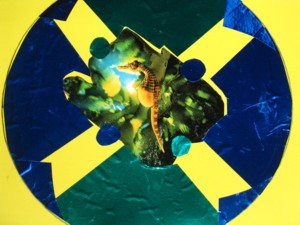
My first image was with crayons and had yellow and blue twirls that looked like something from outer space. The other three were collages with pictures of hummingbirds, a sea horse, a waterfall, a palm tree, mountains and a field of wild flowers at the center. Beautiful shiny blue green and yellow metallic paper surrounded my circular images.
Since our workshop was in the fall, a time of harvest, DuPre asked us to answer five questions in our journals.
What is ripe? What do we want to harvest? What are we letting go of? How is death a part of our lives right now? What we are making room for?
I wrote that I wanted to celebrate my connection with nature, to let go of what I cannot change, to let my savior complex die and make room for joy.
We were then asked to study our images and ask: What is my image saying to me? What season am I in emotionally? What needs to happen next? It was a shock to see that two of my mandalas were at the center of huge white crosses. To my dismay I realized the two white crosses were really scull and bones warning signs. I shared with the group how I viewed the trees on my land as family and once stood in front of a bulldozer prepared to die when a worker tried to uproot our old oak trees. My mandala and tears showed me the extent of my grief about poisoning our planet. I also felt sad for those who had not been nurtured by nature’s peace and were unaware of the planet’s peril. A number of women said they shared my feelings. I now see art therapy as a gentle, safe way to understand, honor, nurture and heal ourselves in a retreat setting and when alone. To learn more about Virginia DuPre’s Individual, Group and Couples Art Therapy in Atlanta go to www.arttherapyatlanta.com or call her at 404-272-3890.
The Free Preview includes excerpts only. The full print edition is available from Barnes and Noble. Both the print and electronic editions are available from the publisher's Web site ("Malignant Self Love - Narcissism Revisited").
The Narcis