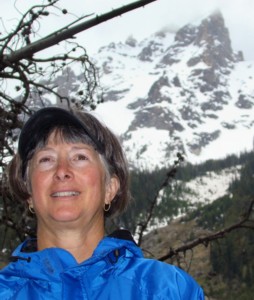
I first saw the craggy over 12,000-foot granite peaks of Wyoming’s Grand Teton mountains on a ski trip to Jackson Hole in the early 90s. Whatever I did the row of twelve shark-tooth snowy white summits drew my gaze. They rose with stunning abruptness above a glaciated valley filled with frozen white streams and lakes.
My dream was to see them in a warmer season when the Tetons’ jagged skyline is a backdrop to clear blue lakes, tumbling waterfalls and wild-flower carpeted meadows.
I got my wish in the spring of 2008. Bud, my husband, and I spent a week camping at Jackson and Jenny Lake. Since we’re from Georgia we read the park safety literature on wildlife with interest. One publication said to stay at least 100 yards away from bear and 25 yards from other wildlife. It said bison injure more visitors than grizzlies each year and that moose, particularly mothers protecting their young, can be aggressive.
Because Jenny Lake is "tents only" every campsite has a large bear-proof food storage box for groceries and scented articles such as soap. The Camp Host told us to be careful as a moose and her calf were hanging around camp.
The campground is nestled under lodge pole pines on the southeast bank of clear blue Jenny Lake.
Bud and I packed a picnic lunch and rode the 10-minute Jenny Lake Shuttle to Cascade Canyon. Since the trail is above 7,000 feet the snow was knee deep. To minimize sinking we followed the well worn compacted foot steppes of others. Hidden Falls’ roar reverberated through the canyon before we saw the waterfall plunge over high cliffs. Scrambling further up the trail we had lunch on Inspiration Point with a panoramic view of Jenny Lake.
We discussed the Shuttle Boat Captain’s comment that the Teton Mountains’ height increases after each earthquake. We were fascinated to learn that earthquakes along the Teton mountain’s fault line causes the mountains to rise while the valley floor drops. Massive glaciers from earlier ice ages have also filled the valley and carved the peaks.
Bud took the boat shuttle back to camp while I hiked the 2.4 miles back to the boat dock around the south edge of Jenny Lake. Since there was less foot traffic I carefully crossed the deeper snow drifts.
A woman sat on a tree stump overlooking a small lake. “There’s a black bear over there,” she whispered. I looked at where she was pointing and saw a tiny outline of a black bear. It was slowly foraging among the bushes. A young man arrived from the opposite direction. We pointed out the bear. He said he’d just seen a moose and her calf.
We left when the bear disappeared.
I froze when I rounded the next bend. A moose stood eating right on the trail. Since the snow looked hip to knee deep in the adjacent woods it seemed wise to wait. I scrambled up a nearby shoulder-high rock and sat down. Five men stood on the other side of the moose.
To my horror the moose looked up at me and began walking towards my rock. I looked pleadingly at the men. They stood wide-eyed and open-mouthed.
I felt my heart pounding. The moose made a low bleating sound as she drew near.
I held my breath. She passed within inches and disappeared in the woods.
The men came forward. “Are you okay?”
“Wow, did you see that?” I laughed nervously. “I could’ve touched her head.”
I jumped off the rock and showed them my shaking hands.
The men said my location may have made the moose nervous as she had a calf nearby.
Since Jenny, String, Leigh and Jackson lakes are located adjacent to each other at the base of the Teton Range Bud and I decided to canoe the 1-mile long String Lake the following morning. Since the lake is shallow (10 feet at its deepest) and relatively warm compared to the other lakes it was safer. Like Jenny Lake String lake is surrounded by lodge pole pine, spruce and fir trees. We had lunch on a bridge near the canoe portage and hiked the southern tip of Leigh Lake.
We also spent a few days at Colter Bay Campground on Jackson Lake’s 17-mile long and nine-mile wide vast expanse of water. The lakes deep gouge was created 10,000 years ago by retreating glaciers. The azure water empties into the Snake River and eventually turns south and then west through Snake River Canyon into Idaho.
Like a compass my eyes seldom moved away from the Tetons: her white snow caps, shrouds of wispy clouds, varied moods and pink and yellow evening afterglow.
Being held captive by the Tetons’ magic was pure bliss and I mourned when we left.