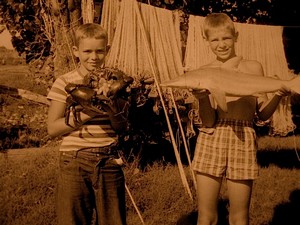
I reached through the fence line, spun the valve, and then stuck my hand under the trough's nozzle. The water was cool. I watched a fly struggle to climb the side of what had been Gramma's bathtub. The tub had been a gift from her husband Chipper, long before they had running water at the ranch. They'd divorced soon after the first pipes brought fresh water to Hale Kia. Because Chipper had no money and no where to go, Gramma gave him a life estate on the banks of the mangrove swamp.
The mares stood under a mango tree out in the pasture. They were waiting for the mangoes to fall. Sandy and Cody faced off and began nibbling one other's neck—that's how they reached the hard places. Whenever stallions trespassed, the mares rubbed their rumps against the smooth wire.
I leaned over the top strand. The steel flexed down and tightened to accept me. I felt good hanging there, with just my toes touching the ground.
The wire was warm against my bare chest and I looked up and followed the red scar of road cutting along the ridge. I could see the hunters' orange truck crawling down through the pines like a ladybug through sour grass. It was already through the third gate. Only two gates remained. Gramma had once again leased her mountain to the cattle rancher. The lease continued on even though my father was the new owner. Water spilled over the lip of the trough so I spun the valve back and the water eased off. I was glad my father wasn't with me because he loved pointing out examples of "plain laziness." He expected my older brother Ben and me to be perpetual motion machines on the ranch. His favorite thing to do was compare us to himself when he was a boy. According to him, we were tenderfoots who couldn't "hold a candle" to his accomplishments.
I wondered if the hunters could see me in the pasture. They'd come early for the keys and I'd recognized Moki from earlier expeditions. He'd promised to never shoot a doe because Gramma was worried the wild deer were disappearing. Moki had returned with a headless and gutted deer that he claimed was a spike. When Gramma'd asked why he bothered butchering it in the mountains, Moki said it made packing it down easier. She'd refused his offer to give her venison steaks.
"That's no spike," Gramma had said when Moki returned to his truck.
"Hope he chokes on the meat," Ben had replied.
I walked through the long blades of pili grass back to the house. My father was inside the house waiting because Moki had the keys to the gates and he wanted the keys back. Although Hale Kia was his, he wanted to maintain the illusion that Gramma still owned it because she commanded respect on the east end. He equated that respect to fear because the locals knew Gramma had an itchy trigger finger. He also realized that his half-brother Tommy had friends on Moloka'i and, if they knew about the change in ownership, they'd tell Tommy. My father wanted decades to pass before his brother found out.
Ben was on the front lawn wrestling Gramma's poi dogs. Ben took after my mother in looks—he had blond hair, green eyes, and refined features. I had the dark complexion and wide nose of my hapa haole father. My mother wasn't around because she always spent summers in her hometown of Boston. The dogs took turns charging him and he grabbed their snouts and flipped them over on their backs like turtles. We were juniors at Punahou School in Honolulu and Ben had started hanging out with a group of rebels who hated everything our school stood for. Ben kept a .22 rifle in his room. He'd use it for crazy things like firing at the KGMB traffic helicopter from our backyard. Then Ben bought a new gun with more fire power for Moloka'i—a .257 rifle with a sniper scope.
The smallest poi dog left Ben and barked at me. I held out my hand and, after the dog sniffed me, it wagged its tail.
"These dogs hate me," I told Ben.
Ben hunched over like my father. "Now, Jeffrey," he said, "did you water those horses?"
"The orders increase whenever Mom leaves," I said.
"He's a five star General," Ben replied.
One of the poi dogs stood on its hind legs and pawed Ben's swim trunks. Ben flipped the dog over and started drumming on his belly. "This honay's gotta fat rice belly," he said in his falsetto voice. The dog wagged its tail.
I saw my father standing behind the screen door. He was looking at the mountains through a pair of binoculars. He wore a V-neck with holes and wrinkled khaki shorts. There was a permanent hunch in his back and he always looked like he was scowling, even when he was laughing.
"Moki's coming down," I told Ben.
Ben rubbed the dog's ears. "Sounded like a war up there."
"Think they got anything?"
"Who knows," Ben said. "Let's report to the General."
We walked up the knoll and stood outside the screen door while my father adjusted the focus.
"Second gate?" Ben asked.
My father didn't answer. His hair was salt-and-pepper and he kept it greased back with Yardley's hair cream that smelled like rotting fish. His face was covered with stubble. I was taller than him by two inches when he slouched and I knew I could take him in a fight. But fighting him would only prove I was stronger; Gramma would say I'd attacked the man who had given me everything.
"Dad?" Ben asked again.
"What."
"Have they passed the second gate?"
A rooster crowed from deep in the valley.
My father lowered the binoculars. His eyes were red. "Get inside," he said.
I followed Ben in and the screen door closed behind us. Smoke clung to the ceiling. My father sat down on his Lazy Boy and put his feet up on the foot rest. He watched a football game on TV and started drinking Miller's High Life out of a bottle. Water droplets from the bottle beaded up on the leather armrest. "God damn Forty-Niners," he said.
Gramma sat at the head of the dining table. The hunch in her back was even more pronounced than my father's. She smoked through a chrome holder and flicked ashes into a can with an "Indian Pudding" label. Her lauhala hat sloped over her forehead. A copy of TV Guide was open in front of her with shows circled in pencil. Each summer she escaped more and more into television, as if the world portrayed on that tiny screen was more important than the world around her. She no longer rolled the bails of lauhala because it was too painful and I was doing most the cooking. But her imagination kept humming right along—she kept seeing my mother and Ben in commercials despite my pleadings to the contrary.
"Why wouldn't Ben tell you he's on TV?" I had asked her.
" 'Cause he's a sneak."
"What about my mother?"
"She's sneaky too."
On TV, the Dallas Cowboys intercepted the ball and ran it all the way back for a touchdown. Ben cheered.
"That Brodie's the bunk," Gramma said.
"Cowboys all the way," Ben said.
"We wait," Gramma said, "we wonda."
"It's still preseason," my father reminded Ben.
Ben sat down at the table, a chair away from Gramma. "The
Forty-Niners are mahus."
"Why mahus?" Gramma asked.
"Have to be to live in San Francisco," Ben replied.
I sat between Gramma and Ben. I searched for the orange truck through the window. I wanted to be part of the waiting. I figured that Gramma let Moki hunt because she knew if she didn't, he would just end up poaching. An angry Moki might burn down her mountain house or poison the horses with barley meant for rats. It was better to have a friend on the east end than an enemy, especially if that friend was Hawaiian.
"Jeffrey," my father said, "how many shots did you hear?"
"Six or seven."
"Really?"
"I think so."
"Don't 'think so'," Gramma scolded. "Learn to 'know so'."
"I heard at least nine," Ben said.
My father finished his beer and belched. "Gramma says twenty."
Gramma crossed her legs. She had on denims. "Warned 'em not ta shoot any does."
"Don't worry, Gramma," I said. "They got nothing."
"Buncha duds," Ben said.
"Why duds?" she asked him.
"Why would they take so many shots?"
My father chuckled. "Ben's gotta point there, Mother."
Gramma shook her head. "Time will tell."
My father looked at the TV, then at the screen door, then back at the TV. He peeled the label off his empty bottle and rolled it up into a ball. "Why in Hell didn't they punt?" he asked. He dropped the balled up Miller's label into the bottle and jammed the bent cap over the bottle's mouth.
Gramma plucked her Chesterfield off its holder and crushed it against the bottom of the can. "A good hunta needs only one shot," she said.
"What if they kill a lady goat?" I asked.
"Goats are okay," my father said.
"What if, what if," Gramma said. "What if the rabbit hadn't stopped?"
* * *
When the orange truck parked on the lawn, my father opened the screen door. Ben and I followed him out. The poi dogs lifted their legs over the truck's wheels and sniffed at the tailgate. A tarp was pulled over the bed. The doors swung open and two men got out and stretched. They smelled like a day's work.
"Hello, Moki," my father said.
"Long time no see, Mista Gill," Moki answered. He wore red overalls and a puka shell necklace. His hair was gray and coarse. He placed his boot on the front bumper and tied the lace.
The other man wore a black tank top. His arms were red and stained with tattoos. He pulled out a rifle from behind the seat and slid the bolt action to check the chamber. He wore camouflage pants and a black cap with "Hanoi Hilton" embroidered in gold. An unlit cigarette hung from his lips like a fuse.
Gramma came outside. "Ya fullas have any luck?"
"A'ole, Brownie," Moki said and handed her a wire loop strung with keys. "Cades get all da luck."
Cades put his rifle back in the truck. He scratched a wooden match over the truck's roof and carried the flame to his mouth. He took a hit and blew smoke through his nose. I recognized him as the haole hunter we'd once caught poaching. He pretended not to know us.
My father glanced back and forth between Moki and Cades. It was as if he was watching them from a distance, as if he still held the binoculars.
Cades walked to the tailgate and signaled Moki with his eyes. They lifted the tarp.
Ben climbed up on the bumper. I joined him and looked into the truck's bed. A pair of eyes stared back. There were horns that looked like they were made of velvet—I touched one and it felt spongy. The hide was dark brown with white splotches and blood hardened on the steel bed. I couldn't find the bullet hole.
"Where'd you shoot 'im?" Ben asked Cades.
"In the heart."
"Skin 'im hea, Brownie?" Moki asked.
Cades took off his cap and put it on backwards. "You folks take da hind quarta," he offered.
Gramma put her hands on her hips. She looked up at the mountain then back at the men. "Use that big ironwood nea' the dump. Ya know the one, Moki."
"Short on rope," said Cades.
"My mo'opuna'll run some ova," she said. "C'mon, Ben."
"Jeff'll do it," Ben said.
My father looked at Ben. "You heard your grandmother."
Ben followed Gramma inside.
Moki and Cades climbed back into the truck. I watched my father walk over to a hala tree next to the house—he urinated on its trunk. Moki drove the orange truck toward the hanging tree.
* * *
I knew the hanging tree. It grew beside the dump. Once, instead of fishing, I'd climbed the old ironwood and swung from its branches. I'd felt the scars from the ropes. Now I stood under the tree watching the truck back up over the ironwood needles. The ground was a shifting puzzle of light and shadow. I could hear the ocean, but I couldn't see it. I stood under the ironwood as the truck pulled up to Chipper's shack and then backed up.
Ben jogged across the lawn with three coils of rope and a Buck knife with a ten-inch blade. The poi dogs jogged beside him and he joined me under the ironwood. "We get meatsies," he said.
"Ever see that guy Cades before?" I asked.
"Yeah," he said. "Fuckin' poacher."
The truck stopped and the poi dogs crowded the tailgate. Ben handed Moki the rope and Moki tied slipknots around the hooves. Cades threw the ends of the rope over the branches.
My father stood on the grass, back in the light. "Need any help?" he asked.
"No need," said Moki.
Cades nodded. "Dirty work."
Moki and Cades hoisted the buck up and out of the truck. There was a snapping sound as the head twisted down and the body swayed. The tips of the horns made patterns in the needles. The men pulled out their skinning knives and the poi dogs gathered under the carcass. Moki began cutting the hide at the hooves. Cades did the same. They'd already gutted the buck in the mountains, but blood still fell. Flies gathered. The dogs licked the blood off the needles and one growled as he licked. Ben shaved the blond hairs off his forearm with the Buck knife.
"Going to mount that head?" my father asked.
"No can, Mista Gill," said Moki. "Stay one velvet horn."
"He's a beaut," my father continued.
Cades held his cigarette in the corner of his mouth and stared at my father. Then he pulled the hide down over the meat.
"Cut da hind quarta," Moki told Ben.
Ben raised the Buck knife and started sawing away at the meat. Blood trickled down the blade and splattered. A dog licked the blood off Ben's feet.
My father crossed his arms. He shifted his weight from one foot to the other as they butchered the animal.
"Like hunt?" Moki asked Ben.
"Sure," Ben said. "I love venison soaked in soy sauce."
"Ben's a good shot," my father said.
"Next time," Cades said, "we'll take your boy."
"Would you like that, Ben?" my father asked.
"I can go myself."
Cades slipped his knife into the chest cavity and carved through the cartilage. "What kinda gun you got?" he asked Ben.
"A .257 Remington."
Cades nodded. "That's a good gun."
Ben had killed his first buck with the .257 but it only had one horn and that horn was small. He'd fired from the mountain house to the opposite ridge and I helped him pack it down through the valley. Gramma had laughed when she saw what she called Ben's "one horn trophy." She'd told him he would never shoot a buck as big as the one she shot in the gardenia grove next to her mountain house.
Ben hacked through the hind quarter. Some of the meat fell and the dogs gobbled it up. "This blade couldn't cut butter," he said.
"Mine's like a razor," Cades said and handed him his knife.
Ben took the knife and resumed his cutting. "Now this is more like it," he said.
More flies smelled the blood and they came in swarms. Moki twirled the end of a rope, but they kept coming. The flies were blue and it became a frenzy of wings. The maggots fell like snow.
"Cheesus," my father said.
"No worry, Mista Gill," Moki said. "We wash da meat."
"I'll get a hose," my father volunteered. He walked over to Chipper's water pipe next to the jasmine. There was no sign of Chipper and my father didn't knock on his door to ask permission. The blue tarp roof of Chipper's garage fluttered in the breeze.
My father struggled dragging the hose. Somehow I couldn't see him as the boy he'd claimed to be. He'd bragged about taming wild horses in the high country, hiking to find the source of the falls, and killing a hammerhead shark with a single thrust of a steel fence post. Then something hit my face—it was
wet and it squirmed down my cheek. I flung it off and headed for Kainalu Stream.
"Jeffrey," my father called. "Help me out!"
I pretended not to hear. I jogged through the sour grass along the bank. The grass stung my legs and I followed a narrow path until I reached the ocean. I cupped my hands where the water was clear and washed my face. I put my feet in and felt clean again.
I wondered what the men were talking about. My father was probably running me down. "That kid's a damn sissy," I imagined him saying. Then it would get back to Gramma and I'd never hear the end of it. Even my mother would know when she returned from Boston.
"Hey, Jeff!" Ben called. He ran along the path with his Buck knife and jumped down on the sand. "How 'bout that Cades?"
"Acts like he doesn't know us," I said.
"I'd like to gut 'im."
"Did you see the General dragging that hose?" I asked.
Ben washed his knife in the ocean. "He's an okole kala kua'aina,"
he laughed. His teeth were white.
He was still that young.
Want to review or comment on this short story?
Need a FREE Reader Membership?
Reviewed by Darcy
6/19/2002
Excellent--think this could get published in a university review!
About the clients and escorts who once were part of Professional Escorts of Marin County, California. The timeframe was from 1974 until 1990.
You will enjoy the easy to read book that gives a glimpse into escorting. Enjoy the read.
Jamie was a healthy, active 12-year old who loved to skate and played hockey as well as any boy. Then one afternoon during a game, she suffered a stroke that changed her world. Her memoir takes the reader through her ordeal and her journey out of the