I am pleased to announce that this original short story will be published in early May by The Jewish Press (NY),The Largest Independent Jewish Newspaper in America. www.JewishPress.com
Tefilin and Teacher The time was 6:03 A.M., and I was already late for shul. My father had passed away in October of 2008. I say Kaddish for him. Morning brochos had begun at 6:00 o’clock. I had to be there within four minutes or miss the Rabbinical Kaddish. To worsen matters, I hadn’t taken my 3 o’clock Parkinson’s meds on time and began feeling a rise in what I call my “trembling index”. Laying tefillin, I anticipated, was going to be a problem but one which I had faced before. I hurried off to minyan, arriving in time to join the others in declaring: Y’he sh’may rabba m’vorach le’olam ulolmei allmayaw.
Minyan was more crowded than usual. Two new fellows had shown up to my right. Ordinarily a table of three, we had grown to five. I felt cramped. “This is not going to work,” I thought, trying unsuccessfully to don my talis. I gathered up my stuff. Needing more room, I opened the side door to the main sanctuary. I found its private refuge to be helpful on mornings like this.
With enough light from the hallway, I managed to get my talis and tefillin on after ten minutes while listening to the shliach tzibur race through Yishtabach with a single gulp of breath. I checked my Rosh quickly and reentered the beis medrash in time for the Borechu.
When I came to “…ukshartam l’os al yadecha v’hayu letotafos bein einecha …” my thoughts turned back to an earlier time fifteen years before.
The first chapter of Pirkei Avos enjoins us to accept a teacher upon ourselves. As it happened, it was Mr. Irwin Parker who first accepted me upon himself as his student after wandering into the minyan where he served as gabbai.
An apothecary by training in pre-war Poland, Mr. Parker later survived Mauthausen. His wife and children were among the Kedoshim. Reb Isser, as I learned to respectfully address him, stooped forward, a result of the beatings inflicted by the kapos at Mauthausen. The same perpetrators broke his nose repeatedly. Never reset properly, it became permanently misshapen, its tip misaligned with a crushed bridge. Other beatings damaged his eyesight, causing his left eye to float. A man in his late 70s when I met him, Reb Isser bore the moral authority of one whose quiet tenacity to overcome permanent injuries proved indisputably that a new pharaoh had arisen but failed to destroy us a generation before.
I never asked Reb Isser why he had taken me under his wing. Perhaps he saw in me a fledgling fallen from the nest or the shadow of someone he lost in his previous life … but to me Reb Isser was a man I had always wanted to know, a giant yet so small, a wise man yet so every day, a Jew who had been to hell and back. As a boy, I had been taught to rise up before the hoary head. Learning from such a man would be an experience I’d relish.
One afternoon he took out a small blue velvet bag from inside the portable bima.
“Roll up your sleeve,” he nodded toward my left arm. “Slip your arm through this loop and slide it up to your bicep.”
“Like this?’ I wondered, so nervous my legs were shaking.
“No, no. You see this knot? It has to be on the inside facing your heart.
“Oh, okay. I got it.
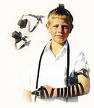
”We tightened the slip knot to my bicep and wound the black leather strap seven times around my forearm.
“Nu?” he waited. “Mach a brocho …”
“ … al mitzvas tefilin?” I asked reluctantly.
He gave me one of those looks.
“ … le haniach tefilin, right?”
“Yes. Now the Rosh. Remember? Bein einecha.”
“Okay, got it. How’s this?” hopeful I had gotten it right.
“Ach, a yiddishe man!’ he kvelled.
I felt like such a kid.
I invited Reb Isser to my house one afternoon for tea and to show him-as I had wanted to do for a long time-a photograph of my Grandpa Harry Austin to whom he bore a striking resemblance. He was nearly speechless when he saw his own likeness in the person of my grandpa. He then placed a sugar cube between his lower lip and gum before he sipped his tea. Nothing less than a sweet fragment of an old world, it reminded me of what I had
seen my grandfather do as a boy.
I watched him intently, this righteous man who often likened the tefilin shel yad to a telephone hand set and the shel rosh to its receiver.
“Our tefilos,” he said, extending his metaphor, “are long distance calls. If you dial His number often, you get unlimited minutes for less money.” Steam from his cup momentarily clouded the sparkle of his blue eyes.
“Kinda like a divine telephone service plan, right?”
“”You’re learning, Reb Avrum. Boruch Ha Shem!”
“More tea, Reb Isser?” He nodded. Happily, there were plenty of sugar cubes.
Years later, that morning in shul, as we neared the end of the second Ashrei, I realized how, in “straightening the bent”, The One Above enabled Reb Isser to give over a tiny but critically important part of Torah. The inconvenience of Parkinson’s Disease, I resolved, would not lead me to forsake the mitzvah of tefilin, Reb Isser’s brocho to me.
In "A Touch of Your Presence" are words that would inspire, encourage and strengthen one's soul when faced with challenges and difficulties and to know the awesomeness of God's power.