My mother and I were extremely close—best friends, actually, although it wasn’t always that way. When she died, it felt like part of me died with her, as cliché as that sounds. We didn’t always get along, but circumstances kept us together, at least in my view. First, my sister went away to college, came home, graduated, and went away again to graduate school. Then my maternal grandmother, who lived with us, died. My father became ill, lost his job, and died shortly after that. My sister got married a couple years later and then made her new home hundreds of miles away.
With each of those events, it grew harder for me to leave my mom and venture out on my own. I felt that she needed me, and I certainly needed her, although I probably wouldn’t have admitted it at the time. There never seemed to be a good time to leave home even though I was itching to have my independence like any normal twenty-something. More and more, we seemed to get on one another’s nerves and be at each other’s throats. Like two animals in captivity, deep down we both knew we’d be happier dwelling in separate cages.
My mother actually found my first apartment for me. I had come home from work one day, and there was the newspaper, folded open to the Classifieds section. A red circle drew attention to an ad for a one-bedroom apartment, reasonably priced, located just five miles away. We looked at the place together, and I fell in love with it on the spot. I signed the lease and moved into the apartment, signifying the end of one chapter of my life, but heralding the beginning of a new one.
That was also the day we became friends.
Our bickering stopped and, more than ever before, I began to realize how much I valued her opinions. My mother had been a homemaker most of her life, and I had been a parasite all of mine. She delighted now in her new role as “welcomed advice” giver and tactfully pulled me back from bad decorating choices, fortunately before any significant purchases were made. I did make some good selections in the process, though, and my new apartment gradually began to reflect my own personality.
A couple years later I “moved up” and bought a place in the suburbs. My mom sold her own home several years after that and bought a condo just a mile from my townhouse—easier for her to maintain and close enough to one another in case of an emergency, but far enough apart to give us each our privacy.
But then she died. She got breast cancer, and surgery removed the malignancy. Six months later, cancer was discovered in her chest wall. A nasty bout of shingles attacked her spine, and by October of that year, she passed away. I sank into a deep depression and cried almost all the time. I’d cry while dressing for work in the morning. I’d cry in the car driving to work. I’d cry in the privacy of the restroom during the workday. And I’d cry on the way home. Nothing eased the ache in my heart. I couldn’t imagine ever feeling any less sad.
My good friend, Lois, suggested we spend Thanksgiving together as her kids would be with her ex. I offered to prepare the turkey. It was good to have the company, especially on my first holiday alone. After dinner, she left to pick up her children, and I busied myself clearing up the dinner dishes. Later, I absently flipped through the TV channels but, not finding anything appealing, turned off the lights and went to bed.
The next day I got up early because the woman who cleaned my house (my guilty pleasure) was due there shortly. I left for work before she arrived, and the rest of the day was unremarkable, quiet actually—it was the day after Thanksgiving, and many other businesses were closed.
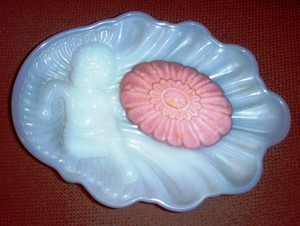
My mother had two small decorative bars of soap that she treasured along with her other collectibles. Each oval bar was baby pink in color and carved to resemble a flower’s layered petals. She tucked one away on a closet shelf for safekeeping, nested in its tissue-lined gift box. She placed the other beside a little, reclining cherub on a delicate, milk-glass dish, to be admired but never used, like her fancy candles that were “too good” to burn.
After she died, I claimed the two decorative soaps for myself. Just as she had done, I put one away and set the other one in its dish on the edge of my kitchen sink. It was the last thing I looked at each morning before leaving for work and the first thing I saw when returning at night. It seemed to represent my mom’s spirit watching over me and my house and then welcoming me back home. That evening I came in from work and, out of habit, went directly to the kitchen sink to wash my hands and get ready to prepare dinner. I glanced at the milk-glass dish—but it was empty! My stomach clutched for a second, but then I forced myself to relax and mentally reach back in my memory to that morning. I was positive I had seen the soap there in its dish before I left for work.
Remembering that the cleaning lady had been there that day, I hurried out to the garage and carefully picked through the garbage bags she had tied up neatly in plastic trash bags. I dug through both bags, but the dainty pink bar of soap wasn’t there. I went back inside and telephoned my housekeeper, asking if she had placed it elsewhere, but she had no memory of it. She offered to come back to help me search because she sensed how important it was to me. I declined her offer, of course, hung up and rummaged through the garbage bags again and then the kitchen cabinets and drawers, “just in case.” No luck.
Later that evening, I called Lois and told her about it. We reviewed my search efforts, and she asked if I had checked the sink disposal. In my agitated state, it hadn’t occurred to me to look there. I held my breath, reached down inside and with simultaneous feelings of relief and heartbreak, I felt a mushy, oval object languishing at the bottom of the drain. I lifted it out and gazed through my tears at the now unrecognizable shape in my hand that once had been my mother’s treasured bar of soap. It must have fallen into the drain accidentally during the day. I couldn’t bear to throw it out, even if it was no longer beautiful. I set it on the edge of the sink to dry overnight. I’d deal with it tomorrow.
The next morning, I awoke and went into the kitchen to make breakfast. I casually glanced in the direction of the sink and did a double-take. My eyes riveted on the once-again empty glass dish on the counter on which I had placed the wet bar of soap the night before. It was gone! I raced to the sink and drove my hand down into the disposal once again, like a diver thrusting into a pool at a swim meet. But the drain was empty. I searched and I searched, but I never found the soap again.
About a year later, I read that grief counseling would be offered at my church one evening a week. The name of the facilitator was the same as mine, Annette, so I took it as a sign that I should attend. I’m very big on “signs.” I hoped she might help me discover the way out of my continuing sadness over my mother’s death.
I joined the group and, as the weeks rolled by, listened to each one tell his sad story. Everyone else’s sorrow depressed me even more than I already was, and I began to wonder what people got out of these meetings. How could that help anyone, feeling more miserable by just being there, enduring everyone else’s desolation along with your own? It didn’t help to know “I wasn’t alone,” that others suffered, too. I was suffocating. It felt like my tears and their tears were turning to quicksand, making me sink even deeper into my depression.
I continued attending the sessions anyway but I felt restless because, in my heart, I really didn’t want to be there. When I had first signed up for the sessions, I had assumed the other group members had also lost loved ones through death, that there would be a commonality from which we could all draw strength and move forward. I didn’t expect to see people there who had lost marriage partners through divorce. Never having been married, it was difficult for me to relate. I could feel compassion for them, but I really couldn’t understand their pain, and I assumed they couldn’t understand mine. Inside, I was stretching toward the door, yearning to leave. I wasn’t getting anything out of it and was still so very sad. I wanted to be nurtured. I wanted to be healed. None of this was happening.
There was no obligation to speak while in the group. Annette invited people to recount a memory of a lost loved one when (or if) they felt ready to talk. I listened to the others speak, but only half-heartedly. I was there physically, but my attention easily drifted back to licking my own wounds. Group members related snippets of memories about loved ones that had made them feel good or made them feel badly. Each one’s story came from his own stage of healing. Then there was silence. That happened a lot. Annette was good about allowing the silence to run its course. She would know just when to speak, just before the silence became awkward.
But one night it was I who broke the silence. I wanted to talk. After all those evenings of just sitting there listening to others, suddenly I needed to tell my story. There were so many things about my mom that I wanted them to hear. But how would I know which to pick? And why was I doing it—to portray her in the best light? To portray myself in the best possible light with her?
My own urgency took me by surprise, and I heard the words cascading from my lips without being able to stop them—and it was all about the lost bar of soap, of all things. It had been approximately a year since that incident. I jealously safeguarded the remaining bar of soap, still cocooned in its tissue paper wrapper and gift box. I didn’t know why I was telling that story, other than I was still upset about it. It wasn’t the only remembrance I had of my mother, but it was yet another piece of her that had been torn from me.
As the details tumbled out, I felt the same emptiness I did when I realized I hadn’t been with my mom when she passed away, the one time that I had left her by herself. I had no idea what time she actually died, but I’m sure it was on “my watch.” I had stayed late at the office to finish a project. I phoned her to let her know I’d been delayed, but there was no answer. That’s when my boss told me to leave and check on her. Those were the two demons that haunted me constantly—that I wasn’t with her at the end and that I lost the precious bar of soap that she treasured all those years, something I knew she loved and would have entrusted me with. I failed her twice.
No one in the room spoke, not even Annette.
But then she ended the silence and said, “You are very close with your mother, aren’t you?” (Not “you were close,” but “you are close.”)
I found that very strange but intently took in every word.
“You understand,” she continued, “that your mother has not left you, that she’s always with you, don’t you? But she needs to be where she is, and you need to be here, where you are. You no longer have to wait to get home from work to tell her something. You can tell her the very second you think about it. She knows instantly, even without you having to speak the words. You can always share with her ‘in the moment,’ the moment that something happens.”
Then Annette focused on the day my mother died, about how bad I felt because I wasn’t there with her and that she had to die alone. She reiterated what I had told the group before—that when my mom got sick, I was with her everyday, sometimes more than once a day, since I worked just a couple miles from her. I was there with her all day every Saturday and Sunday. Annette acknowledged that my mother’s pain was unrelenting, but perhaps she was trying to stay alive for my sake, because she knew that I needed it, that I wasn’t ready to let her go yet. She said that the one time I wasn’t there gave her permission to leave.
“I believe the missing soap is a metaphor,” she went on. “Your mother is still talking to you now. She’s saying, ‘Wash your hands of this and let go.’ She didn’t disappear along with the soap. Only the pain disappeared.”
And in that instant, in that very millisecond of time, my own pain ended. It was as if she had flipped a switch, turned a dial, made it stop. At once I understood, and I accepted it. It was done, and I could finally allow my mother to go, to “rest in peace,” and I was at peace, too.
I stopped fighting it and won the battle over my demons. Once again, I could recall memories of her with fondness. There had been enough painful memories of her illness for both of us. I didn’t need to think about them anymore. And my search for the soap ended, too. That was the last time I attended grief therapy. I had stopped grieving. The remaining bar of soap now resides on my bathroom vanity (without risk of losing it down the drain), and I can look at it now and smile.
I’ve prayed to God for many things during my life. Most of what I’ve pleaded for I haven’t received, at least not in the way I’d envisioned. I finally learned how to pray the most simple, but most powerful, prayer of all: Thy will be done. Now I receive everything I need because I’ve stopped trying to be in control.
Thank you, Annette. Thank you, Mom. And thank you, God, for my miracle. Thy will be done!