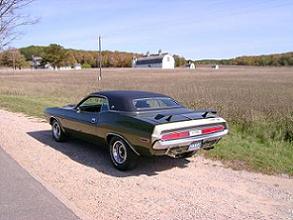
The Challenger of Then and Now
After decades of nonproduction, Dodge recently began producing the legendary hemi-powered Challenger sports car again. To capture the era, the 2010 Challengers were styled to resemble the original 1970 Challengers. While the new generation of Challengers might resemble the old school Challengers, they easily surpass the originals in safety, cornering, braking, top-end performance, and fuel economy. However, it was the 1970 Challengers that were optioned for quarter mile performance, manufactured by hand, and that have amassed an eclectic patina of owner histories that can never be purchased with 2010 models.
Unlike the 2010 hemi-powered Challengers, most 1970 hemi-powered Challengers were optioned for quarter mile performance. The hemi Challengers of today include all the modern comforts as standard equipment to attract the modern-day sport-car buyers. They have power steering, power brakes, power windows, cruise control, air conditioning, and, of course, a compact disc player, all included as standard equipment. However, to satisfy the 1970 buyers, Dodge offered none of those options as standard equipment on the Challenger. Back then buyers could order most of those options, but the majority elected to forgo the luxury items, so they could own a lighter and faster Challenger for drag racing. Power steering robbed horsepower, and air conditioning wasn’t even available with the optional 426 hemi engine. As for a stereo, an AM radio was standard unless someone ordered an AM 8-track, but many ordered their car’s radio deleted to save weight. Imagine trying to sell a new car today with no air conditioning, no power steering, no power brakes, and no radio! Yet, that is the way many muscle cars were optioned back in the day for drag racing. In 1970 almost every option was a` la carte, whereas in 2010 almost every option is standard. In 1970 most of the buyers who opted for the powerful 426 hemi wanted the elephant-sized motor in as light of Challenger as possible. Whereas, today’s buyers want the 6.1 hemi, which is just as powerful though much smaller in size than the 426 hemi, placed in a Challenger heavy with luxuries.
Not only were the 1970 Challengers optioned differently than the new Challengers, they were also manufactured differently. Currently, the 2010 Challenger’s 6.1 hemi engines are robotically assembled in Mexico, before being shipped to the sole Canadian manufacturing plant that robotically assembles all of the new Challengers. But in 1970, the 426 hemi engines were all hand assembled at Chrysler’s Detroit-based tool room, by skilled machinists, before being crated and shipped to one of the two U.S. plants that produced the 1970 Challengers. Today’s Challengers are almost entirely assembled by computer controlled robots that also paint the entire car. In contrast, the 1970 Challengers were almost completely hand assembled and spray painted.
For about forty-three thousand dollars someone can buy a brand new, state-of-the-art, hemi-powered Challenger. But that person can never buy the awesome mosaic of owner history that has accumulated over the past forty years on every surviving 1970 model. For example, just take my 1970 Challenger that I bought, in need of a refurbishment, in 2005. I started on the restoration almost immediately after hauling the car home from Ft. Wayne, Indiana. Restoring an antique car is kind of like an archeological dig, and one never knows what hidden treasures might be unearthed. Upon disassembling my car, I found a very old Texaco Travel Card imprisoned inside the passenger side door. On the front it read Stephen H. Haver, and after discovering the card I showed it to my wife to see if she could find Mr. Haver’s phone number on the Internet. Not more than ten minutes had passed before she entered the garage to tell me she had successfully located a Stephen H. Haver along with his phone number, she said there was only one name that matched the search, and he lived in Junction City, Kansas. That afternoon, I called the number and left a message on Mr. Haver’s answering machine. In the message, I explained how and where I found the gas card along with a request asking him to please call me back if he remembered my car. Later that evening, I was just about to go to bed when the phone rang. I answered, and to my surprise it was Stephen Haver who excitedly informed me that I owned the 1970 Challenger which he had bought brand new in Killeen, Texas.
The history he would go on to share with me over the next hour on the phone is something that is priceless and something one can never buy with a new Challenger. He explained how he had been stationed at Fort Hood, Texas after being drafted and sent to Vietnam as a chopper pilot. Stephen told me how he had originally ordered his Challenger from a military store while still stationed in Vietnam. He went on to explain that after he had finished his second tour of duty and arrived safely back at Fort Hood military base, he had a friend drive him a few miles away to the Dodge dealer located in Killeen, Texas. Once there, he took delivery of his sparkling new 1970 Challenger, which had been patiently awaiting his arrival. Stephen went on to reminisce about how he had taken his current wife on their first date in the Challenger back in 1970. He said by 1971, they had married, been blessed with a baby girl, and moved, for work, to Lincoln, Nebraska. He said the Challenger was a daily driver, and that by late 1973 it just didn’t work well for a family car, so he traded it in for a station wagon. Stephen said he never took any pictures of the Challenger, and that his last memory of the car was seeing it parked at the car lot as he drove his station wagon away. As for how the Texaco Travel Card ended up a detainee of the passenger door, Stephen said he’d never forget. He was filling up the car at a Texaco station and had left the card setting on the console. His young daughter had picked up the card to play with it, before accidently dropping it down the top of the door into what would become its time-vault. Upon Mr. Haver’s request, I returned his card along with dozens of fresh pictures of his first and only muscle car.
As fast as the new hemi-powered Challenger is on top end, it can never close the forty year historical gap that divides it from its 1970 predecessor. When someone slides into the formfitting bucket seat of their brand new Challenger, he or she won’t be able to trace down previous owners, discover hidden antiquities, or learn about their car’s historical travels, because the 2010 Challenger is as void of stainless steel and chrome trim, as it is history. It is a newborn that can only travel forward in time and never look back. Over the last couple of years I have located other previous owners of my 1970 Challenger, and I have listened to their fond memories of when they owned my car. By doing so, I not only learned all the states my car once resided in, but also collected four decades of wonderful memories. These priceless, uniquely American memories which have accumulated over the past forty years on my own and other 1970 surviving Challengers can never be purchased with a 2010 model.
©2009 William Bailey
Check out my 1970 Challenger and go for a ride at these three links:
http://www.youtube.com/watch?v=WlqcSZSq3bk
http://www.youtube.com/watch?v=6i9YC12gSUQ
http://www.youtube.com/watch?v=06MqxseKFtw