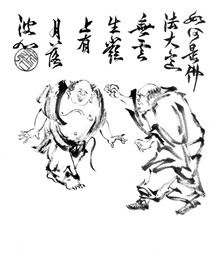
Doing nothing what should not be done, we leave nothing undone.
There once lived a great warrior. Though quite old, he still was able
to defeat any challenger. His reputation extended far and wide
throughout the land and many students gathered to study under him.
One day an infamous young warrior arrived at the village. He was
determined to be the first man to defeat the great master. Along with
his strength, he had an uncanny ability to spot and exploit any
weakness in an opponent. He would wait for his opponent to make
the first move, thus revealing a weakness, and then would strike with
merciless force and lightning speed. No one had ever lasted with him
in a match beyond the first move. Much against the advice of his
concerned students, the old master gladly accepted the young warrior's
challenge. As the two squared off for battle, the young warrior began
to hurl insults at the old master. He threw dirt and spit in his face.
For hours he verbally assaulted him with every curse and insult known
to mankind. But the old warrior merely stood there motionless and calm.
Finally, the young warrior exhausted himself.
Knowing he was defeated, he left feeling shamed. Somewhat disappointed
that he did not fight the insolent youth, the students gathered around the
old master and questioned him.
"How could you endure such an indignity? How did you drive him away?"
"If someone comes to give you a gift and you do not receive it," the master
replied, "to whom does the gift belong?"
* * * * * * * * * * * *
Another master by the name of Dao Shu was an adherent of
the Northern School of Chan (Zen in Japanese), founded by
Shen Xiu. Once, together with a few disciples, he retreated
to the deep mountains to practice Chan (meditation) in solitude.
A mischievous spirit began to taunt them day and night,
appearing variously as a filthy beggar, or assuming the
aspect of Buddhas or bodhisattvas or monks, or producing
magical lights or sounds. The young monks were frightened
nearly out of their wits because of the extremely of many of
its demonic antics. But one morning, after several years of its
tricking practice, all of a sudden the spirit disappeared once
and forever.
"This juggler made a great deal of his tricks purposely to delude
our minds," explained the master. "There was only one resort
against the demon's tricks -- the way of doing nothing what
should not be done. This means nothing to see and nothing to
hear what is out of your line. Even a myriad tricks must
eventually be exhausted, but as to the method of impartiality --
it is boundless and can be employed forever!"
Brief Comments:
If Dao Shu had tried to defend himself against the demon's
tricks by resorting to his own skill of transformation, it would
probably have resulted in an endless battle between two 'black
and white' magicians. Only being adherent to doing nothing what
in out of one's daily duties means doing precisely what should be
done. Because of that, it became possible for the master and his
disciples to overcome the demon, negating its skills. In fact,
however, the method of doing nothing what is not to be done
can produce something everlasting, in full accordance
with Lao-zi's concept of the existent derived from non-existent.
Everything has its limit, even the largest and strongest things
are not immortal and everlasting. As for "nothing," it is unlimited
because it is unformed, and owing to this fact, it can be used
universally. For this, we need to know at least two things: What
is called "emptiness" and what is called "fullness" to realize the
third one called "non-emptiness - non-fullness." It is just so
with "emptiness," that is, in the Chan mind, and proves the most
useful and meaningful among the true things.
Lao-zi states (Verse 42):
"What others have taught I also come to teach:
'A man of violence will not meet his natural end.'
This I shall treat as the premise of all the teachings."
There is nothing that could be added. However, these parables are not about violence, they speak of objectiveness and precise contract with reality. Cheers
It is interesting that Gandhi, Martin Luther King, and Nelson Mandela, all masters, employed nonviolence as a way of defeating violent aggression. It worked beautifully because violent aggression eventually runs out of steam and stoic resistance builds the more you use it.
Explains the realizations that have given the author the views of living life fully. The life each person dreams about.
You must take a look at yourself before dreams can be reached.
Deciding what is the core of belief.
This book presents a narrative story of one person's journey of transcendental Awakening and Enlightenment as guided by his two Sage companions. It is grounded in Zen Buddhist and Taoist perspective and uses the I Ching as its structural framework. T