TDYs to Saudi Arabia – Part 2
Author © Scott D. Zachary
“Come in, Lieutenant Zachary. Have a seat.”
Colonel Champion’s cheerful demeanor deformed into wariness as he watched my entourage follow me through the doorway. The four of us sat down around the long table that butted up against the front of the Colonel’s desk: Brad at the far end facing Colonel Champion, Mr. Crabb and Sergeant Shepard across from me.
“What can I do for you?” asked Colonel Champion.
“It has come to my attention, sir, that Airman Williams is being railroaded out of the Air Force on trumped-up charges without a chance to defend himself. We are here to…”
Colonel Champion sprung to his feet and cut me off. “Who in the hell do you think you are coming in here and challenging my authority!”
Fire blazed from my eyes as I monotoned, “Sir—with all due respect—our next stop is the Inspector General’s Office. I just thought you might like an opportunity to rectify this injustice before we go there.” I punctuated the end of my sentence by thumping the classified conveyance form on Colonel Champion’s desk as though I was trumping the Ace of Spades with my Joker.
“What’s this?!” lashed Colonel Champion.
“That, sir, is the proof that Airman Williams did not compromise classified information as it has been assumed. Airman Williams is one of the most reliable airmen that I have ever known in my ten years in the Air Force. I assert that Airman Williams’ assumed guilt in this security breach and his being labeled with a bad attitude was easy to swallow predicated on his penchant for using two words.” I pivoted to face Airman Williams, imploring, “Are we ever going to hear ‘That sucks!’ out of your mouth again, Airman Williams? Ever?!”
Airman Williams quivered. “No, sir!”
Returning my attention to Colonel Champion, “That’s that. Now, what can you tell us about this supposed potential international incident, Colonel Champion? Airman Williams doesn’t know anything about it.”
“I frankly don’t know anything more than the fact that a potential international incident was attributed to him.”
I nearly swiped, “Is that anything like pinning the tail on the donkey, sir?” But I knew I was already stretching the limits of military decorum, so instead, I challenged, “Attributed to him, sir?”
“Here’s my proposal, Lieutenant Zachary. I will research this international incident business, and if—I repeat, IF—it turns out to be an unfounded rumor, I will rescind my decision to prevent Airman Williams from re-enlisting. Is that acceptable to you, Lieutenant Zachary?”
I stared stone-faced at Colonel Champion for several seconds without answering. Then I pivoted my attention to Brad. “Is that acceptable to you, Airman Williams?”
Looking as though I had bitch-slapped him, Brad uttered, “Yes, sir!”
Swiveling to address the Colonel, “Yes, sir. That’s perfectly acceptable. Thank you, Colonel Champion.”
I was too emotionally spent to feel my relief as the four of us walked out of that office.
* * * * * * * * * * * * * * * * * * * * * *
I thought it ironic that several weeks later Lt Colonel Champion assigned Brad to come on this second TDY with me so that I could keep him out of trouble. There was no way on earth that we would be going to the Army Officers’ Club again—NO WAY! Brad and I focused on our work during this trip to Riyadh.
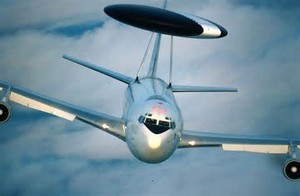
The Operations Commander had heard that the AWACS surveillance capabilities would soon be able to track surface vehicles and ships. With ten days remaining in my thirty-day TDY, he came into the tape library with a high-level request.
“Two of the Navy’s cruisers collided in the Persian Gulf. Their Commanders’ stories and the tracking data from the ships are in dispute. Both ships sustained severe damage to the extent that a fishing trawler towed one of them to port, and the other nearly sank as it limped to shore. It will take weeks to investigate their stories. The Fleet Admiral has requested tracking data from the AWACS to help sort out the truth.”
“I’m sorry, sir, Boeing has only partially installed their look-down surface-surveillance capability in our newest software version.”
The Ops Commander scowled his extreme disappointment.
I continued, “The AWACS was, in fact, logging surface data. We should have the ships’ tracking data on the magnetic backup tape. However, Boeing will not be delivering the software to enable us to analyze that data until their next software delivery several months down the line.”
“Is there any possible way you could do it, Lieutenant?” pleaded the Commander.
“No, sir. I might be able to develop software to display the ships’ tracks, but it would take months to do it—and that’s if I knew the configuration of the data structures on the tape. I don’t.”
“Damn!” he exasperated as he stormed out of the room.
I was heartsick that I couldn’t fulfill my Commander’s and the Admiral’s request. Unable to sleep that night, I went down to the VACS (Verification and Analysis of Complex Systems) trailer that housed our computers, made a backup copy of the magnetic tape in question, and began playing with it. The binary ones and zeros initially looked like random gibberish. At first, I had no realistic hope of deciphering Boeing’s numeric data patterns. I had been involved with the installation of a radar enhancement a year before and remembered a few of the symbolic data delimiters; thus, I was slightly familiar with their surveillance data structures pertaining to aircraft tracking, but not much.
Thirty intensive hours later, I nurtured a flickering hope of tracking those ships for the brass. Brad started bringing my meals to me as I worked, and I slept with my head on the desk for an hour or two whenever I couldn’t go on. I became obsessed with deciphering and mapping those millions of binary bits twenty-plus hours a day for a week. Then the patterns started making sense like those advanced calculus equations in college which I had to go over and over and over until the logical tumblers clicked in my mind. And like the pieces of a jig-saw puzzle, their associations became easier and easier until the last pieces are indubitable. I mastered the data!
I worked three more long, arduous days until I was able to print the graph of those two ships’ tracks. Woozy with exhaustion, I proudly presented the result of all my work to the Ops Commander. “Here you go, sir!”
He scrutinized the primitive graph that I handed him. “This doesn’t tell us anything we didn’t already know!” He screamed in my face. “Time! Time! I told you that the Admiral already knew the ships’ courses—he needs to know their courses with respect to time!” And he stormed out of the trailer.
I looked at my watch—twenty-four hours till I would be leaving. I loathed the thought of staying past the end of my tour, especially after being bawled out for giving my extreme best. At that moment, the Shift Supervisor came by our office. “Heads up! The Wing Commander, General James, will be coming in on the AWACS tomorrow. You will make your quarters spotless! If there’s anything that is not in good repair, fix it or get it fixed!”
“Yes, sir,” Brad responded.
I didn’t answer—I was trying to decide if it was possible for me to decipher and plot the ships’ times in association with the ships’ courses, and do it in the next 24 hours.
“Lieutenant?” exhorted the Shift Commander.
“Oh yeah—I mean, yes, sir!”
“And shave, Lieutenant!”
“Yes, sir.” With marked determination in my voice, I turned to Brad. “Mop the floors, and please bring me dinner in the trailer.”
“Yes, sir!” Brad grinned. “And breakfast tomorrow morning, sir?”
“You got it! Thanks, Brad! And thanks for doing both of our jobs again while I dive back into insanity.”
I turned around to face the computer terminal about 6:00 p.m. I worked non-stop machine-gunning the keyboard until noon the next day and achieved the seemingly impossible. It couldn’t have been more than fifteen minutes after I had programmatically animated the ships’ courses on my computer screen when the Ops Commander walked in. “I told you yesterday to shave, Lieutenant! The General is here!”
“I have something more important to show you, sir.”
“I don’t have time.”
“You might want to take the time, sir—I have the time-lapsed courses of those two ships that collided for your viewing pleasure.”
“Do what? I thought you said it couldn’t be done.”
“Yes, sir, I did. But, I made it possible.”
“You said Boeing’s updated software wouldn’t be available for months.”
“I wrote software to display their time-lapsed tracks.”
“Since yesterday?”
“No, I had designed some of it in the process of working twenty-hour days since you first asked, but I gave up until you pissed me off yesterday—sir!” I beamed as I pressed the <Enter> key on the keyboard. “Watch.”
The Commander stared at the ships’ tracks on the computer screen as their courses altered in concert with their tabulated time and geographic latitude and longitude. He craned over the monitor scrutinizing the ships’ icons for several minutes until they stopped at the same point.
“I have the display set to thirty-second intervals. You can enter the start and end time, and you can change the mathematical precision of the timestamps down to ten-thousandths of a second, sir!” I smiled arrogantly.
“Great work, Lieutenant!”
“Thank you, sir!” I handed the Ops Commander a thick stack of pages. “Each page shows the ships’ progressive coordinates with timestamps. I’m all done here. Brad and I have to pack our bags.”
* * * * * * * * * * * * * * * * * * * * * *
The following Monday morning, I strutted into the Mission Support Deputate building where I worked, knowing that I would likely be awarded at least a commendation medal for my extraordinary achievement. I had just sat down at my desk when Ron Crabb came to me, saying, “Colonel Davis wants to see you now.”
“Cool!” I sprung to my feet and cockily swaggered to Colonel Davis’ office. I knocked, and the Colonel tersely commanded me to enter. I walked to his desk, stood at attention, and with a big grin on my face, I snapped a smart salute. “Lieutenant Zachary reporting as ordered, sir.”
“Who in the hell do you think you are, Lieutenant?!”
I was staggered.
“You were ordered to prepare our facilities for the General’s inspection, and you disobeyed your Shift Supervisor’s order.” Colonel Davis got up in my face, screaming his spit on me, making me madder and madder. By the time he paused his tirade, I was shaking mad and glaring a hole in his head. He finally stopped ranting and sat down at his desk, staring at me.
“IS THAT ALL, SIR?!”
I could have chosen a better response because that one must’ve hit a nerve as he lashed, “NO, THAT’S NOT ALL! The General’s aide reported to me that there were gouges in the wall around a dart board in the Magnetic Tape Library!”
I was a wrecking ball looking for a place to land. I growled, “Permission to make a statement, sir!”
“It better be good.”
Ominously, “It’s a sad day in MY AIR FORCE when appearance takes precedence over operational capabilities, SIR!”
“What the hell are you talking about, Lieutenant?”
“The Admiral of the Fleet requested surface tracking data for ships that collided in the Persian Gulf. I fulfilled his request instead of making our facilities pretty for the General’s inspection.”
“That’s nonsense! Lieutenant Rogers did that.”
“Is that what he told you, sir?”
“No, that’s what I heard.”
“You might want to get your facts straight before you go telling anyone else that. I take claim on that accomplishment—SIR!”
“If that’s true, then there’s still the matter of the trashed facilities to clear up with the General. The terse complaint came from his office.”
“I brought back a tape that demonstrates the two hundred hours I worked in ten days to make the displaying of surface track data possible. Requesting permission to go see the General and clear up that other little matter, sir!”
“Permission granted.”
* * * * * * * * * * * * * * * * * * * * * *
I marched straight from Colonel Davis’ office to the one-star Wing Commander’s office and notified the General’s secretary that I wanted to see him. She informed me that the General was out on the flight line, and it could be a while before he returned. I waited in the reception area for more than two hours until the General walked past me into his office. Another hour elapsed before his secretary finally said, “You may go in, Lieutenant.”
I took a deep breath, marched into the General’s office, stopped in front of his desk, and pivoted. I snapped a sharp salute. “Lieutenant Zachary reporting to make a statement, sir!”
“Have a seat, Lieutenant.”
I sat at attention while he studied me for a moment.
“What’s on your mind, Lieutenant?”
Pointedly, “I am distressed—sir—at the sorry state of my Air Force where trivial propriety and appearance has outranked the importance of operational capabilities and readiness.”
“I want to know about this.”
“I was ordered into Colonel Davis’ office this morning where I anticipated commendation for having supplied the Fleet Admiral with tracking data for the accident that occurred in the Gulf. Instead, the Colonel harshly reprimanded me for not patching a tattered wall around a dart board in our office in Riyadh. I knew you were coming to inspect our facility, but I thought it was vastly more important that I solve the questions surrounding the collision of two multi-million-dollar naval ships.
“You did that, Lieutenant?”
“Yes, sir. I ignored the Shift Supervisor’s order to tidy up our premises and gave it everything I had to achieve the impossible.”
“I think we have some wires crossed in this situation. You do deserve a commendation, Lieutenant.”
“Without Airman Brad Williams’ support, I don’t think I could have managed it, sir.”
“I will see that Airman Williams gets the recognition he deserves, as well. You two have made the AWACS Wing shine!”
* * * * * * * * * * * * * * * * * * * * * *
In the early spring of 1985, I submitted my resignation to take effect at the end of my current commitment. A retention officer at Air Force Officer Assignments called me numerous times to lure me out of my decision with prize assignments around the world. I turned down several before they offered me Woomera Air Station in the Australian Outback, which is a little over five hours driving time to Adelaide near the Indian Ocean. The assignment would include nine months of preliminary training in satellite telemetry and tracking at Space Command Headquarters in Colorado Springs. That seized my wanderlust—hook, line, sinker, and fishing pole! Not to mention the opportunity to learn the science of satellite tracking!
While I was at the library researching Australia, someone else snatched up the position in Woomera before I could say “Yes.” The next job offer was Kolsås NATO Base near Oslo, Norway. Oops, there went the fisherman too! The assignments officer barely got “Norway” out of his mouth when I said, “Sign me up!”
Packing up and moving to Norway was a whirlwind experience. I hadn’t been on the job there more than a few days when Airman Brad Williams called me. “Lieutenant Zachary?”
“It’s Captain now, Brad. How are you doing?”
“Congratulations, Captain Zachary! I owe you a great big thank you, sir!”
“What’s going on?”
“I re-enlisted yesterday.”
“Congratulations! I’m thrilled to hear that.”
“And, Sergeant Shepard thinks General James had a hand in my new assignment. You can come visit me at—are you ready—Hickam Air Force Base in HAWAII!”
“That’s fantastic, Brad!”
“You made it possible, sir!”
Tears of joy rolled down my cheeks. Whew, and I nearly got us both court-martialed and thrown into a Saudi Arabian dungeon!




 What to do in Saudi Arabia...
A high school friend of mine has experienced similar Air Force encounters in his well-written autobiography that he hasn't published. Fortunately, Doug wrote a short story last year, All Right Good Night, that I posted for him here. Doug got that assignment doing surveillance from multiple posts around the world, and in Colorado, where he helped avert two situations that brought us close to nuclear war.
Ron