Having been a Medic in the Army my medical experience was not limited to any one discipline. I was trained in several facets of the work and also to think on my feet and overcome any obstacle to achieve a desired result. Be it clamping off an artery or making a machine that achieved a specific task that was needed at the time. I have many times fabricated something that worked as needed, out of nothing but odds and ends that I had on hand. I was used to doing things like that, and I enjoyed it.
After college I went into Respiratory Therapy and had worked in and around Atlanta for some years in larger hospitals, all the while learning modern techniques, machines, and procedures. As a Respiratory Therapist I worked in all the hospital areas from the emergency room to adult trauma Surgical ICU and neonatal ICU’s. And I was proficient at every level of my craft. However in some of the rural hospitals they didn’t always have the most modern equipment and sometimes one had to improvise. This story is about one of those times.
In 1980 I was the head of Respiratory Therapy at Three Rivers Medical Center, a small county hospital in Arkadelphia, Arkansas, a very rural area. I was the first Certified Respiratory Therapist the hospital had ever had on staff. I was working for a company that contracted Respiratory departments to hospitals. In return for a professional staff and modern equipment, the Respiratory contract company would take a percentage of the respiratory department billing. Again, these were usually hospitals in rural areas of the country, and heretofore, all of the respiratory procedures, such as nebulizer treatments, endotracheal suctioning, etc. had been done by nurses. This hospital did have a ventilator in house, but no one knew how to use it, and also the nurses were glad to be relieved of the Respiratory duties.
OK, without giving a class in Respiratory here I have to explain CPAP, it is essential to the story. CPAP means Constant Positive Airway Pressure. Imagine a balloon. Imagine a balloon with a hose feeding a certain amount of air in, and a smaller hose letting the air out. The difference in the amount of air pumped in by the large hose and the air allowed out by the smaller one will create a positive pressure inside the balloon. This was the effect I needed to create for this premature infant. There was a machine and delivery apparatus for doing this, however I didn’t have one and I needed the CPAP right then for my premie.
My only option was to make one out of what I had available. Normally the CPAP device was like a nasal cannula that went in the nose of the baby and created positive pressure by blowing air constantly into the nose. I didn’t have one. I had called the hospital in Little Rock to send their neonatal ambulance to come get this baby. They were on their way and it would take a couple hours but, this baby needed CPAP now.
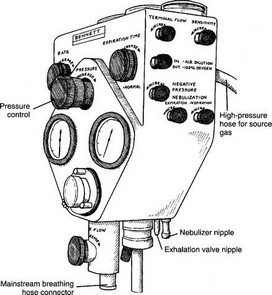
Now my problem was how to make a CPAP machine with what I had on hand. I did have a machine, an IPPB, that was used in the old days as a ventilator. Now days you will probably only find one in a museum. I rigged it up so it had humidity and also delivered a set amount of pressure. The problem was it had a hose about an inch and a half diameter coming from it and no way to fit it to the baby. I had a nurse holding oxygen to the baby while I thought about this problem.
I thought about the balloon idea, so I took a plastic bag and taped the big hose to a hole I made at the top of the bag and put the bag over the baby’s head. Watching the pressure gauge on the machine, I carefully closed the bag around the baby’s neck until I got a constant 5cm of pressure in the bag. At that point I taped the bag so it would keep that pressure and then after a few minutes I took some blood from a heel stick to measure the amount of Oxygen in the baby’s blood to see if it was at the level I needed. It was. I was happy, the Doc was happy so we just waited for the Angel ambulance to arrive.
When the “Pros from Dover” finally arrived with their big time equipment and expertise they took one look at my make shift rig and asked me, “What the Hell is that over the baby’s head?”
Thinking fast I said to them, “Have you never seen a Bubble CPAP before?” Of course they hadn’t, and said, “No.” So I quickly said, “Well gee I guess you learn something new every day.” Then they asked to see the blood gas results of course they were all perfect for the situation. It was about then they brought in their expensive portable CPAP machine and basically took over, which was fine with me because it was late and I had to work again in four hours. But as I left I saw them shaking their heads and overheard them saying, “I never heard of Bubble CPAP, have you? "No, But damn if it didn't work!”
Necessity is the mother of invention. A great story and a great save. I'm sure the parents of the baby were greatly relieved that someone took the initiative to save their child. I have been known to innovate from time to time, finding that the five cent solution is often the best. My nephew is a respiratory therapist and has reached the supervisory level.
I am quite familiar with CPAP having acquired two machines about 15 years ago. I was given three sleep studies when they were very popular with everyone pushing machines for sleep apnea. I was misdiagnosed because I wake up about 10 times a night to urinate with autonomic dysreflexia, a condition that only affects people with higher level spinal cord injury like I have C4-C6. My bladder only empties about a third and requires frequent urination (for 52 years now). My lung capacity is also very low, about 30% of normal. I guess that's why I was diagnosed with sleep apnea. I did experience some of the symptoms at that time according to my helper who turned me at night.
Anyway, when I got the machine I tried it for a while but found that the facemask was very irritating and blowing air out of my mouth drying it out. I always slept with my mouth open slightly and on my back. A few years ago, I found that sleeping on my back caused backache, spasms and too much reflux, so I now sleep almost entirely on my side with a bolster on my back and turn every half hour or so. If I had sleep apnea, it has gone away. I did notice one advantage, and that was that my legs and feet were much warmer with the machine on, probably because it increased circulation or oxygen my blood. I may try it again on very cold nights because I find my ability to get warm gets harder every year. When a cold front comes through, my swollen legs and feet from a day sitting in my wheelchair often take a couple of hours to warm up so that I can sleep after going to bed.
One thing about aging and spinal cord injury. One has to keep adjusting to keep ahead of all the irritations that crop up. Still, on my annual checkups, all of my blood parameters are in the normal range and my psi is very low, unusual for a man my age.
Ingenious! You've a rare combo of scientific knowledge, medical expertise, and inventiveness. And, a way of presenting your experience in a well-written story. Necessity is the mother of invention, but one also needs mechanical aptitude to pull it off.
A passionate and poignant memoir written by a woman whose life has been guided by the words: "I am here to learn how to love well." The book is a deep examination of relationships, family, motivation, and honoring of the Self.
TRUE STORY. Bella survived an abusive powerbroker father with organized crime ties, a drug-addicted mother and a physically/sexually abusive brother. Shocking & inspirational. When she couldn't cry, she tattooed a crying angel to cry for her.