View larger map here of locations in the story.
When I arrived back from my trip around the world, I was told of a travel-study tour to Guatemala two of my colleagues had put together, scheduled for the end of February. I didn't have any vacation, but planned to go anyway for the educational value of the trip, that would include exploring technologies used in the region. A week before we were scheduled to leave, a devastating earthquake struck, thousands died, and our trip was canceled.
A year had passed, and, although it was the rainy season, the tour was rescheduled for June. Our small group was to pick up another small group in Miami, and then continue on to Guatemala City. The flight from Pittsburgh to Miami was the same distance as the one from Miami, but the shift in climate, culture, and geography was much more dramatic.
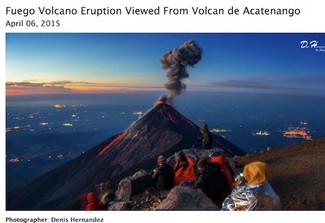
The earthquakes of the previous year had been accompanied by increased volcanic activity. As we flew into Guatemala City, El Fuego (The Fire) was erupting, spewing smoke high into the stratosphere and lava down its sides. I was excited.
At the International Airport we rented a Toyota van that nicely carried the eleven of us and our luggage. Two elderly ladies, who had shared a seat row from Miami with me, lost their luggage and had to wait three days before it caught up with them. The tour leaders had promised lodging and board at a price we couldn't refuse, a dollar a day! We were to stay in the family compound of a friend in the village of San Antonio, nestled in a valley at the base of El Fuego. We were promised that the outdoor accommodations would be comfortable, and that the food would be good. However, the friend couldn't be reached. Family members said she was in Miami, so we were on our own.
We drove out of Guatemala City on a long boulevard flanked by American companies into the mountains, sixty miles to Antigua. Antigua, destroyed at least four times by quakes, was the Capitol city until its unstable earth forced the government to the firmer ground of Guatemala City. Nestled in the mountains at 6000 feet at the base of the volcano, Agua (Water), Antigua was a small, but vibrant center for trade and artistry. Colorful hand-woven fabric was everywhere evident in this picturesque land.
We waited in the central square while the tourist bureau found us housing. The group was split three ways. I headed with about half the group to a German-owned resort, El Roserio, on the outskirts of town. On the way, at a corner, we could see lava flowing a third of the way down El Fuego. The next day, the lava flow was gone, and we never saw any eruptions the rest of the trip. I shared a large room in a dormitory-like structure with two other guys for about five dollars apiece. The resort was on the edge of town. The view from the balcony was dense jungle, filled with a cacophony of sounds that rivaled rush hour traffic. Instead of large, dangerous, unseen animals, this din was created by many different kinds of birds, each with its own way to call out to others. In the morning, I stood on that balcony for a long time, taking in the sounds and watching huge ravens fly over like bombers with a mission into the forest.
The next morning, we left by van for a three-day trip to the interior. Each Indian group, most descendants of the Mayas, has its own way of weaving, clothing, and colors like the Scottish clans. We went to San Antonio first. The long mountain road into the village was lined with roadside vendors, each hawking their woven red cloth patterns. As expected, the friend was not there, so we continued on to Lake Atitlan.
We traveled over newly paved, earthquake-damaged roads, winding in and out of mountain passes to some of the most spectacular landscapes on the planet. The volcanic soil was very rich. In some regions, the mountainsides were terraced with rows of corn at several stages of maturity growing together. The plots were small and hand-tilled, broken occasionally with patches of blooming irises, cannas, other flowers, and groups of banana plants. The road leading to Lake Atitlan reached 12,000 feet, passing beautiful villas clinging to the mountainsides with breathtaking views of the water 4,000 feet below. We stopped in Panajachel, a lakeside resort and artist community, for the night.
A block from our hotel, after our evening meal, we came upon the strong odor of onions. Just around the corner, under the awning over a board walkway, a huge pile of onions lined the wall. A group of farmers, mostly women, was busy cutting them up, creating an eye-searing atmosphere. In the morning, when I returned to see the results of their work, the boardwalk was bare and there was no evidence of the activity of the night before.
I went to the post office to mail a postcard. It was a small building, maybe ten feet wide. There was a single counter with one postman behind it. Several people clamored for his attention with no regard for waiting in line or courtesy to their fellow customers. I finally got the postage I requested and left with a new respect for the US Postal Service.
Atitlan is a large, natural lake set at the base of three 13,000-foot volcanoes. It is on the continental divide and the Pan American Highway. The next morning we drove up the Highway toward Mexico. Our first stop was Monostonango. Located twelve miles off the Pan American Highway by dirt road, Monostonango offered the best wool blankets. On the road in, we saw beautiful orchids hanging from trees. It was against the law to take them, but we saw many for sale in the markets. There was a huge market, located in the center of town. We saw few Americans, and it was refreshing.
We returned to Atitlan for the night. The next day at noon we took the mail boat across the lake to Santiago, an Indian village of lava rock and thatch, with yet another, market. Although I saw pictures of huge bass, the fish in the market were only four to six inches, a sign of over fishing. The lake was majestic, nestled amid its three volcanoes, but rather barren.
In the market, little girls were selling bean necklaces. I thought my nieces might like them, so I bargained with a girl for two, down to 25 centavos. When I reached for my money, I had no change. The girl, about seven years old, was very disappointed. Later, I got some change and approached her again in the crowd. This time she was frightened, cried and tried to run from me, probably thinking I was playing a cruel trick. Somehow, I convinced her to stop and listen, confirmed the price, and gave her the money. Her face lit up in delight, having made the sale, and I left knowing that I'd not left her and her family thinking that I was a cruel American who tricked little girls.
Back in Antigua, I was tired of markets, so asked the local tourist bureau about climbing Agua. The man told me that Agua required a guide and that I shouldn't go because it was the rainy season. He recommended instead that I visit the Candeleria, a 400-foot hill on the outskirts of town, lined with candles, some kind of shrine. It was obvious that he didn't think me capable of the climb and he angered me when he thought I'd be interested in local religious superstition instead. I was determined to go.
I was now staying in a little "Holiday Inn," the Santa Lucia Guest House, built after the quake to house overflow tourists not booked in local resorts and hotels. It was nice and cheap. I paid a small boy the equivalent of $3.50 in quetzals in the furniture less lobby each day to stay there. Santa Lucia was ten blocks from the nearest restaurant, but near bus routes. The others in our party were in other locations, so I had to walk to see them. There was no telephone. Each night, I linked up with the two old ladies for dinner. Otherwise, I was on my own. As their unofficial guardian, I walked them back to the German resort. At night all the doors and entrances to the courtyards were boarded up, making the narrow walled streets quite barren. One night walking back it started to rain. I was walking quickly, head down, along the wall on the narrow sidewalk, when I ran into wrought iron window bars in my path that stuck out about six inches from the wall. I was knocked off my feet and my glasses went flying. But the lady with me helped me pick myself up from the wet pavement. My face was skinned but nothing was broken.
On a second trip, we headed for Chichicastanango further north up the Pan American highway. Chichi is a famous tourist site, noted for its display of the villagers’ religion, a mix between Mayan and Roman Catholic rituals. The high point of my visit there was dinner at a new hotel, built after the quake, complete with marimba band and hummingbirds in the courtyard. I was tired of markets.
On the way back we stopped at IXMHE, a Mayan ruin in the high mountains. The site was small and not impressive, but I was having trouble walking on the steps of the ruins, so I didn't explore it fully. We stopped at a village of thirty thousand that was reduced to rubble and corrugated steel roofs after the quake took five thousand lives. The tile roofs were now corrugated galvanized steel panels because so many villagers died from falling tile. The place took on the tin shack look of so many slums instead of the picturesque look of adobe and red tile. The quake took the beauty and the spirit of the place. Villagers now wore polyester flowered shirts and carried plastic water pots instead of the native wool shirts and clay pots. This strange aberration was a direct result of US relief after the devastation and it was sad to see.
All the walking and light meals were doing me good. My pants were falling down, but I was walking stronger each day.
I caught up with George Maughan, our tour leader, and asked him if he and Gay would join me on my trek up the mountain the next day, Friday. I'd already decided to go to Tikal on Saturday and there were no more days left in the tour. George said that he had planned to go but the missing weaver friend had returned to San Antonio and everyone was invited for the day. No one wanted to go to Tikal with me either, so I borrowed plane fare of $90 and planned to do that alone, too.
That night I got back to my room about 10 pm. I was excited about my climb the next day so wanted to go right to sleep. My room was open to the interior of the guesthouse. Two young women and a man came in late and made noise talking and laughing. The noise kept me up a long time.
I left about 5 am, walking the streets that led out of town to the road to the village of Santa Maria de Jesus, on the route George had showed me to the dormant volcano, Agua. I expected to catch an early bus to the village, but there were none, so I walked and enjoyed the cool morning. There was no place to eat, but I passed a bakery on the way out of town, the sweet, irresistible aroma hit me as I passed the open door and beckoned me in. Amid an unbelievable array of breads, cakes, cookies, and snacks, all based on corn meal or flour, I bought two corn flour rolls for 15 centavos. I ate one as I walked, saving the other for lunch. I'd planned to travel light. The roll was the only thing I was carrying in my bag except my Antigua map.
After seeing no buses, I asked someone where they were. They told me the first bus wasn't until 8 am. I decided to keep walking until one came along. About two miles out of town a large open truck passed, filled with about fifty troops. I thought nothing of it because the Guatemala Army was everywhere, often setting up roadblocks to check for rebels or people traveling illegally through the country.
Finally, about five miles out, a bus came along, and I got my ride to the village and the start of the trail. I was the only American among the few passengers. We were deposited in a large, empty, and treeless square that probably served as a soccer field and market on market days. Most villages held market days once or twice a week.
The locals evaporated, and I was alone. I drank deeply from a public fountain and walked out of the village. The sun was already high, and I decided to turn back if it got too tough going up. Each street heading up the mountain became a trail heavily traveled by people and cattle as they made their way either to fields or the forest each day. All the trails merged to a single road that snaked its way back and forth up the mountain. The main walking trail took a more direct route up, sometimes crossing, sometimes merging, with the road. The trail was a concave of hard packed mud and rather easy walking.
I was alone as I left the village and the lower fields for the tattered forest higher up. Many years of grazing and wood gathering had decimated the forest. It was an hour before I reached trees of any size. Most of the small trees showed scars from machetes.
I passed two boys with a burro. One said, "Buenos dais" and held out his hand. He gave me a small, green apple. I was grateful and decided to save it for lunch.
Finally, I was on the road in tall trees. The road was badly rutted and steep. The air was getting thin and cool, but the sun was hot. I ate my roll and the tart, green apple. I wished I had some water, but in its place, the apple was refreshing. I passed a road crew. They looked like criminals and probably were. I joked to them about my red "Gringo" nose and was glad to leave them behind.
Up ahead, an Army truck had to jockey back and forth to make a sharp curve. It looked like the one I'd seen in the morning and probably was. It too, was filled with troops.
Soon, I reached the tree line and the landscape was mostly red cinders and eroded ravines. The view opened up and I could see Antigua at about 5000 feet below to the north, its white buildings forming a square surrounded by green jungle. To the east, I could see Santa Maria about 2500 feet below, and beyond that the expanse of coastal jungle leading to the Caribbean Sea. I passed a concrete block shelter and headed up the steep road toward the top.
I came upon three young people on the road. My legs were screaming in pain, so I had to stop every few feet to let them rest. But, I was not having trouble breathing. A young man was lying on his back and said that he was sick. Two girls were tending him. They said that they were students from the University of Iowa. I asked them if they had any water, but they had drunk all they had. Maybe that's why the guy was sick. I decided to head on up and they said that they would catch up.
It got tougher and tougher to walk, until I was taking only three steps before I had to rest. I was hot from exertion, but the cold wind tore at my exposed arms and face, cooling them from the burning sun. At the base of the final cinder cone to the top, two soldiers rested by a Jeep. I approached them and said "Agua?” asking for water, but the older one, who appeared to be an officer, shook his head and waved me away with his rifle. I skirted the cone to the left of their position, looking for a place to go up, and to find water. Tufts of moss and grass clung to the shifting steep slope of ash to the top. Some of these tufts were large enough to collect the daily rains and mist that accompanied the clouds constantly colliding with the mountain. Where they overhung eroded ash below, droplets of water were constantly falling, beginning their descent leading to mighty rivers far below. I looked around for cans or discarded cups that thoughtless tourists often leave in such places, but I found none. There was no way I could collect the drops. So, I sat below one of the largest tufts, lay back and opened my mouth. The cool, pure water dripped, not always from the same spot, into my mouth.
I stayed there resting for fifteen minutes or so until I got restless to be on my way. I got little water, maybe a mouthful, and decided that I would have had to stay all day to completely quench my thirst. Fast moving clouds obscured the top of the cone. After several attempts to climb upward on the shifting red ash, and sliding back down, I decided that I didn't have the strength or agility to climb into the crater. I passed the two resting soldiers and returned down the road.
Now, I saw the full expanse of how far I'd come. It seemed that I could see all the way to the Caribbean Sea, and I'm sure, the Pacific beyond El Fuego, if I was on the west slope. Below, Santa Maria de Jesus seemed so far away, but I knew that steady downhill walking would bring me to it. After a short walk, I came upon the shelter, sitting below the road on a leveled foundation of ash to the left. A trough on its corrugated metal roof funneled water into a large barrel.
I trotted down the steep trail leading to the shelter and over to the barrel. It was uncovered. Heavy moss clung to the sides, but the water was crystal clear all the way to the mossy bottom. I stuck my face in and drank deep. It would be easy from here.
I started up the trail to the road. About halfway up, I lost my balance and fell backward on the cinders. I rolled, so, although I got a bit dirty, I didn't hurt myself. I got back up on unsteady legs, grateful that I wasn't hurt, and more respectful of the toll the day had taken on my body, and carefully worked my way up to the road.
The road and trail were easy going downhill, so I moved along at a good pace. About half way, it got dark and ominous, so I began to worry. I was on the trail and it was a concave of hard-packed mud, smooth and easy to walk on when dry, but possibly a slippery, muddy slide, when wet. I knew now why they warned me about the season. I rushed now, hoping to get as far as I could before it rained, and I'd have to leave the trail for shelter.
The thunder rumbled but the danger passed, and I reached the village. About half way to the square, I passed a store that sold pop. I entered a room filled with bottles in cases. Showing the clerk what I wanted, I pointed to a bottle of orange soda near the bottom of a stack of crates. To my surprise, she reached down, lifted the crates and retrieved the bottle I pointed to! I gave her the equivalent of five cents and walked out with a very dusty, but refreshing, reward for my climb.
While waiting for a bus in the square, the sky opened up. It was a short downpour, but I was glad to be under the awning, wondering about those kids still up on the mountain. I got back to my motel about 4:30 and joined the old ladies at the hotel that evening for dinner. They had enjoyed their lunch in San Antonio but were tired of markets too and envious of my stories of the mountain.
Late that night, I caught up with the students from Iowa at the motel. They were the same ones who had kept me awake the night before. The guy had recovered from his sickness and made it to the top. They had gone to the right of the two soldiers and climbed the cone to an opening where they could enter the crater. The clouds were thick, but they could hear yelling. Then, the clouds lifted, and the yelling was troops playing soccer in the bottom of the crater! Some of the troops were playing chess and generally having fun during their high altitude training. There was also a chapel built in the crater. Since I never saw it, I don't know how big it was. They said they didn't get rained on, so they were as lucky as I was.
The next morning, I caught a bus for Guatemala City about 8 am. Buses often raced for a fare and I was the prize of one of those scuffles. For about 65 cents, or a penny a mile, the bus took me to Guatemala City. I caught another bus for a short ride to the domestic airport. Our flight, at $90 with money I’d borrowed, via DC-6, took us directly to the coastal jungle site of Tikal.
The DC-6 was comfortable, with wide seats and big windows. When we reached Tikal, our pilot circled and banked the plane so that we could see the site. Set in a sea of trees, the ruins rose up above them in a geometric pattern that survived 600 years of jungle growth. Tikal was once a city of 30,000 people, covering 24 square miles. The University of Pennsylvania had worked ten years, removing centuries of growth from the structures, and had uncovered only a fourth of the complex.
We landed on a dirt runway. The dust flying and the jungle surrounding the vintage plane made it seem like I was in an old movie, landing in another time and place. We ate lunch at the Jungle Lodge, a rustic and outdoorsy hotel, where tourists could experience "roughing it" with outdoor showers in a hotel setting.
After lunch I joined a tour group led by a young expatriate from North Carolina everyone called "Jungle Jim". After touring the museum that sheltered the bones of a Mayan chieftain burdened in death with silver and jade from New Mexico, as well as exquisite art from the former inhabitants, we ventured out into the great plazas, palaces, and pyramids.
I joined the group climbing up on the Palace and saw a spider monkey in the tree canopy nearby. But I felt insecure, constantly worried about tripping on the uneven rocks or falling on the steep steps. And then, I watched as even old ladies grabbed hold of cables and climbed the Pyramid of the Jaguar and other monuments. I could only watch, content in the thought that the day before I had stood at 12,500 feet on a volcano I'd climbed alone.
On the flight back, the only evidence of the rainy season was the puffy clouds our pilot shirted on the way back over steamy jungle to the cool air of the mile high capital. I walked up the aisle and watched the pilot fly the plane through the open curtain to the cockpit.
Even losing a half hour when a cab driver took me to the center of the city rather than the highway to Antigua to catch a bus, I still got back in time to share my stories of the day with my lady friends at dinner. On the way back to Miami the next day, George told me that he had climbed Agua alone while I was at Tikal. Gay had allergies to the jungle vegetation and decided not to go. A week later, George gave me photos he'd taken on his climb; it was a nice memento to show family and friends of where I'd been.