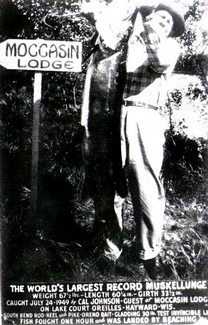
World Record Muskie - Others
The muskellunge is an ancient fish related to the alligator gar and the largest of the pike family. Highly prized because of its rarity in regions of the northern United States and southern Canada where it hides in plain sight, very hard to catch. Affectionately called, muskie or musky, it also has a variety of names from Indian lore and early misspellings.
Flaming Pines Lake, aka, Loc du Flambeau Pins, was a shallow, glacier formed, lake about 50 miles long that varied in width from 2 miles to 10 miles wide, straddling the US/Canadian border. Flaming Pines was fed by the Flaming Pines River and a few creeks from Canada to the north and emptied by the same river south into the United States. The lake had been closed to fishing for 50 years because a shut down taconite plant on the west end of the lake processing iron ore had polluted the water so badly with heavy metals like lead and arsenic that the fish were deemed poisonous.
Chippewa and Ojibway descendents living on the north side of the lake in Canada continued to fish the creeks and the river because they were not polluted by the taconite plant throughout the long history of the ban on fishing in the lake. The natives dreamed of being able to go back out on the lake because of the staple fish that they needed for food. Natives remembered what their ancestors caught there from legendary stories of many big fish. One of those fishermen was Raymond Raintree, 32. He occasionally caught fish illegally in the lake and heard the stories often from elders.
Raintree's cabin was a short distance north of the lake along a canal dug for cranberry marshes a century before, long abandoned. When he was 18, Ray married his 16-year-old bride, Jennifer. He had, with the help of his father, built a cabin on a homestead on the canal 7 miles from the village where he grew up. Homesteading away from the village suited Ray and Jennifer well. He didn't like all the gossip and drama that took place in that little community. Preferring instead, to make a living hunting, trapping and fishing in the nearby wilderness. Jennifer objected a bit at first, but grew to like the seclusion of the place.
Lars Christianson, 28, was a professional fisherman from Minneapolis. Lars had made his name in bass tournaments in the South and Midwest as well as holding some records for northern pike and muskie in various fishing meccas in the United States, Mexico and Canada. His articles were featured in Outdoor Life, Field and Stream and several other magazines. Christianson was currently developing a television program and actively filming his exploits while fishing with remote cameras, and once in a while, a camera crew he hired.
Like many others, Christianson had learned of the opening of Flaming Pines Lake for muskie fishing. A joint effort between Minnesota and Canadian wildlife authorities for a week in late August for trophy fishing only. The fish in the lake had been tested, but still contained dangerous heavy metals. All that Lars thought of when he heard the news of the lake reopening was, there could be a world record muskie there. And he couldn't get that thought out of his mind. His excitement grew as August approached and he made a concerted effort to be there for the entire week of the season making sure that he would be in position to catch a world record fish to add to his accolades.
August was generally hot and dry in northern Minnesota during that time of the year, and this year proved to be on target. While the lake was filled with fishermen at 6 am on opening day, the weather was such, that while fishermen were catching fish, no one was catching any muskies. They just weren't hungry or angry enough to chase something in their territory, but lounging, overfed and lethargic, in the warm shallow waters of late summer.
And so it went all week long. A few muskie were caught, usually in the early morning or late in the day, but whatever the fishermen offered was not tempting the big fish. The fish that were checked in ranged from 32 inches, the lower limit, to about 38 inches long and weighing up to about 20 pounds. But, nowhere near the world record of 67 lbs. 8 oz. caught by Cal Johnson in Lake Court Oreilles in Hayward, Wisconsin, on July 24, 1949. That record replaced earlier records that were determined to be falsified of a 69 lbs. 15 oz. fish caught by Art Lawton in the St. Lawrence Seaway and a 69 lbs. 11 oz. fish caught by Lewis Spray in the Chippewa Flowage, Wisconsin. While the biggest muskie ever caught was a 120 pounder by net in Lake Arbor Vita, Wisconsin, there was also one weighing 71 pounds hanging over a fireplace in a bar in Hayward netted in town. So, theoretically, there was a world record fish out there that hadn't been caught yet. It was only a matter of time and enough time for a fish to grow that old and that big without getting caught or die for it to happen.
But most of those record level fish were caught in October as fall turned to winter. The late-summer fish in Flaming Pines Lake were lethargic and not cooperating. There was a heavy presence of wardens and conservation officers from both Ontario and Minnesota on the water and in the air to make sure that the rules for the special season were being upheld. Many were having their equipment seized and/or fined for fishing without a license, improper fishing gear or illegally catching other fish and not returning them to the lake. Drones were always present in the sky making it very difficult for perpetrators of illegal activity to get away with it.
Ray Raintree worked the north side of the lake in his fiberglass canoe in shallow areas where there were cattails and lily pads knowing that big muskie sometimes lie in waters no deeper than their body with their tail fins nearly out of the water waiting for small fish that occupied these waters to swim into striking zone. He had his old casting rod that his father gave him with 45 pound test line and a well used and tooth-marked jitterbug that wobbled across the water on the surface and made a lot of noise like a frog. With a limit of only one muskie per angler, he was hoping for a large one, thinking only of food for the table and not a trophy.
Lars Christianson put his 18 foot bass boat in the water right where the Flaming Pines River flowed out of the lake. With his 120 hp Mercury outboard, he raced every morning to the best fishing spots along the south side of the lake; being first to cast with his saltwater rated spincast rod and reel with 15 pound test monofilament. He tried a variety of lures ranging from spoons and handcarved wounded minnow imitators all the way to baby ducklings with realistic paddling webbed feet. With multiple cameras and even a chase boat he hired with a camera crew, Lars was sure to chronicle his attempt at a world record muskie.
Both men moved along the shoreline, casting in likely spots, trying to entice a behemoth to take their bait. But at the end of the first day, both men left the lake with sore arms and no results. It was hot and the deer flies were particularly nasty. Ray tolerated them as a nuisance, swatting any that landed on his dark, thick weathered skin. His woodsman hat keeping the sun off his head and the deer and horse flies from landing there. Lars had on a thick coating of sunscreen combined with insect repellent. Like Ray, he had a baseball cap and sunglasses to keep the sun's glare off his eyes. Still, fishing without results was trying on both men. Ray returned to the cabin to tell his story to his wife, and Lars returned to his motel and edited the day's video to provide something for his Internet blog and stream his many fans to view.
On the second day in the early morning, Ray got a break and caught a 29 incher. Keenly aware of a drone overhead, he released the fish, expecting to catch a larger, legal one later. He rested during his lunch and thought about what he could do to catch a fish, but returned again home that evening to Jennifer with nothing to show for a long hard day. His arm was sorer than the day before and his eyes hurt, but he was used to waiting for the prize and tough enough to stick it out. Why it was called fishing and not catching.
Lars was driven. He was experienced at the long haul, too. So, on the second day, when he got nothing except a couple of smallmouth bass of notable size that he returned to the water, his phenomenal luck was not producing this time. But Lars knew that luck had nothing to do with it. Muskie fishing required patience and long hours on the water--the right conditions. Those conditions hadn't happened yet. He needed a front to come through, bad weather. Something to rile the fish up a bit and get them to strike--make them hungry. Lars thought of going back to the motel room and waiting until those conditions presented themselves, but he couldn't. Like most of the fishermen out there on the second day, he was playing the long shot--time on the water--fish in the boat.
That night it happened, after fishing hours, a front came through and it rained. But no one was allowed on the water from 6 pm to 6 am because officials found it too difficult to monitor all the fishermen at night. The morning of the third day was damp and much cooler, but like the first two days, quickly warmed up under a hot sun. By the end of the day, producing some lunker bass for Ray… two, 8 lbs. 12 oz. and 12 lbs. 2 oz. smallmouths he couldn't take home even if he wanted to, and let them go back, once again, under the shadows of the lily covered water where they had guarded their territory zealously and ferociously.
Wednesday was the hump day and breaking point for most of the fishermen. They were sunburned and sore, tired of casting with no results, and generally upset because they had to let catches of northern pike and smallmouth bass return to the lake. The promise of record muskie wasn't happening. Up to that point, only five lucky fishermen of the 554 signed up had caught a legal muskie ranging from 34 inches to 45 inches and 13 lbs. 3 oz. to 40 lbs. 6 oz. Ray was one of the lake natives numbering about 100 who did not have to register. But he would have certainly turned in any record fish as long as he could take it back to his family to eat afterward.
But the largest fish caught late on Wednesday, on a buck tail spinner, was a 52 inch, 32 lbs. 5 oz. fish. The muskie was skinny for its length and probably sick, because Lars had snagged it inconveniently in the tail and unceremoniously dragged it in without much fight while the cameras were rolling. Somewhat embarrassed, Lars, just as unceremoniously, released the fish quickly after weighing and measuring, still hoping for the world record, although beginning to doubt. That fish would've helped feed a small village on the north side of the lake, but trophies were all that was allowed, and Lars was in no mood to be charitable.
Thursday proved hotter and only an occasional angry smallmouth or northern was caught. The number of fishermen on the lake dwindled to only about 100 stalwarts. Ray and Lars were still out there… Still hoping… Still thrashing the water in all the likely places where a big muskie would have its territory.
Friday morning came and both fishermen were sore and tired, but they couldn't give up and were still the first on the water at 6 am, not knowing of each other's quest. By noon, there was a rush by all of the other fishermen to get on home for the weekend and there remained very few boats on the lake in the blistering sun. By midafternoon, only locals from both sides of the lake stuck it out, amounting to about 15 boats. But the time was drawing near, 6 pm, and the season week would have drawn to a close with Lars's catch being the largest of the week; had he kept it and not returned the skinny fish to the water--probably to die, in its current condition, anyway.
But then, it happened. About 5:30 pm, angry clouds appeared in the north, coming down from Canada and it was obvious that the promised front was on its way. As always happened, lightning could be seen flashing off the clouds in the distance, black and roiling against the hot blue sky. Wardens on the lake with loudspeakers announced for everyone to return to the safety of the shore with a lightning storm coming up. Almost everyone on the lake heeded the warning except two: Lars Christianson and Ray Raintree. Here are their personal accounts of what happened next:
Lars Christianson - I pulled up off a rocky point where I had caught the lethargic skinny one. Hoping that a larger fish had taken over its territory. As the closing of the season drew near and the front approached, I renewed my casting effort with new energy hoping for a strike. But time ran out, and it was getting almost as dark as night. I crossed the line and kept on casting past 6 pm. It must've been about 6:05 when the baby duckling lure that I was casting was hit with a mighty strike. In all my days of fishing I had never seen or felt a fish strike like that except in the ocean with marlin and sailfish. And those with the boat doing 15 kn trolling.
The strike narrowly ripped the rod from my arms and hands and as the fish left the water with the fake duckling in its mouth, I could clearly see he was the largest muskie I had ever caught or even seen. A kind of buck fever overcame me as he raced around the point and ripped off screaming line against the drag nearly to the end before he turned and came back faster, only to dart out again and leave the water at the end of the line in a mighty flip exposing his magnificent body in the darkening light of the front upon us.
I regained my professional senses and played him with the caution that I knew I had to if he could be conquered before he broke my line or my rod like so many muskie stories I had heard over the years. Still, he ran, and the fight went on for 10, 15, and finally, 25 minutes in violent wind and rain. All in all, that fish had the energy to jump against the line seven times, sometimes falling on the line with me praying that he wouldn't cut it with a scale or fin.
My camera crew had left with the others headed back to Minneapolis at noon. The wardens were off the water along with their drones. Wind and cold rain pummeled me and the fish. When I got him alongside, amazed at his length and girth, I was sure of the world record and shaking with cold and the thought of it. Fortunately, I had two cameras on the boat catching the action and my head mounted Gopro cam to follow my eyes' every move. Proof that I needed that I was the one catching the fish. Narrating what was happening the whole time. Sometimes with my voice becoming quite shrill or quaking.
I was aghast when I looked down and saw that the heavy steel leader clip on the duckling had pulled open and only tension was keeping it from falling out. The monster could regain strength and take off one more time at any moment. Way too big for any net. I reached for all I was worth for my holstered 22 pistol hanging from my boat's driver's seat. It was a real stretch trying to keep tension on the fish while my whole body was shaking, but I made it without dropping the gun in the blinding rain and wind. It was hard to hold steady and aim between the behemoth's eyes but it was about 4 inches and I managed to get off a shot without missing. The fish rolled and died. I was mightily relieved, and with a gaff and much effort, dragged the monster on board.
My shaking stopped and my excitement grew. I couldn't tell if I had the world record or not. I couldn't lift the fish to weigh it. But the muskie's length and girth indicated that he was. I raced full speed in the blinding rain and whitecaps on the lake to my take out point on the river. When I got there, my truck and trailer were the only ones left, except for one lone warden awaiting my arrival, too.
He was as excited as I was and we drove to town and the checkout point for Minnesota. To my good fortune, my fish weighed 73 lbs. 2 oz. But it was already 7:15 pm, an hour and 15 minutes past the closing of the season. To verify the time that I caught the fish, they confiscated my cameras. Within a half hour, the officials determined that I caught the fish after the season closed and my world record was nullified. I was fined $5000, my fishing gear was confiscated and I wasn't allowed to claim the world record. I was allowed to show the video to my viewers as long as I made sure there was a disclaimer about the world record. I'm okay with that. My viewership jumped along with my sponsorship, and I gained at least $5 million in net worth because of that one fish. Not a bad week's work.
Ray Raintree - I welcomed the front for two reasons. I knew it would bring cooling rain and I knew that muskies would become active. I continued casting, not paying attention to the time and grateful that the pending storm had driven the drones from the sky and the warden boats from the water. I concentrated on a patch of cattails surrounded by a lily pad backwater that had produced both bass and the undersized muskie earlier. It was also sheltered a bit from the fury of the storm that hit with a vengeance, blowing my canoe around like a bobber as I tried to continue casting.
I glanced at my watch as the main storm front hit and I aimed my canoe into it to avoid being flipped over. It was 6:07 pm, but I couldn't stop fishing because this was the best time to catch a big fish. But casting where I wanted to was quite difficult in the fierce wind. While the jitterbug generally went where I wanted, on this cast, a gust of wind blew it way off course and I hurriedly reeled it in so that I could cast again where I wanted to. But suddenly, my hurried reeling was stopped cold.
"Oh shit," I cursed, I thought, a snag. There were logs just under the surface in that area and I thought I had caught one. I pulled hard and it didn't give. But my canoe was being pulled in that direction and I let it, knowing that even in the wind and rain I would be able to get over the top of the snag and, perhaps, save my old, trusty beat up lure. But before I got there, the jitterbug broke free, dragging heavily what I had snagged and it and my canoe were converging on one another.
In a flash of lightning, I saw it! A huge tail fin like none I'd ever seen emerging from the water 20 feet away. It was a muskie! A huge muskie! I could hardly contain my excitement as I pulled as hard as I could and reeled the monster slowly closer to my canoe with no idea how I would land it. I prayed that it wouldn't fight and wreck my gear. My prayer was answered. The huge fish ran once, halfheartedly, and then, turned about and let me pull it ever closer to the canoe.
When I had the massive head of the fish directly beneath me with a taut line, I reached for my hunting knife on my hip and took aim between those broadly spaced eyes and struck him there with all the force I could muster, fully expecting an explosion of activity where I would lose my knife, my rod, and perhaps, overturn my canoe while the storm raged on. I plunged…
The fish wiggled with a mighty shudder but stayed in place to my relief and died. The monster was way too large to pull into the canoe, so I tied it securely to the gunwales using a stringer in the front and some rope I had to tie the tail in the back. That done, I paddled, my now sluggish, canoe toward home, cold and soaking wet, but so happy to have finally got the food I needed for my family to enjoy in the coming winter. Maybe, a world record catch. Maybe…
As I paddled into the cranberry canal leading to my home, the rain quit and I could see a warden boat on the water a couple of miles off coming my way. I knew that I had caught the fish after the season was over. I knew I had immunity from some laws, but not from this special joint country season on the lake. I needed this fish, so I urgently paddled so that the wardens wouldn't catch me on the water with it.
When I pulled up to the cabin, my worried Jennifer and 12-year-old son, Lake, and 10-year-old daughter Placid, ran out to greet me and were amazed to see the fish tied to my canoe. Jennifer quickly ran back in the cabin, came out with her cell phone, and took a landscape shot of the fish tied half out of the water. I told them I was worried about the wardens and that I would go to my fish cleaning station. "Stall them." That they should, "Clean out the freezer," to accommodate the pounds of fish that this one would provide and to expect, "A fresh fish fry," when I returned, later.
I paddled with all my might up the canal the half mile to my fish cleaning station. I purposely cleaned fish there to keep bears and other fish loving predators away from my cabin. It worked very well but was a bit of a nuisance in cold or wet weather like that night. When I got there, I dragged the huge fish up on the bank and hooked it up to my tree branch hung fish scale that registered to 200 pounds. It was old, and a bit rusty, but accurate. When I raised the muskie's tail off the ground, the scale registered 76 lbs. and about 3 oz. A world record!
The monster's girth was a full 36.6 inches and its length almost exceeded a 6 foot long stick that I marked off big catches on. It sure looked like a world record fish. But I was unconcerned with that. I quickly scaled and cleaned the fish. In spite of its lethargic behavior in its old age, the flesh was firm and white and I expected that it would taste better than any lesser fish that I have had the pleasure of broiling on hot coals. I hurried because I was looking forward to a muskie fish fry after such a trying week, being cold, wet and hungry.
As I always did, I nailed the head and the fins to a nearby tree to count coup of the large fish that I caught. In this case, on the backside of a large tree just behind my fish cleaning shed where there was no more place to put another with so many already there. When I had nearly filled the canoe with the cut up fish, I saw a light coming indicating a warden's boat and I slipped off in the opposite direction to a small creek where I would hide until the warden left.
In the meantime, two wardens had stopped at the cabin and inquired where I was. Jennifer, knowing the situation, played coy and told them that I hadn't arrived home. She was a bit worried I was so late. But, I was probably out drinking because I hadn't caught any fish all week. She knew that I would disappear if they came, so when they asked if they could check out the cabin and go up the canal looking for him, she said, "Okay." The kids giggled back in the cabin. They had sent the picture out to friends on the Internet and it was already going viral. Fortunately, it only showed the canoe side and the fish half out of the water, not Ray. The canoe gave some scale to the size of the fish.
I waited under some willows where I saw the lights of the wardens' boat stop at my fish cleaning station. I had thrown the guts and scales into the water and the rain had made everything wet, disguising that I had cleaned a fish there. They didn't see the head and fins that I had tacked to that tree in the dark and I wasn't there for them to ask any questions. Soon, they quit looking around and returned to the lake. I returned with over 60 pounds of fresh fish. We would have some for Christmas dinner.
Months later, I was visited by an American by the name of Lars Christianson who had a fishing television show. He said that he had learned of the photo of a huge muskie that was posted on the Internet on the same day that he had caught his greatest catch. He asked me if I would be willing to be video interviewed and would cooperate on his investigation. He said that by careful examination of the canoe they had tracked mine down from some small markings on its side. Tribe members in the village had directed him to me.
We had a nice interview and I took him to my fish cleaning station. I showed him the head and fins. Mr. Christianson verified by measurement that he believed that my head was bigger than the fish he had that was confiscated. When I told him what it weighed and showed him its length on my measuring stick, he conceded that my fish was probably also the world record… unverified. We left it at that. Ontario Fish and Game never came to investigate. I was grateful for that. But Christianson paid me handsomely for that hour-long show and I became a local celebrity for what everyone knew was my greatest catch. Still getting inquiries from universities around the world and sports magazines these days.
Copyright 2019 © Ronald W. Hull
1/15/19