My first memories of that farmhouse by the highway are warm. But it was cold coming down from upstairs in winter. Would race down after waking up and throwing on our clothes to sit down before the newfangled central oil heater in the living room that had a small fan at the bottom blowing heat our way as we put on our socks. But the kitchen was always warm. Mom had started a fire from the embers or a wood match with newspaper in the wood stove. Had hot water going for coffee and was already making our breakfast.
In winter, we had hot cereal like oatmeal, malt-o-meal or cream of wheat. Or Mom's homemade cinnamon rolls. She made two kinds of doughnuts: glazed ones and doughy ones. Both were delicious in their own way. There was bacon and eggs, and when she had it, ham. Sometimes we had fresh squeezed juice. Or juices that came in a can, like pineapple or pineapple/orange. In summer, we had all the cereals. But none were colored or sugared in those days. We put ample sugar and whole milk on everything. Or syrup, when we had pancakes, waffles made on an electric waffle maker or French toast. There were jams and jellies made from raspberries, black caps, current, blackberries, apples or whatever else like strawberries that Mom had to make preserves with.
Our favorite was crackers and coffee, consisting of saltine crackers in a bowl, covered with coffee and condensed milk with added sugar. We didn't know that the starch in the crackers turned to sugar. We knew nothing of sugar shock. Didn't know it was all caffeine, salt and sugar. A very inexpensive depression breakfast. Lots of energy to get the day going.
Mom would get the fat from a butchered pig and render lard in that wood stove. She was baking something there all day. Most of her recipes used lard. But later, she changed to using shortening instead of lard or butter. The kitchen always smelled heavenly and there were bowls of cake or cookie mix to lick clean before the cookies, too hot to put in your mouth, came off the cookie sheet.
Our father brought home condensed milk by the case. He drove truck for Western Condensry that made condensed milk for the war effort. Later, he gathered whey from local rural cheese factories and brought to the plant to be made into calf feed or a foul-smelling sticky substance used as a road binder to keep the dust down on local dirt roads.
With cars driving fast up and down those gravel roads, many farm front yards were covered with dust, including the front of the houses and trees. When it rained it all became mud. It was hard to keep a car clean or the rocks from opening up the undercarriage to rust driving those dirt and gravel roads.
We played out back of the house with our dog, Rags. Occasionally, a kid slightly older than us would have his cousin come from Chicago. They would come over and show us what they knew. Largely consisting of the behavior of dogs. I recall us marching through the tall grass nose to tail on our hands and knees, just like a pack of dogs. A high point of my early memory!
Our house had a big screened in porch that we didn't go out in, in winter. It may have been sealed by storm windows, I don't recall. But I do recall that that porch was filled with flies in summer and we couldn't go out there much. There were lots of flies everywhere because this was dairy farming country and flies were a byproduct. Every ceiling was covered with flies' specks and rolls of flypaper spiraled down from above.
Every midsummer evening, we welcomed the planes that flew over and sprayed that very distinctive flavored DDT. It killed the flies and mosquitoes nicely, but got in the milk at our grandparent's farm and couldn't be filtered out like mastitis and other impurities. But the cats loved to lick the filters and catch mice and rats in the barn.
I remember when our uncle who hauled peas to the cannery for local farmers would stop by with a bit of pea vine still on the truck. We harvested those peas. Some for Mom for dinner and some for us. Always a treat to eat from the shell. One day, my brother came around the yard too quickly and ran directly into the corner of my uncle's truck. Gave him a very nice scar on his forehead because he didn't get a stitch in those days.
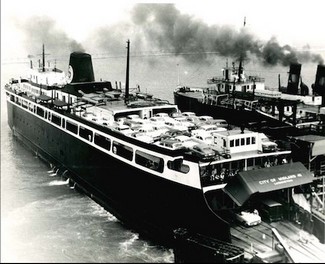
Shortly after moving into the farmhouse on State Highway 29, we took a trip with our maternal grandparents to Indiana where my grandmother had Old Order Amish aunts and uncles. It may have been to a funeral. It was a long trip, made interesting by us taking the car ferry, City of Midland 41 across Lake Michigan. I do not remember this detail, but the City of Midland was the best car ferry operating from Manitowoc, Wisconsin to Ludington, Michigan at the time. It was joined by two other car ferries, the SS Spartan and SS Badger in 1952. City of Midland 41 (video) ceased operation in 1988 and the SS Badger, refurbished, still operates today. One of the last coal fired ships on the lake. City of Midland 41 was rebuilt into a barge tender and still operates in Ludington.
It was a memorable trip for Roger and me. I don't remember the time of year, but I was told that it was late November and the last trip of the year. Perhaps because it was a funeral. But, what I do remember was that the boat was nearly empty and the boat rocked, first, for a few hours front to back, and then, later in the journey, from side to side. We thought it was great fun, but our mother, grandmother, and great-grandmother were all seasick in the lounge. We were forbidden to go out on the deck with Dad and Grandpa because it was too dangerous. When they came back later with foam all over their suits and coats when a wave came over the bow and hit them, we understood that it was dangerous to be out there in the wind. The bow on that car ferry was very high, maybe 30 feet. It must've been quite a wave to come over that bow!
I don't remember anything more of that trip, but we probably were treated very well because our relatives in northern Indiana were wealthy farmers. I found out that Lake Michigan was famous for strong gales and rough seas, sinking many ships, but I didn't find anything From that time period.
Perhaps it was the following summer, but we drove down all the way to Indiana again in late August. I don't remember our grandparents being with us that time. Cars in those days did not have air conditioning. Dad drove us right down through Chicago, on city streets, because as a truck driver, he knew those streets. In the heat of the day, with brick buildings right down to the street and no trees for shade, a lot of people were out on the street seeking shade and whatever breeze they could find. We were driving through the "slums." Most of the people were black.
I noticed that there were a lot of shiny Cadillacs and Lincolns parked along the street and wondered about them, so I asked my dad. Dad replied. "They make good money in the factories. But they don't own their homes and can't buy any. They can buy cars on time, so that's what they own." I never forgot that lesson I learned that day from Dad. Why poor people buy upscale cars.
When we got to Indiana, the sky was lead gray, the water tasted bad and we couldn't sleep at night it was so hot. I thought that Indiana was a terrible place to live compared to Wisconsin where it was much cooler and the sky was blue… The water cold and tasty.
But our Old Order Amish relatives were rich. They grew corn and soybeans. Owned Cadillacs. Had electricity, unlike the Mennonites in Wisconsin, and spent part of the winter in Florida. But they dressed old-fashioned and the men wore long beards and black clothing. The women wore white bonnets and long black skirts that reached to their homemade, high laced shoes.
In the big farmhouse they had a room devoted to a huge loom for weaving rugs and cloth. The interior was filled with hand carved decorations and handbuilt furniture. The toybox was filled with hand carved trick puzzles, oddities like chains carved out of a single piece of wood, balls encased in square wood enclosures carved from a single piece of wood, and other examples of great carving skill. I remember an inlaid wall picture of an Indian paddling a birchbark canoe on a river made from many pieces of wood and bark creating a very realistic scene.
A boy in the family about our age had his own little tractor. He pulled us around in a wagon behind. Never in a million years would I dream of having such a thing to drive around. They were truly rich!
When we left on that trip, Mom what ample food and water outside for our dog, a rat terrier, Rags. When we returned over a week later, Rags had somehow got locked in the house. He ate the curtains to survive. But he did and that's all that mattered.
Copyright 2019 © Ronald W. Hull
6/12/19