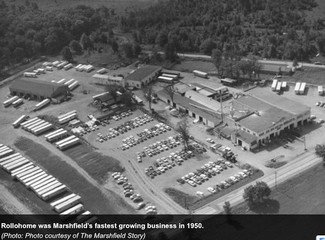
Rollohome Corporation in its heyday in the 1950s. Like the one featured with Desi and Lucy in the movie, Long, Long Trailer.
During the summers of our 13th and 14th years, for reasons I don't recall, perhaps there just wasn't any opportunity, except helping Dad put a roof on a neighbor's garage, mowing the yard, shoveling snow, tending to the large garden behind the house and washing the family car. We spent those summers playing a citywide hardball league. There was no affiliation with the national Little League like we tried out for, but didn't make, in Wausau. I do recall that we spent a lot of time at the swimming pool and also a lot of time going fishing on the Little Eau Plaine River, 5 miles north on a blacktop county road with our bikes. But that's another story.
There was a cannery in town, but there weren't any jobs picking beans. I believe it was because there were machines coming available to canneries that picked the beans and kids were no longer needed to bring in the crops. There were jobs at the cannery for kids and adults, but we were about 3 miles away and we didn't even apply.
Our mother worked at the local shoe factory. She worked with a foreman, Mr. Nowaki, who had some businesses on the side and told her that he needed help. On Mom's recommendation, Roger and I started working in his raspberry patch. The location was about 2 acres right up next to the tracks in town, about five blocks south from where we lived. Nowaki lived on Central Avenue and about two blocks from the patch. It was undeveloped because nobody really wanted to have their house right next to railroad tracks in the early days, especially with all the noise and coal smoke from steam engines. There may have been houses there before the big fire of 1887 that completely burned the town down, caused by a spark from a train passing through. By the 1950s only grubby businesses like a scrapyard wanted to be close to the tracks.
Nowaki was an expert grower and had four kinds of raspberries growing in rotation. Starting when the first berries got ripe, we picked most of the summer and Nowaki would sell the berries from his front porch because Central Avenue was wide, heavily traveled, and cars could pull right up to the curb in front of his house to buy from his wife when he was at the shoe factory or in the field. He probably sold some to grocery stores. I don't know, and I don't remember what he paid us, but it was enough that we continued to work even though I remember that my hands and forearms were totally scratched raw all the way to the elbows from picking.
I do remember one time that there was one variety of raspberry that was rather long and dark purple color when ripe. Apparently it didn't sell well, because Nowaki allowed us one day to take home probably half a bushel of those "pie berries" he called them. Mom was very happy and made pies and raspberry jam with them. I always loved raspberries, wild or farmed in a bowl with condensed milk and a little sugar if necessary. I don't remember if we ate those pie berries that way or not.
Late in the season, Nowaki had another job for us. By that time the raspberries were dead stalks about 5 feet high where he had trimmed them to keep them from growing any taller. Our job was to take cutters and cut off the stalks about an inch above the ground because he told us, "There is a worm in those stalks that we have to kill for the next year's crop. When we looked, inside each stalk that we cut off, there was a hole in the center, and sometimes, we could see a worm working its way up inside. After we cut them, we took all of the dead stalks to a pile where Nowaki burned them and the worms. The next year, if he didn't replant and re-fertilize, those same plants would return from the 1 inch stubs and roots that he covered heavily with straw to keep them from freezing in the winter. Nowaki was a master grower and I admired his skill with his raspberries.
In the spring of our sophomore year in high school, Nowaki had an entirely different job for us. After school, we would walk a couple of blocks from school to a vacant lot that was piled high with lumber from a country school that he had purchased, torn down and brought to that lot right in a residential neighborhood. Nowaki probably owned the lot. It would've been valuable so close to the high school.
Our job was to take each piece of lumber and carefully pull all the nails out of it, and then stack it so that it could be reused as used lumber. It was a tedious job and sometimes difficult to get the nails out, but I believe we finished the job in two or three weeks of working about an hour and a half each day before we had to get home for supper. I don't remember what we were paid for that work either, but I think it was more than we made picking and winterizing raspberries.
When the carnival came to town during the Central Wisconsin State Fair in the last week of the summer including Labor Day, there were jobs for kids that were higher-paying. The first year that we worked, we got a job making change for a tent game where people threw nickels and tried to get them to stay on plates that were strategically tilted so that it was very difficult. We worked from 12 noon to 12 midnight with moneybags around our waist containing various denominations of coin for making change. Roger was on one side of the open tent and I was on the other, making change, watching the customers throw their nickels and handing out cheap prizes when customers managed to get a nickel on the plate to stay. The top prize, a three-foot tall teddy bear, usually required a lot of nickels to be tossed and some adjustment of the plate after the customer had obviously spent over five dollars attempting to win a teddy bear.
A carny who was one of the members of the family that owned the game concession was always on watch to make sure that we didn't pilfer or pinch any of the considerable money coming in. I seem to recall we didn't pick up any of the money on the floor until the end of the day. But I do recall that my hands got black from handling all the coins, either from dirt or silver oxidation. We worked six days straight, for something like, $12 for the 12 hour day. It was exhausting and we were glad when it was over and school started the next week.
Labor Day night a big storm came up around 11:30 p.m. We had to break down the tent set up and carry all the teddy bears back to an open semi trailer filled with teddy bears. We got it done just before a very strong wind came through followed by lightning and heavy rain that we had to go home in. I thought about taking out a couple of teddy bears and putting them aside in the dark to take home, but I didn't. They wouldn't have noticed that night, but we were honest kids and decided not to. I do remember them showing us huge jars of silver dollars and being amazed at how much money they took in every day, one nickel at a time.
The next year, we tried out for selling in the stands because a classmate of ours made a killing getting a percentage selling popcorn. But we were given selling pop at 10¢ a bottle, receiving 2½¢ for each one we sold after retrieving the empty bottles. Although we stuck with it, our classmate still made a killing because there were only a couple of popcorn vendors, while those like us, selling pop, popsicles or ice cream bars, were many and therefore didn't make very much.
The next year, when we were 16, because we were older and had experience with the carnival, we were given our own concession to run. It was a cork gun place where the customers had to shoot cigarette packages over for different prizes. The guns weren't that powerful, and erratic if the corks were not placed in the barrel deep and straight. Most of the time when a cork hit a target, the target wasn't knocked over, but just knocked back a little bit. It usually took two or three direct hits for the target to be knocked off the shelf. Spending more money with more tries for the prize was the game. We were unsupervised the whole week, and I can't recall how much we made, but it was a percentage of the take, I believe.
During our junior and senior years in high school, we got a job at St. Joseph Catholic Church in their bowling alley, located in the church school basement, setting pins. We weren't Catholic, and there were only four lanes, but we got the job through our friends who also had jobs there. There were two shifts, 7 to 9 pm and 9 to 11 pm. So there were eight jobs available every night except Sunday when the bowling alley was closed. Roger and I snagged three nights a week, Tuesday, Thursday and Saturday, the most nights they would allow us to work.
We had it easy, because we had semiautomatic pin setting machines. After the bowling ball hit the pins and slammed against the heavy rubber backstop, we would jump in the hole, grab the ball, lift it up about 5 feet and quickly send it flying back on the track to the bowler. And then, we would quickly pick up all the pins and place them in the proper locations on the semi automatic machine and either put our feet up for the next ball or put all the pins back and push a button for the machine to lower and place the pins after a spare or strike. It was fast-paced on bowling league nights, but could be slow when there was open bowling. I don't remember what we got paid, but it was enough for us to have spending money and buy the clothes we needed. We still saved most of the money we made for college in our savings accounts.
Setting pins was easier for us than when our father did in the early forties and had to actually place the pins on painted spots on the alley. Much harder to do quickly. And, there were still bowling alleys around that had manual machines that had to be pushed down by a bar that required quite a bit of strength that we didn't have. We were skinny lightweights at about 100 pounds.
Setting pins could be quite dangerous. I recall there were only two return tracks for the bowling balls, so we had to share them with the guy setting pins in the next alley. Often we would return the ball at nearly the same time. One time, I got my finger between two balls. There was a loud "click!" when the two balls hit, and I felt nothing, but knew my finger was between them. I split the end of my finger. It bled a bit and I had to have it bandaged. Days later, I lost the nail, but kept on working that night. Another time, I didn't get my legs up in time and a pin came flying back and the top of that pin hit me squarely in the shin with excruciating pain that lasted for some time. The blow probably fractured my shin, but I kept on working and it healed itself, though sore, for a few days.
At the end of our junior year the Monday after school got out, Roger and I joined the line at Rollohome Corporation, a long five blocks from our house, at 7 am. A man came out and chose people to start work, picking people even in line behind us. We went home discouraged and told Dad about it. He said, "I deliver there every day. Let me talk to Rollie (Roland Frey, one of the owners) today and see what I can do. That evening he told us, "I talked to Rollie today. Told him that you guys are small but real good workers. He told me to have you come in tomorrow morning.
The next morning, we were the first picked even though we weren't the first in line. It sure helped to have pull from a hard-working big, strong truck driver father. Some of the others chosen before us were gone. They didn't measure up to long hard work days. We were put on the assembly line building the walls for either side of 50 foot long, 10 or 12 feet wide, homes. Roger was placed building the left side that was built lying down flat, and I was placed building the right side that was vertical. The only reason they were different, was probably space in that building they used for the assembly line. It didn't make much difference when it came to finishing a side and bolting it on the plywood floor and steel frame that had been wheeled in from outside with 12 inch square tile flooring already installed every hour when the line moved up to the next station.
The sides were built on templates and out of 2 x 2s. Rather flimsy until the outside aluminum was put on, the interior quarter-inch finished paneling walls were installed and the sides were attached to the ends. After that, the unit was strong enough to be pulled down the road behind a truck to the home's destination. But not often strong enough to withstand a tornado or hurricane. Some went as far as Alaska, South Texas or Florida. Our job, with help from three or four other guys, was to place the studs and cross pieces for windows, doors and support as fast as we could and then nail the framing together with 16 penny nails. One time, I counted how many nails I pounded in a day, but I forget what it was--a lot!
After a few days we had big blisters on our hands from all that pounding with the hammer we were issued. Those blisters turned to calluses, and by the end of the summer, I was afraid that I was becoming like the comic book character, Popeye, with huge, unattractive, muscular forearms. Right away, I volunteered to climb up into the loft and bring back rolls of pink or yellow fiberglass insulation about 2 feet in diameter and 8 feet long. The fiberglass cut into my arms and gave me lots of scratch marks that itched, but I didn't care, because the other guys wouldn't do it. I got to go up on a scaffolding over the top and unroll the insulation, stapling it as I went with a staple gun. Once in a while getting to shoot staples at unsuspecting guys below. I was king of insulation stapling!
Our pace was one unit an hour. And that was fast. We had to scramble and get the framed side lifted off the template and firmly bolted in place on the floor so that eight units would be built each shift. There were different models that required changing the template sometimes. One day, while Roger's side was being lifted up from lying flat by his crew to be put on the floor and frame, Roger caught one of his fingers on the tip of a nail sticking out and ripped it pretty badly. But after first aid was back to work the next day.
Most of the workers were farmers who were working in the factory, some driving 30 miles or more to get there every day, to supplement what they could make from their farms that were always in need of expensive equipment and sometimes, failing crops or low prices for their milk. These old guys, worked at a rather slow pace. Roger and I, bound for college, worked like hellions and enjoyed it. By the end of the summer and it was time to quit and go back to our senior year in high school, the superintendent, "Crash" Kraschnewski, begged us to stay on full-time, but we politely begged off. We had bigger things in mind after college.
I remember one time after working 12 hour days one week and bringing home my paycheck. We were working for $1.25 per hour minimum wage. It was $120, more than I had ever made in a week before. I showed it to my grandfather and he declared, "Oh Lord! No kid should ever earn that much money!" He was being genuinely upset and sincere. I understood. He lived through the Great Depression where money for food was scarce. If they got a paying job at all, it paid hardly anything, a few dollars a week. He had to sell his farm before I was born in the late 30s. His father's homestead. He was getting older and couldn't work it anymore.
After our senior year, we returned to Rollohome for one more summer. This time we were put out in the yard in the finishing crew. Since the mobile homes came off and out of the assembly line every hour, often there were parts missing that didn't get installed and other parts that could only be installed afterward. That was our job. There were older, skilled guys doing things like bathrooms and kitchens. Roger and I did almost everything else that needed to be done, like replacing cheap Japanese wood trim, installing lights, installing mirrors and not cracking them, and whatever else was required.
At 7 am, those northern Wisconsin mornings, you could skate on the floor and working on your knees under a cabinet to clean it out could be excruciating. And then, by noon the temperature inside could be over 100° with all the windows and doors open. The most onerous job I had to do was replace 12 inch vinyl tile that was sometimes gouged during construction. I had a 12 inch square flat electric hot plate that I placed over the tile to heat it up and make it soft. And then, with a chisel, I had to dig the tile out that was glued to the plywood flooring. The result was an uneven scarred plywood surface to glue down the replacement tile. The result was bumpy and unsatisfactory for me. I don't know if those tile contained asbestos or not. I didn't work with them enough to make any difference in my health, anyway.
But there was danger. One day I woke up with my eye irritating me, especially when I tried to wear my contact lens that were difficult anyway with all the dust. It turned out that I had a piece of steel embe dded in one eye and a doctor at the clinic cut it out with a sharp knife by simply telling me to, "Look straight ahead," as he did it--scary. And then one day, one of our group was standing in the open doorway watching the hotshot tractor driver bring in another unit. The driver reached up and closed the open door the guy was standing in to get it out of the way and cut one of his fingers off.
And the next summer, when we didn't work, an electrician and uncle of one of our classmates, was working with the makeshift electricity supplied to the homes for light and working with power tools, and got electrocuted and died.
After our first year in college, I got a job at the Prashak Machine Company drafting detailed drawings for old man Prashak's sketches for the concrete block making machines that he invented. Roger came along and did odd jobs in the shop floor and for Mr. Prashak. I got the job through my scholarship from the Kiwanis Club. It was a good salary, but I finished all the drawings required on mylar for easy reproduction at the end of that summer, so they didn't need me a second summer.
We came back again to work the finish crew after our sophomore year in college. As I look back on it now, we were always working throughout our childhood and enjoyed it very much. And there was always a little money coming in that we could save for college. With my scholarship I was well prepared to pay my way. I still accounted for every penny spent in college. We stayed in the dormitory and ate out in restaurants for a dollar a day.
Our breakfast consisted of two rolls fresh from a bakery and a cup of coffee for 25¢. After class about 3 pm we would stop for a hamburger special including a hamburger with lettuce, French fries and a Coke for 65¢. A beer, or in my case, an orange pop, when out in the evening, cost 10¢. A small notebook that I have totals up my freshman school year cost at $865 with tuition part of the scholarship. Of course we ate a lot whenever we had a good meal free and always brought back lots of baked goodies from Mom whenever we went home the 100 miles on weekends, paying $1 each way for a ride. A penny a mile was the going rate. I charged the same when I bought a $250 car the spring of my sophomore year.
Roger, without a scholarship, had to start working while he was at school. He washed eggs for a chicken farmer, drove cab, and used my car as a Fuller brush man his junior year and summer. Graduated on time with his class in four years and got six very good engineering job offers.
After leaving my junior year in college at Thanksgiving for exploratory spinal surgery and becoming paralyzed in my hands and arms, I rehabilitated and got back to school the following year with federal rehab money for my tuition, room and board to finish my bachelor's degree. In the spring of 1965, I shocked my rehab counselor when I showed him the hundred dollar unmodified car that I bought with my savings from my rehab money, but he let it go. I returned straight As and finished the semester behind my class in January 1966.
When I asked for rehab money to go to graduate school because physical work was out of reach for me, they turned me down. But I got an assistantship at the University Wisconsin and started there in industrial engineering that same month. That spring I got a fellowship to Stanford. I left the University Wisconsin that fall and drove off to California in that hundred dollar car with my grandmother as a traveling companion. But that's another story.