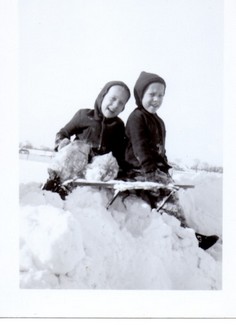
I don't remember going out in the snow like this, but it looks like we were having fun. May have been the historic snowstorm of May 27,1947 when we were 5.
Wisconsin is placed in the middle of the North American continent. During the summer, as my uncle told us, "Every couple days, a front will come through, and the weather will change." That is true of winter, as well, but every once in a while a polar front will come down from the Arctic in the middle of the continent. Usually the coldest place in the country would be northwest of our location in North Central Wisconsin 200 miles away through International Falls on the border with Canada. But sometimes that cold would settle further south and give us one of our many below 0°F winter days or week long events.
This cold combined with fronts that came with Pacific or Gulf of Mexico moisture created snow as early as October that lasted well into March and sometimes, much later, in May, like the historically recorded snowstorm on the 27th 1947. Where we lived was in snow nearly half the year. We got used to it, but always longed for spring.
My first memory of being cold was when Roger and I would get out of bed in the morning smelling good things wafting up from the kitchen and then rush downstairs to the living room and plunk down in front of the 5 inch in diameter fan at the bottom of our living room oil heater, the only heat in the house other than the kitchen wood stove to put our socks on, followed by our shoes. Our wood and linoleum floors were cold. But I heard that some kids didn't even have shoes.
And then, we would go into the kitchen where Mom would be making us bacon and eggs, waffles, pancakes, donuts, coffeecake, toast and other good things in the overly warm woodstove place where she would begin doing whatever cooking and baking she would do that day. Dad had already gone to work. During World War II, he worked a lot and we rarely saw him except on Sundays.
When we were four, Roger and I came down with a number of winter illnesses. Probably because of the dry heat and low humidity that dried out our sinuses and made us more susceptible to diseases in winter. We weren't sick during those first two or three years we lived in the one room shack. Without memory, I don't know how we kept warm there. Probably a potbellied stove that Mom probably cooked on, too. A kettle full of water always boiling to provide hot water and tea. Humidity for the room.
I do remember that the summers could be very hot and we would wear short pants when we played outside. In mid-summer it would get hard to sleep without air conditioning and we would sweat in bed all night. Still, as soon as there was a January thaw, we would strip off our shirts to get a head start on a summer tan. Usually resulting in a bad sunburn, especially on Memorial Day, the first day when everyone got out and sunbathe for real
Probably because there were so many farms around, there were always a lot of flies, both inside and out of the house. In the evening in summer, planes would fly over and spray DDT. I can remember the smell of it in the air. I'm sure that the spraying kept the mosquitoes and flies down, but the practice did great damage to birds of prey and was stopped when found in mother's milk.
With Highway 29 in front of our house in Owen, there was always a lot of traffic. But we weren't allowed to play out front to watch cars go by. I do remember that the roads could be very treacherous throughout the winter. In 1947, Roger and I were with our grandmother when she slid off the highway on ice and we rolled over in the ditch recounted in the Accident Tales. That was also the year of the great snowstorm I've already mentioned.
But when we got to Wausau when we were 7, (photo of us when we were 11 with our sister) we discovered snow shoveling with a sidewalk in front of the house and along the side all the way back to the garage off the alley that had to be shoveled out so that Dad could go to work. Snow came every few days and the sidewalk had to be clear because many people, including the mailman, walked our street daily. It was the first thing we did in the morning, before breakfast.
Our grandparents at that time, 1951 or 1952, had a truck farm at Elk Mound, 100 miles from where we lived on Highway 29. It was spring, May, and very warm, so we all made the two hour drive to our grandparents' farm to stay the weekend. We had our new light spring jackets, shiny green satin, that we proudly wore. Shortly after we arrived on Saturday, it began to snow, the wind came up, and by the next morning, we were snowed in with only those light jackets and no boots.
We stayed indoors and played games like always, but wanted to go outside and couldn't. By Monday morning, basic supplies with all of us there, like milk, ran out. So Mom and Grandpa put on boots and snow clothes, and walked out to the road, and then a mile south to the county highway. After that, it was another mile or two to a small store. When they got to the road, it was buried under 8 to 10 foot drifts that had built up against the woods on the east side of the road. They had to crawl on top of the drifts because when they tried to walk it got waist deep and they couldn't make any headway.
Dad shoveled all day to get the long driveway cleared out so we could get to the road when it opened up. (a picture of a portion of the drive cleared) Mom and Grandpa got back with the needed groceries, but it wasn't until Tuesday evening that a snowplow with wings was able to open the road by sometimes clearing the way off the road on farmers' fields. Characteristic of those blizzards that created high drifts, blowing from west to east, the county road and Highway 29 were blown free of drifted snow. We left for home Wednesday morning after being snowbound. Missed three days of school with a good excuse.
Our large Victorian home in Wausau was heated by a furnace in the basement. A truck would come in the fall and dump a truckload of coal through a chute into a special coal room in the basement adjacent to the furnace. We were lucky because we had a hopper and screw type feeder that fed the furnace with coal, so Roger and I would only have to fill the hopper with coal once a day or so in the coldest weather. Other people had to continually go down to the basement during the day and night to shovel coal directly into the furnace. That's one of the ways we earned our 10¢ weekly allowance, along with shoveling snow.
As snowstorms came and went in the city they got to be a drag in January and by March with occasional thaws there was a lot of ice and slush to deal with on the walkways and streets. But the city continued to go to work and I don't recall that school was ever shut down because of cold or snow. But then, most of us walked to school and we had only to cross one street and one block to get there. As the snow melted from the high banks everywhere where it had been plowed or shoveled, it turned black from all the soot in the air with everyone burning coal. The black helped melt the dirty snow quicker and was washed clean by spring rains. There was a lot of need for spring cleaning, inside and out of the houses.
My memory of storms when we were in Marshfield were a couple of times when the snow drifted nearly to the top of the eaves of our bungalow in the front. Everyone on the street worked together to get cars able to make it down the two blocks to Central Avenue, the main street, so that they could go to work. We didn't go to school then for a day or two and often built snow tunnels or snow forts for snowball fights. Strangely, these storms often came on weekends so we didn't miss any school. On most days when there was snow up to 10 inches, snowplows had the roads cleared so that everyone could get to school either by walking or having their parents drive them.
There was a vacant field across the street from our house and the neighbor offered to supply water. So Roger and I poured a lot of water on that field to try to make an ice-skating rink. Most of the water seeped into the ground, but we did manage to get a rather lumpy and bumpy skating rink one year. I remember getting figure skates while most of the guys got hockey skates and went skating on the two or three city made skating rinks around town on vacant lots. All of these rinks had a small shack brought in so that we could warm up and put our skates on in. There was usually a potbellied stove and an old man hired to keep the stove fed with coal or wood and keep the peace from bullies and thieves that were sometimes present.
The rinks could be great places to skate, especially at night and where we could meet girls and skate with them. I tried to do some of the tricks I saw on the Olympics, but never did very well. And there was the time when we went outside of town to a small pond to skate with our bikes and got caught in a very cold front that came through. You can read about it in Bicycle Tales.
Our junior prom was on May 8. Dad gave us each $20 and I was driving after just removing my cast from my left wrist from a green break I got pole vaulting in March. (a picture of the break on my left wrist that was put in the local paper). Roger was recovering from pneumonia and in operation to remove scar tissue on his lungs. I'm not sure if he even had his driver's license yet. About 5 o'clock, we washed the car in the rain. By the time it was for us to go to a party before the prom, it was snowing heavily. While we were at the prom, about 8 inches had fallen, and driving became difficult on streets that weren't plowed.
After we had dinner with our dates at a nice restaurant, we went to an after party. Several of the girls convinced me that they wanted to go 15 miles out of town to Richfield Park to watch the sun come up. I drove around to two or three of their houses while they changed from their gowns to jeans. It was about 3 am when I realized that we might get stuck on those country roads and that we really didn't have time to get out there and see the sun come up. I told the girls that I wasn't going and took them home. Roger and I got home about 5 am. Some of the girls wouldn't talk to me after that. My date, who I only dated that once, wrote me an email a couple of years ago, reminiscing.
When we moved out to the farmhouse 9 miles out of town in March of our senior year, Dad used a company truck on Saturdays and Sundays to move us out. Unfortunately, it snowed every weekend that month and made the move more difficult, dirty and sloppy. Once we got there, we found that while the County Road BB was plowed often, we found that getting to our pin setting job in town proved tough at times. On school days, plows made sure that the buses like we rode made it into town. School bus routes were plowed first.
I loved to sit on that farmhouse front porch and watch frequent summer storms roll in from the west. We often could stay on the porch if the wind was in the right direction. There was always the fear of tornadoes. But while I saw the evidence of many, I never experienced one. There was the one storm that took out some of our American Elms along the back fence row, but not the ones in the front yard. Stately shade trees. Dutch Elm disease, in a few short years, wiped them all out. I don't know if a disease-resistant strain has been developed to replace all those lost. I heard that elm was the hardest of hardwoods, but never had the experience of trying to drive nails into it.
I believe we were at the drive-in theater that night when that storm came through. I recall my car actually acting like it was going to be lifted up by the blast of wind before the storm hit. When we got home, the side of our garage had been pulled out by the wind's fury. The next day, I went down to the nearby woods and found many, many trees down. And there was the time we went camping in the Boy Scouts when a storm came up almost lifting our pup tent away while we held onto it. Between the lightning strikes and booming thunder, a few trees came down during that storm, too. Fortunately none of us suffered any injury although we were surrounded by trees.
When I left Wisconsin and stayed in "Climate Best by Government Test, Redwood City," we experienced a rare and small tornado that damaged a couple of buildings on El Camino Real a few blocks from my apartment. The only injury I sustained was my mother, listening to the news at 7 am, calling me at 5 am. I stubbed my toe badly scrambling to get to the end of the bed where I had my phone on the floor. Returning from California on a visit to Wisconsin in August 1968, I brought a terrible storm with me and have a picture showing an example of its wrath. Those are my younger twin brothers in the picture. It got so dark as the storm approached my picture of it is almost impossible to view.
Copyright 2020 © Ronald W. Hull
2/28/20