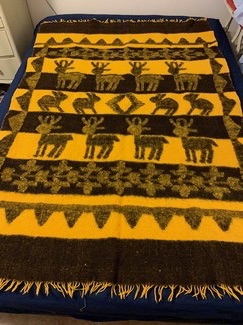
On Tuesday we went on a trip of three days. After we reached the Pan-American Highway, we drove off the highway through a deep forest to a small mountain village that remains unnamed. The weavers got busy conferring with the artisans in the village. I bought a "mucho grande" wool blanket of black wool with both warp and weave in bands of white wool dyed golden with black deer images and bands of black wool with half golden deer and rabbit images. All of the weavers told me I got a fantastic deal at eight dollars.
It may have been there, but somewhere along the line, I bought a black shoulder bag adorned with shimmering bright yellow, red, blue and green embroidered birds. It carried everything I needed every day and became something I had in my car to hold my eight track tapes for a couple of years until it was stolen out of my car at the apartment house where I was staying in Atlanta. I loved that bag and wish I still had it like the blanket.
Everywhere, we saw evidence of the earthquake. Landslides, places where the road had been repaired, and even a village where most of the homes had tin roofs rather than the traditional red tile. During the quake and aftershocks, the tile would rain down on people, sometimes injuring and even killing people because they weighed about 30 pounds each. In one village we stopped at, 5000 people died. When we looked in on one small home, back in the darkness there were two elderly people that were bedridden. It was a sad sight to see. Those poor people had no nursing homes for the badly injured or elderly.
But the countryside could be magical, too. On the high ridges one could look off down the mountain slopes into clouds coming up all the way to the Pacific. Here in the Sierra ranges, an extension of the same volcanoes as the Sierras in Mexico and California, all the way up to the Cascade Range in Oregon and on through Canada to Alaska, the combination of fire and the colliding of tectonic plates in a tropical climate created a beautiful landscape of fauna and flora quite unlike any other in the world. Rapidly changing at different altitudes with the ambient weather.
The high mountains, while dangerously shaky, provided coolness against the strength of the tropical sun. Everywhere one looked were vistas of volcanoes, their conical shapes piercing the sky. The combination of white clouds colliding with their sides. Rainforests growing on their slopes and, except for the roads and timeworn foot trails, hardly a bit of level ground, anywhere.
But the native people made full use of the rich, red volcanic soil by tilling and planting corn and other crops on the steep hillsides in terraced rows. In one cornfield could be seen corn in all stages of growth to maturity. Planted and grown year-round. At the ends of the rows, lavish flowers, some that I knew like irises and cannas, grown to perfection, and then cut and taken by the women to the local market for sale. Cut flowers graced the homes of the wealthy, businesses, hotels and restaurants every day. No need for floral shops or greenhouses.
By late afternoon, we had reached the resort town of Panajachel, set on the northwest corner of Lake Atitlan. Like Crater Lake in Oregon, Atitlan is a giant caldera filled with water and surrounded by two massive volcanoes. At high altitude, the lake provides stunning views from almost any viewpoint with reflections of the volcanoes in its placid waters. We stayed at a small motel. After eating there, I went for a walk and sensed the strong smell of onions. As I rounded the corner under a covered walkway, there were onions piled about 6 feet high along the entire building. Two native women were working on them. My eyes were burning so I didn't see exactly what they were doing as I made my escape.
Wednesday morning, I got up early to go to the post office to mail a postcard, the onions and the women were gone. But when I got to the small, single room, post office it was jammed with people and there was no line. Everyone was just crowding up to the counter, trying to get the clerk to wait on them by yelling and waving their arms at the poor fellow. So much for the Guatemalan people being timid and reserved. After I waited a while in frustration, I left the post office and mailed the postcard later that night at our hotel.
Before leaving, we took the mail boat, a free ride, across the lake to visit San Pedro La Laguna, a native village on the other side of the lake. When I saw the 3 inch bass offered in the market I realized that overfishing had created a situation where only minnows were left for fishermen. The legendary large bass in the pictures were gone. While walking around the village market, I was looking for something for my nieces and thought that the bean and seed necklaces that little girls were selling were appropriate.
I approached a girl about five and negotiated with her for two necklaces. When I offered her a large quetzel note in payment, she scrunched up her pretty little nose and shook her head, "No." Her smile was gone. She backed off and I wandered around looking for a place to make change and found one. When I had the right coins, I went looking for the girl again.
The market area was filled with people, both natives and tourists. But eventually, I saw her and I approached her again. This time she got a fearful look on her, as though I were going to cheat her. But I knew that her parents would be very upset if she didn't make that sale. So finally, I cornered her, even though she was crying. And I held out my money and said the right words.
She handed me the necklaces and I handed her what we had bargained. Her face turned to smile as quickly as she had to crying. She wandered off happy and I know at the end of the day her parents would be happy for that small sum she earned. My nieces enjoyed their necklaces. Later, I was told that worms sometimes emerged from those seeds and beans that were used to make those necklaces. If that happened, my nieces never told me.
Returning across the lake that afternoon, we drove to Chichicastenango, another market town. By that time I was getting tired of markets, weaving and textiles and thinking of doing something else. By evening, we found a brand-new hotel that had been built since the earthquake. In the courtyard while eating that evening, hummingbirds flew everywhere and Macaws in resplendent color were strategically placed on perches but unable to fly free.
In addition to the blocks-long massive market there, we got to see the worshipers swinging smoking pots in a mixed Mayan/Christian ritual at the 16th-century Santo Tomás Apóstol Church. Interesting, but I much preferred seeing people in the markets walking with their pigs for sale on leashes or their chickens carried in handmade crates to sell live.
On the way back to Antigua the next day, we stopped at the Mayan ruin of Iximche. There wasn't a lot to see. The squat pyramids of stone were built to withstand earthquakes for a thousand years. I was thinking of something bigger…Tikal… but we only had three more days. Along the way, we passed the Army pulling over buses and checking them and their occupants for rebels and arms. The whole country was in a state of martial law because of a rebel uprising of many years. Still going on today, I believe. Obviously American tourists, we were not stopped or questioned for documents like the natives.
On a high point of the Pan-American highway on a turnout where we could see the Pacific far below, I bought a straw mobile that I was told was a fertility symbol. I had it hanging from the ceiling in my office/bedroom until recently when the fishing line I used to hang it failed. The fertility symbol also failed me in that room for 35 years because no children were conceived there as far as I know.
Another high point we stopped at was strange and unlikely. A clearly German restaurant and bar serving homemade sausage and beer. It seemed out of place on that beautiful overlook, but the owner with a heavy German accent, assured us that he had been there many years. Thinking about it now, he may have been one of those escapees of the Nazi regime who fled to Central and South America to escape prosecution after World War II. You never know.
Back in Antigua, I stopped at the tourist office. Asked about climbing Agua. The guy took a look at me and suggested the Candelera instead. That made me angry. Earlier, we met some guides who were hanging around to hook up with our single women. One, Jorge (George), told me about Agua and told me that he would, "Carry me up there on my back if you want." Of course, for a hefty fee that I didn't have or want to pay him.
I talked to George about going with me, but he told me that Gay was having trouble with mold in the forest and her allergies. I didn't think anything would go wrong, so I decided to go it alone and turn back if I had to. I was used to hiking and climbing the steep slopes of West Virginia.
The next morning, I was up at six and walking toward the road up to the village of Santa Maria DeJesus halfway up the mountain. As I was leaving town, I passed a door opening with a heavenly smell that had me stopping. Inside were all kinds of pastries. Just like an American bakeshop, except that everything was made with corn flour instead of wheat flour. I bought two tasty rolls and put them in my new shoulder bag with a few other things… That bag was becoming indispensable.
I walked and walked, expecting a bus at any time, but none appeared. Finally, after walking two hours and at least 2 miles up the road alone, a bus came along and I hopped aboard. Reaching the town at 7500 feet, I could tell the air was rarer. There was a large open area where the bus let everyone out and they all disappeared into the village. Surrounding the place was side of the evidence from makeshift counters that it was their market on market days.
At that time of the morning the village was quiet and empty. With the mountain directly above me, I walked up through the streets of low-level adobe buildings until they became trails, with evidence of animals taking them up the mountainside that I followed. The trails that I took, did not go directly up the volcano, but worked their way side to side on the mountainside.
The lower slopes were stripped of wood and only contained brushy stunted growth. The further I climbed on the trails, I began to see trees that were all hacked up from machetes of wood cutters from the village below. Finally, I started to reach larger trees. But the higher the elevation, the smaller those trees became, eventually, about 9000 feet, I was above the tree line where there were no trees at all, only alpine plants and ash.
It was in those lower slope trees where I came upon two young boys with a burro. I waved to them and they approached me. One of them had a green apple in his hand and he reached out and handed it to me with a smile. Perhaps the way I looked made them think that I was starving, but they were most generous and I was glad I had that apple for lunch later.
As I got higher the air got cooler while the sun beat down mercilessly. At one point, I reached a road and was on it when a large truck with a staked flatbed came lurching around the corner. The truck bed was filled completely with probably, 50, inmates of the regime. I don't recall if they called out to me, but I believe they did in Spanish. So I, trying to be cordial, I smiled, pointed out my red, blistering nose, waived and yelled, "Gringo!"
I'm sure they appreciated my gesture. Soon they were out of sight and all was quiet again. I had the mountain to myself. Well, almost. Up ahead on the road, I came across a young guy, a college student, lying on the ground, moaning with difficulty breathing. I couldn't believe it. I was fine. He was being attended to by two girls. Like me they were climbing without a guide. He was apparently suffering from the 9000 foot altitude although he didn't look out of shape.
Knowing that it might rain later since the rainy season was already upon the region, I left the trio and walked on alone again. But as I closed in on the 11,000 foot mark, my legs began to give out on me, tighten up and go numb. By that time, I had eaten my two biscuits and the apple, while a bit sour, gave me a little bit of moisture without any water. I was breathing fine, but the tightening of my leg muscles may have been from dehydration, lack of oxygen, or lactic acid buildup. Something I never experienced in all my life of going out and doing strenuous things all day without any water.
But by taking a few steps at a time until my legs became numb; and then, just standing there until the feeling came back, I made my way up and up until I reached the cinder cone, 500 feet from the summit. Looking at water dripping out from moss growing on the cinders, I crawled up under one overhang and let the water drip into my mouth. Looking around for a discarded bottle but saw nothing. I would have had to stay there a long time to quench my thirst.
I tried to climb of the steep cinders of the summit cone, but like sand, they were soft and I slid down. There was no way I could climb up from there. So, oh I skirted around the mountain until I came to a jeep and two soldiers resting in the shade of the cone. I walked up to them and one that looked like he was in charge, came to me holding up his rifle angrily. I called out my plight, "Agua!," pointing to my mouth when I said it. But he just waved me off and threatened with the rifle.
The clouds had closed in and it was hard to see anything or any way into the crater. The cold wind was cutting and the sun was still very hot, so I took the road, right there, down the mountain as an easy way down. Before long I came to a metal building. Obviously, a shelter. I don't recall going inside, but the rain barrel with water funneled off the roof was very inviting.
When I looked down in the barrel, the sides were waving green moss, but the water looked crystal-clear all the way to the bottom. I stuck my head in the barrel and drank my fill. As I started up to the road on the steep cinder path, I lost my balance and did a kind of flip backwards to no harm. On the second try, I made it to the road again.
On the road, I heard the sound of thunder behind me and thought that I needed to get moving. At one point, while the road snaked from one side of the mountain to the other on its lazy susan way up and down, I spotted a concave mud trail about four feet wide going directly down to the village. With the sound of a possible rain storm behind me, I started skipping down that trail, hoping that it wouldn't rain and that trail would become a slick mudslide with me in it like I saw in the movie, Romancing the Stone.
That did not happen and I reached the village in record time. About halfway down two the central bus stop, there was a corner store filled with soda pop. I stepped inside and looked around, the only shopper there. Not knowing Spanish I went over to a stack of bottles in crates and pointed out an orange Fanta to the woman behind the counter. Two guys came over and actually lifted up the bottles to get that particular one! I bought it for the equivalent of $0.10 and had a warm, sweet drink.
When I got to the bus stop, I was the only one there. Fortunately, there was a covered walkway around the edge and the sky opened up while I stood underneath on the walkway for a few minutes. Soon after, the rain stopped and it dried up by the time the bus came. After a hair-raising ride down the mountain on those curves in the bus, I walked off to find my two young at heart old lady eating companions and told them my story of being on the mountain to their amazement.
But I had bigger plans with only two days left. I borrowed money from one of the other weavers so that I could go to Tikal.
Copyright 2020 © Ronald W. Hull
8/25/20